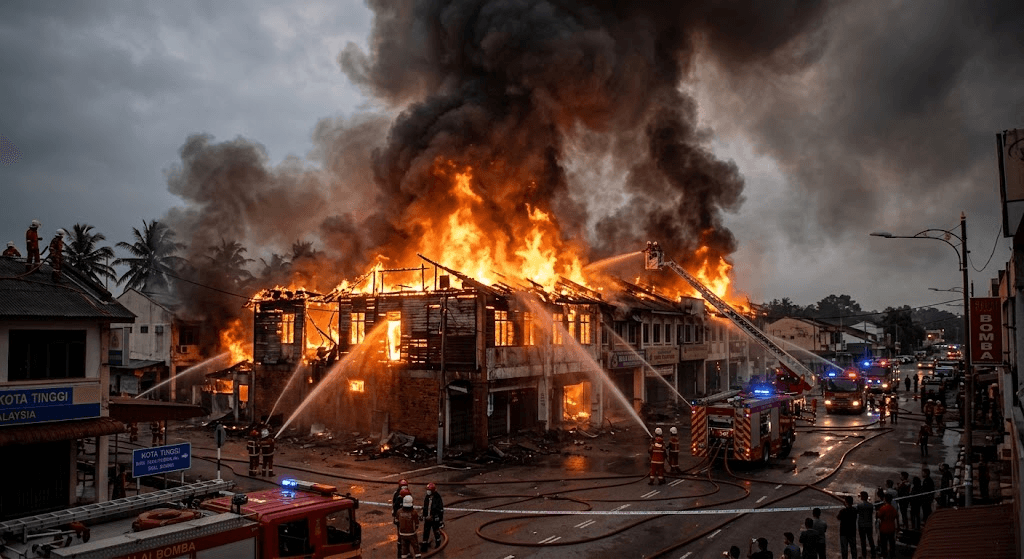
Morning light in Tehran often arrives softly, touching the city’s rooftops and hills with a pale wash of gold. Yet lately the horizon has carried another color—dark plumes rising slowly into the sky, drifting over highways and apartment blocks like clouds that have forgotten how to rain.
In the rhythm of a city accustomed to history’s turbulence, life continues with a careful steadiness. Shops open their metal shutters, buses move along crowded avenues, and families gather around televisions where maps and headlines flicker in restless cycles. But beneath these familiar movements lies a moment of unusual uncertainty. Iran stands between two chapters of its leadership, and the turning of that page is happening while the sounds of conflict echo in the distance.
Just days ago, Ali Khamenei, the country’s long-serving supreme leader, was killed during strikes linked to the expanding confrontation between Israel, the United States, and Iran. His death, which ended a rule that shaped Iranian politics for more than three decades, left the nation’s highest office suddenly vacant and its governing institutions facing an urgent decision.
In Iran’s political architecture, the responsibility for choosing a successor falls to the Assembly of Experts, an 88-member council of clerics whose deliberations usually unfold quietly behind closed doors. This time, however, their work has taken place under unusual pressure—amid military strikes, diplomatic tension, and the uneasy awareness that any new leader could immediately become a target in the unfolding conflict.
Officials close to the process have said that a decision on the next supreme leader has already been reached, though the name has not yet been publicly announced.
Around Tehran, the evidence of war has been difficult to ignore. Israeli strikes have targeted fuel depots, missile facilities, and other strategic infrastructure across the country, leaving heavy smoke drifting above parts of the capital.
The conflict has expanded well beyond Iran’s borders. Drone and missile exchanges have rippled across the Gulf, affecting countries such as Bahrain and raising fears that the confrontation could widen further across the region.
Amid this uncertainty, speculation has gathered around possible successors. One name often mentioned in political circles is Mojtaba Khamenei, who has long held influence within Iran’s religious and security establishment. Yet the secrecy surrounding the selection process remains tight, reflecting both political caution and security concerns.
Leadership transitions in Iran rarely occur during calm periods; the country’s modern history has often intertwined politics with moments of upheaval. But the present moment carries a particular gravity. The supreme leader holds authority not only over religious matters but also over the military, the judiciary, and the country’s strategic direction. Whoever assumes the role will inherit responsibility at a time when regional tensions have reached one of their most volatile points in years.
For ordinary people, the drama of geopolitics often arrives as atmosphere rather than headline. It is felt in the distant hum of aircraft, in the quiet anxiety of families following the news, in the sudden absence of streetlights during precautionary blackouts.
And now, somewhere behind closed doors in Tehran, a decision has already been made. The identity of Iran’s next supreme leader waits to be spoken aloud, even as smoke drifts above the city and the war that shaped this moment continues to unfold.
When the announcement finally comes, it will mark more than a simple succession. It will be the beginning of a new chapter written under the shadow of conflict, where authority, uncertainty, and history meet in the same fragile hour.
AI Image Disclaimer Visuals are AI-generated and serve as conceptual representations.
Sources Reuters The Guardian Associated Press Al-Monitor Agence France-Presse
Published by Banx Network. This article is part of the Banx decentralized media programme, powered by the BXE token on the XRP Ledger.