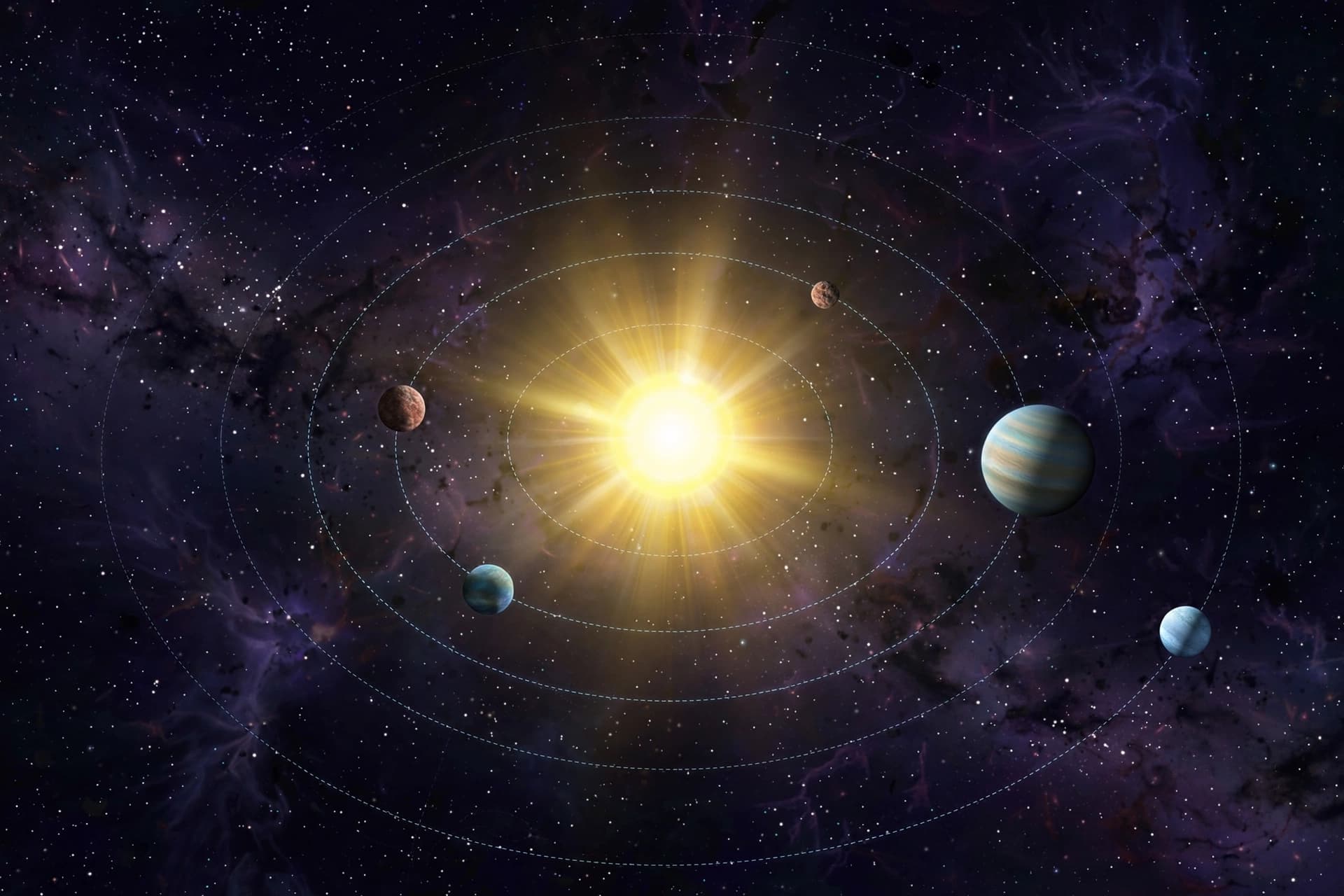
There are moments when the night sky feels almost theatrical, as if the planets themselves have chosen to gather for a quiet procession. In February 2026, stargazers are anticipating one of those occasions—a widely discussed planetary alignment often described as a “planet parade.” Newly released images and simulations are offering a preview of how this celestial arrangement may appear when it unfolds across the dark canvas above.
A planetary alignment occurs when several planets appear in a line from Earth’s perspective. Though the planets are never perfectly straight in three-dimensional space, their shared orbit along the ecliptic—the apparent path of the Sun—can make them seem clustered in a gentle arc. In February 2026, multiple bright planets are expected to be visible in the evening or pre-dawn sky, creating an easily recognizable sequence.
Astronomy sources indicate that planets such as , , , and are likely to be among those visible, depending on location and viewing time. In some regions, may also join the lineup near the horizon, though its proximity to the Sun often makes it more challenging to spot.
Recent astrophotography and digital renderings hint at a graceful sweep of bright points stretching across twilight skies. Unlike rare total eclipses or fleeting meteor showers, planetary alignments tend to unfold gradually over days or weeks. This slower rhythm allows observers to plan, compare nights, and watch subtle shifts in position.
The phrase “planet parade” captures the imagination, yet astronomers emphasize that alignments are a natural outcome of orbital mechanics rather than extraordinary cosmic events. The planets travel around the Sun at different speeds and distances. From time to time, their paths bring them into the same portion of the sky, forming a temporary visual grouping.
For photographers, the event offers both technical challenge and creative opportunity. Wide-angle lenses can capture the sweep of multiple planets against a fading blue horizon, while longer exposures may reveal surrounding stars. Urban observers may need to seek darker skies or elevated vantage points to overcome light pollution.
Beyond aesthetics, alignments also serve as reminders of our place within a dynamic solar system. Seeing several neighboring worlds at once underscores their shared origin and motion. Though separated by vast distances, they appear momentarily united by perspective.
Astronomy organizations are already publishing viewing guides tailored to latitude and hemisphere. Exact visibility will vary depending on geographic location, weather conditions, and local horizon obstructions. Observers are encouraged to consult reliable sky charts closer to the date for precise timing.
In the end, February 2026’s planetary alignment will not alter gravitational balances or herald dramatic change. It will simply offer a clear view of the orderly dance that has continued for billions of years. For those who look up, the parade may feel quietly profound—a reminder that even in the vastness of space, patterns emerge with patient regularity.
AI Image Disclaimer Graphics are AI-generated and intended for representation, not reality.
Source Check (Credible Media Coverage Found): NASA Space.com Sky & Telescope BBC Sky at Night Magazine EarthSky
Published by Banx Network. This article is part of the Banx decentralized media programme, powered by the BXE token on the XRP Ledger.