The world's oceans often appear calm from the shoreline, yet beneath their surface they move like the quiet heartbeat of the planet. Vast currents carry warmth, nutrients, and energy across continents, linking distant coastlines in ways that are rarely visible. When one of these powerful systems begins to weaken, its influence can extend far beyond the waters where it flows, touching weather, ecosystems, and communities separated by thousands of miles.
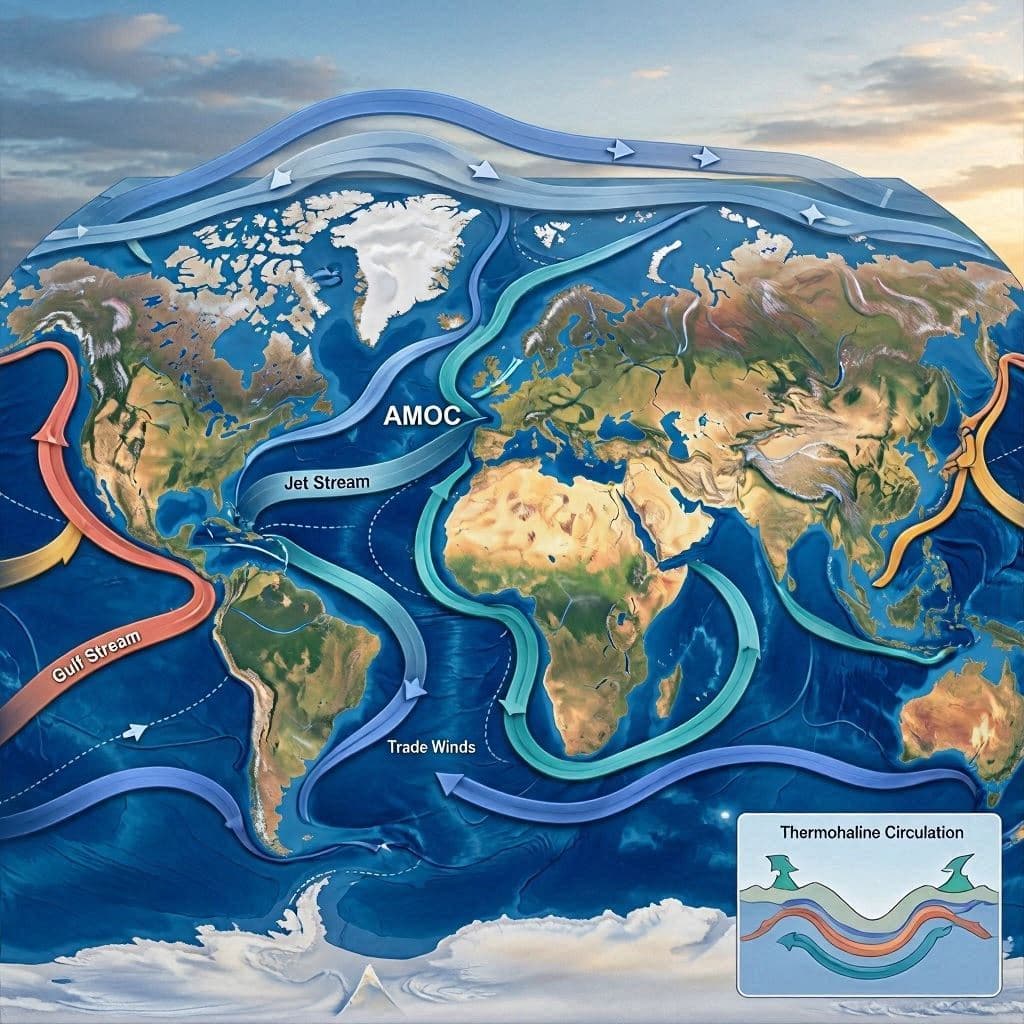
A new study published in Nature Communications examines the future of the Atlantic Meridional Overturning Circulation (AMOC), a major Atlantic Ocean current system that transports warm tropical waters northward before returning colder, denser water to the south. Researchers report that continued weakening of the AMOC could reshape global weather patterns, including stronger atmospheric rivers affecting California by the end of the century under a high greenhouse gas emissions scenario.
The research was led by scientists from the University of California, Riverside, who combined decades of NASA atmospheric observations with climate simulations. Their findings suggest that changes in ocean circulation could alter atmospheric moisture and strengthen the high-altitude winds that steer storms across the Northern Hemisphere. These shifts may increase the frequency and intensity of atmospheric rivers reaching parts of North America's West Coast.
Atmospheric rivers are long, narrow corridors of concentrated water vapor that transport large amounts of moisture through the atmosphere. In California, these systems provide a substantial share of annual rainfall and help replenish reservoirs after dry periods. At the same time, stronger atmospheric rivers can also raise the likelihood of flooding, landslides, and damage to infrastructure during particularly intense storms.
Beyond California, the study projects broader changes in rainfall around the world. Researchers found that atmospheric rivers could become more frequent along parts of western Europe, South America's eastern coast, and regions surrounding Antarctica, while becoming less common across Greenland, the Arctic, and portions of northern Asia. These changes reflect the close relationship between ocean circulation and global atmospheric dynamics.
Scientists emphasize that the AMOC has already shown signs of slowing over recent decades. However, the exact timing or likelihood of a future collapse remains an active area of scientific research, with experts continuing to study different climate scenarios and model uncertainties. The new findings represent one projection based on continued high greenhouse gas emissions rather than a prediction that such changes are certain to occur.
Researchers also note that improved forecasting, expanded water storage, and continued efforts to reduce greenhouse gas emissions could help communities adapt to changing weather patterns if the projected trends emerge. Understanding how ocean currents interact with the atmosphere may improve long-term planning for water resources and disaster preparedness.
The study highlights how a single component of Earth's climate system can influence conditions far beyond its immediate surroundings. While many questions remain about the pace of future change, scientists say continued observation and research will be essential for understanding how the world's oceans shape weather, water supplies, and life on land.
AI Image Disclaimer: The accompanying illustrations are AI-generated visual representations based on verified scientific information and are intended for explanatory purposes only.
Sources (verified):
Nature Communications University of California, Riverside ScienceAlert NASA Phys.org
Published by Banx Network. This article is part of the Banx decentralized media programme, powered by the BXE token on the XRP Ledger.