

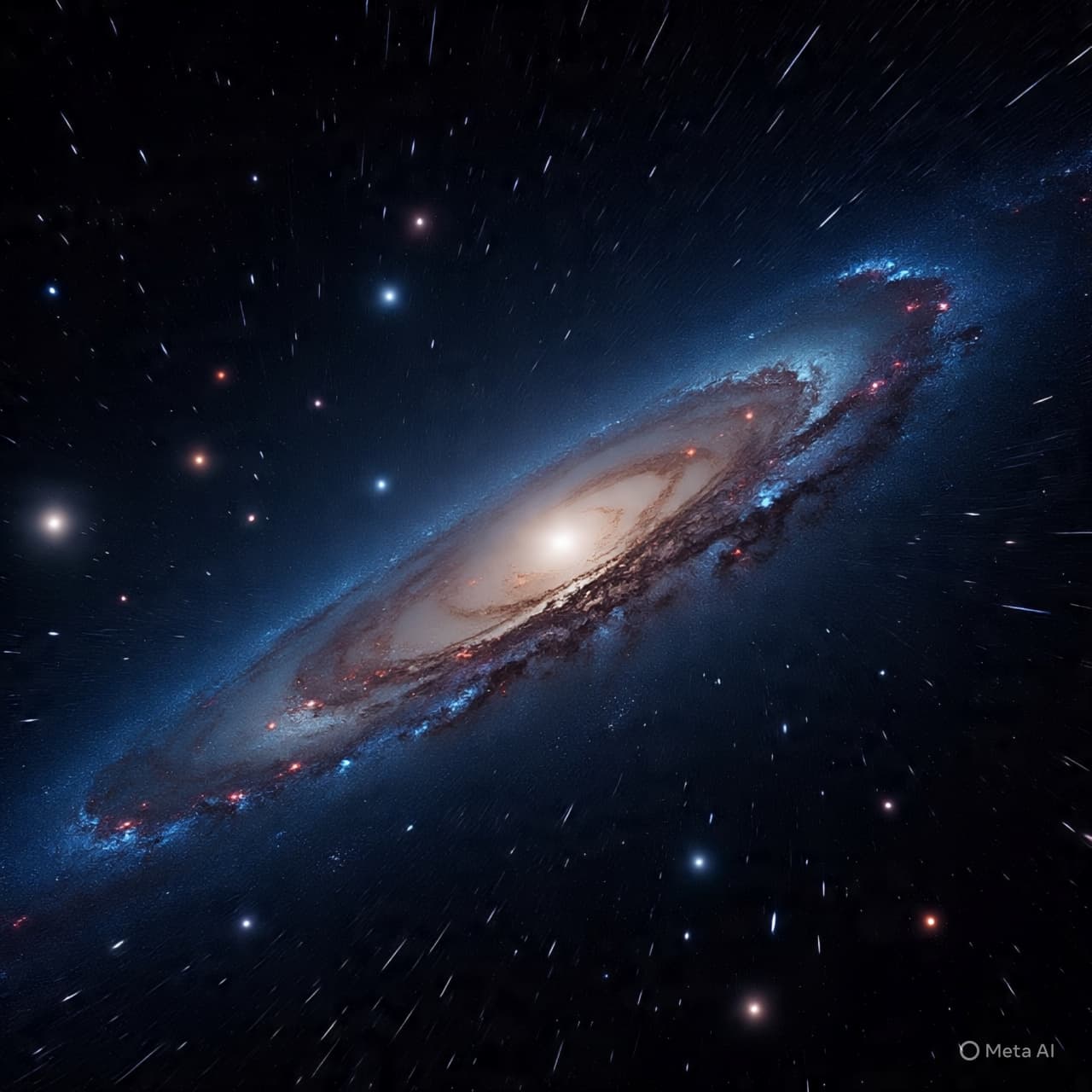
Key Highlights
- Hubble Tension:Discrepancies in universe expansion rates challenge existing theories.
- Dark Energy:The mysterious force driving cosmic acceleration remains largely unknown.
- Ongoing Research:Scientists are employing new methods to resolve the expansion mystery.
The universe, vast and patient as it may seem, carries a quiet urgency within it. Galaxies drift apart, space stretches, and time itself seems to ride along this expansion. Yet recent observations suggest something unexpected—the universe may be expanding faster than our best theories can explain.
This discrepancy, often referred to as the "Hubble tension," has become one of the most persistent mysteries in modern physics. Measurements taken from the early universe, using the cosmic microwave background, suggest one rate of expansion. Meanwhile, observations of nearby galaxies indicate a faster rate. Both methods are precise and trusted, yet they do not agree, raising questions about our fundamental understanding of the cosmos.
For scientists, this is not merely a technical inconsistency. It signals that something fundamental may be missing from our understanding of the universe. The equations that describe cosmic behavior—refined over decades—may require revision, or perhaps even a new framework altogether. This ongoing debate highlights the dynamic nature of scientific inquiry, where established theories are continually tested against new evidence.
At the center of the discussion lies dark energy, the invisible force believed to drive cosmic acceleration. First identified in the late 20th century, dark energy remains largely mysterious. It does not emit light, cannot be directly observed, and yet appears to shape the large-scale structure of the universe. Some researchers suggest that dark energy itself may be changing over time, subtly altering the expansion rate. Others propose that unknown particles or forces could be influencing cosmic behavior in ways not yet accounted for. There are even suggestions that our understanding of gravity may need to evolve to accommodate these new findings.
The challenge is compounded by the precision of modern instruments. Telescopes and observatories, both ground-based and in orbit, have reached remarkable levels of accuracy. This makes the disagreement between measurements all the more difficult to dismiss as simple error. As scientists gather more data, they are faced with the task of reconciling these conflicting observations, which could lead to groundbreaking discoveries in our understanding of the universe.
Despite the uncertainty, the scientific process continues with careful patience. New missions, improved observational techniques, and collaborative research efforts aim to narrow the gap. Each data point becomes part of a larger narrative, one that may eventually reveal where the current models fall short. The ongoing research not only seeks to clarify the nature of dark energy but also to enhance our understanding of fundamental physics.
For now, the expanding universe remains both a known fact and an open question. It is moving outward, undeniably so, yet the reasons behind its pace remain elusive. In this quiet tension between observation and theory, science finds its momentum. The universe, it seems, is not only expanding in space but also in mystery—inviting us to keep looking, measuring, and wondering.
Published by Banx Network. This article is part of the Banx decentralized media programme, powered by the BXE token on the XRP Ledger.




