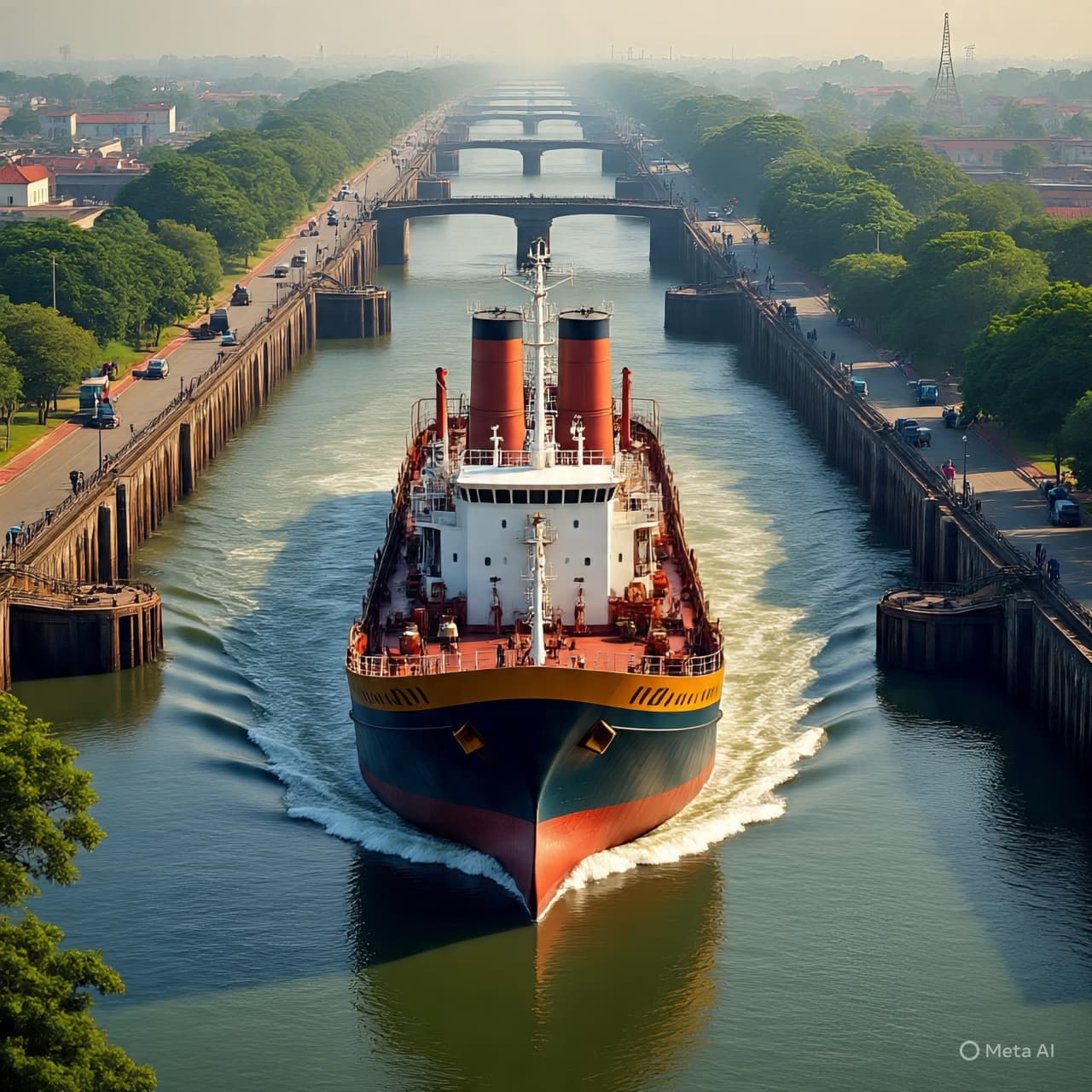
There are places in the world where motion is constant yet rarely noticed—where ships pass in measured sequence, one after another, as if following a rhythm older than the vessels themselves. The Panama Canal is one such place, a narrow crossing where oceans meet through intention rather than geography, and where the movement of goods becomes a quiet expression of global balance.
In recent weeks, that balance has shifted in subtle ways. According to canal administrator Ricaurte Vásquez, the transit of liquefied natural gas vessels has increased, reflecting a change that begins far beyond the canal’s edges. The cause lies in the evolving tensions surrounding Iran, where conflict has introduced uncertainty into one of the world’s most critical energy corridors.
From the perspective of the sea, disruption does not appear as an event, but as a redirection. Routes that once seemed fixed begin to bend, guided by new calculations of distance, safety, and timing. For LNG shipments, particularly those moving from the United States toward Asian markets, the Panama Canal has become a more frequent passage—a path chosen not only for efficiency, but for reliability in a moment when other routes feel less certain.
The increase in traffic is not dramatic in isolation, but it carries significance in accumulation. Each additional vessel represents a decision made elsewhere—a recalibration of logistics, a response to shifting conditions. Together, they form a pattern, one that suggests a broader adjustment in how energy flows are managed across oceans.
There is a certain quiet adaptability in this system. Global trade does not pause when faced with disruption; it reroutes, redistributes, and continues. The canal, long a central artery of commerce, absorbs this change almost seamlessly, its operations adjusting to accommodate the rising demand. In doing so, it becomes not only a passage, but a stabilizing point within a wider network under strain.
At the same time, the increase in LNG transit intersects with the canal’s own conditions. After periods of constraint linked to water levels, improved capacity has allowed for a return to fuller operation. This convergence—of external demand and internal readiness—has enabled the canal to take on a greater role at a moment when it is most needed.
Yet the permanence of this shift remains uncertain. Trade routes are responsive by nature, shaped by circumstances that can evolve as quickly as they arise. Should tensions ease, the flow may gradually return to its earlier patterns. Should they persist, new routes may become familiar, their repetition turning adaptation into routine.
For now, the canal continues its steady work, carrying vessels that reflect a world in motion—one adjusting quietly, one passage at a time.
Panama Canal administrator Ricaurte Vásquez said transit of LNG vessels through the canal has increased amid the Iran conflict, as disruptions to traditional Middle Eastern routes push energy shipments toward alternative pathways.
AI Image Disclaimer
Illustrations were created using AI tools and are not real photographs.
Source Check Reuters Associated Press Bloomberg CNBC Financial Times
Published by Banx Network. This article is part of the Banx decentralized media programme, powered by the BXE token on the XRP Ledger.