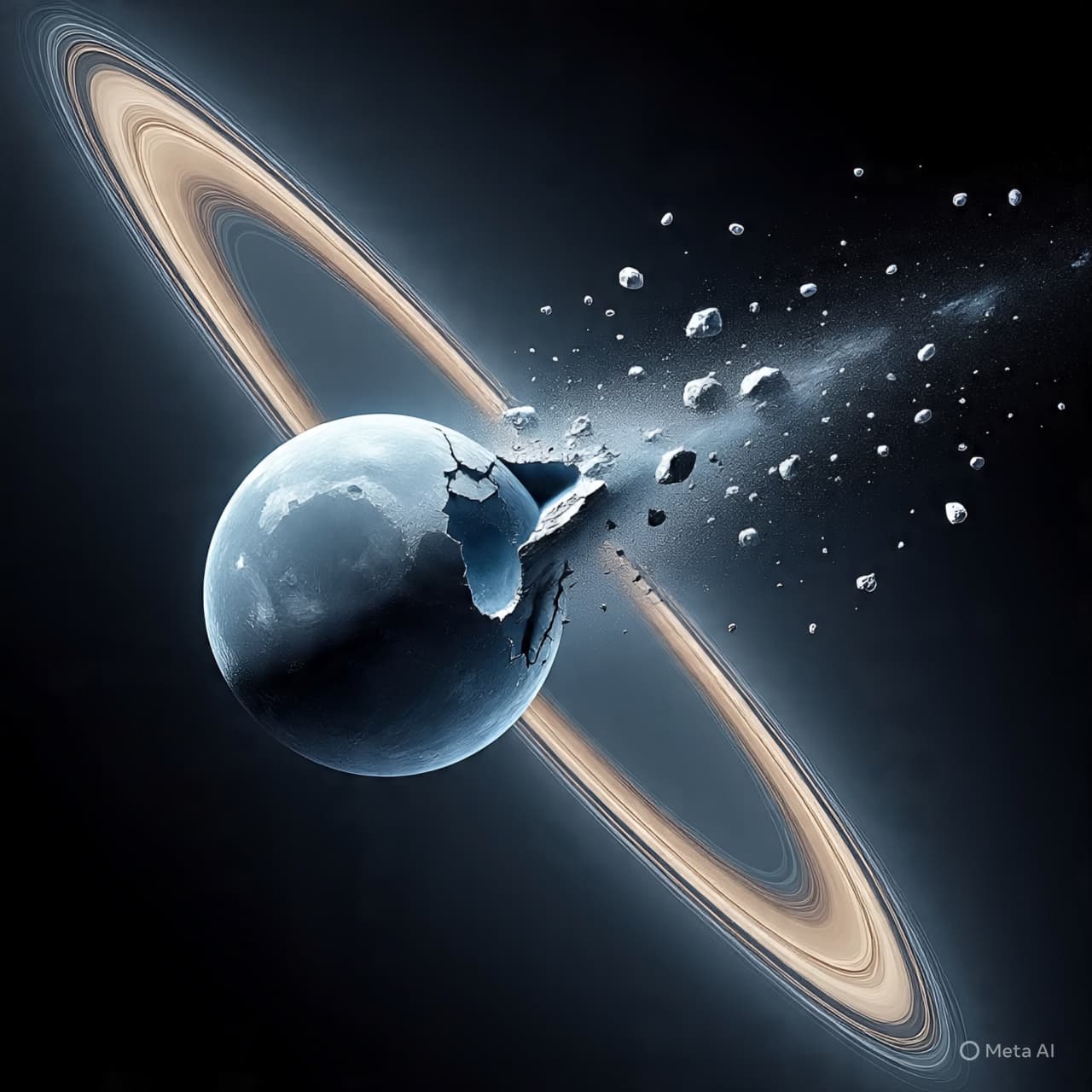
In the silent theater of the outer solar system, where sunlight arrives as a whisper rather than a blaze, Saturn has long worn its rings like a question mark drawn across the dark. For centuries, those shimmering bands have seemed eternal — delicate, precise, almost ornamental. Yet new research suggests they may have been born not from serenity, but from collision — from a moment when two ancient moons crossed paths and rewrote Saturn’s story in fragments. Recent scientific findings propose that Saturn’s iconic rings, along with its largest moon, Titan, may have emerged from a dramatic encounter between two primordial moons. Rather than forming quietly in isolation, these celestial bodies may be the aftermath of a cosmic impact — a slow-motion shattering that scattered debris into orbit while allowing part of the wreckage to coalesce into what we now know as Titan. For decades, planetary scientists have debated the age and origin of Saturn’s rings. Data gathered by the Cassini–Huygens mission reshaped that debate, suggesting the rings are surprisingly young in cosmic terms — perhaps only a few hundred million years old. That estimate stood in quiet tension with older theories that imagined the rings forming alongside Saturn itself, more than four billion years ago. The new modeling deepens this mystery while offering a graceful resolution. According to the study, two icy moons once orbited Saturn in a delicate gravitational dance. Over time, tidal forces — subtle but persistent — altered their orbits. Eventually, the balance failed. A collision followed, dispersing enormous quantities of ice and rock into Saturn’s orbit. Some of this debris flattened into the luminous rings we see today. Another portion gradually gathered itself, like memory reforming after disruption, becoming Titan. Titan, veiled in a dense golden atmosphere, has always stood apart among Saturn’s moons. Larger than the planet Mercury, with lakes of methane and complex organic chemistry, it is a world of both familiarity and strangeness. If it indeed rose from the fragments of a catastrophic event, its origin story becomes even more poetic — a world born not merely from dust, but from the remnants of siblings. The implications extend beyond Saturn. Understanding how rings and moons form — and reform — helps scientists refine broader models of planetary systems. Collisions, once thought to be rare exceptions, are increasingly recognized as formative forces. Our own Moon is widely believed to have emerged from a colossal impact early in Earth’s history. In this light, Saturn’s rings may not be anomalies but echoes of a universal pattern: creation through upheaval. Yet the tone of this research is not dramatic in the way of headlines. It is careful, measured, mathematical. Simulations reconstruct orbital histories. Density calculations estimate how material would disperse. Gravitational interactions are traced like the faint lines of an ancient map. What emerges is not spectacle, but coherence — a narrative stitched from physics. If the theory continues to withstand scrutiny, it subtly reshapes our perception of Saturn. The rings are no longer merely adornments. They become testimony — luminous archives of a past event. Titan, too, transforms from solitary giant to survivor of an ancestral fracture. In the end, Saturn remains distant and serene in our night sky. The rings still gleam. Titan still circles in its amber haze. But beneath that calm geometry lies a reminder familiar to both astronomy and human history: harmony is sometimes the child of disruption. The cosmos does not only build — it also breaks, and in breaking, builds again.
AI Image Disclaimer
Visuals are created with AI tools and are not real photographs.
---
Sources
NASA ESA Science Magazine Nature The Guardian
Published by Banx Network. This article is part of the Banx decentralized media programme, powered by the BXE token on the XRP Ledger.