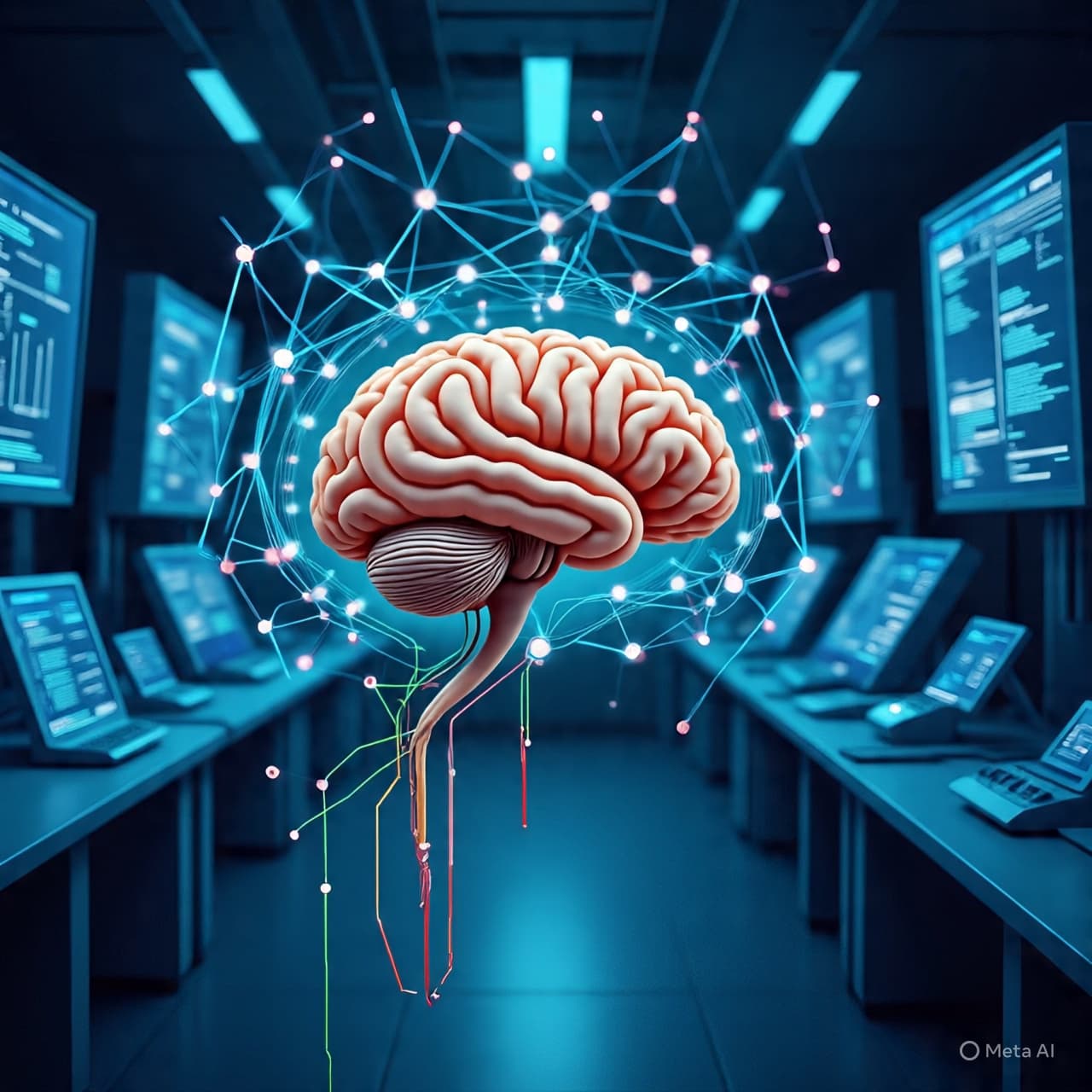
There are moments in the history of ideas when two paths, long considered separate, begin to bend toward one another. At first, the convergence is subtle, almost unnoticed—a shared question here, a borrowed method there. Over time, the distance narrows, and what once seemed distinct begins to take on the shape of a dialogue.
Such a convergence is unfolding between neuroscience and machine learning. One seeks to understand the brain, tracing the pathways of neurons and the patterns of thought that emerge from them. The other builds systems that learn, adapting through data and computation, often inspired by simplified versions of those same biological processes. For years, the relationship has been directional, with machine learning drawing from neuroscience. Now, the exchange has become more reciprocal.
In laboratories and research centers, models designed for artificial intelligence are being used not only to perform tasks, but to interpret the brain itself. Neural networks—once loosely inspired by biological neurons—have evolved into tools capable of identifying patterns in neural data, revealing structures that are difficult to discern through traditional methods. In this way, machine learning becomes a lens through which the brain can be studied.
At the same time, neuroscience continues to inform the development of these models. Insights into how biological systems process information—how they balance efficiency with flexibility, how they learn from limited data—are shaping new approaches in artificial intelligence. Concepts such as attention, memory, and hierarchical processing find echoes in algorithms that attempt to replicate aspects of human cognition.
The exchange is not symmetrical, but it is continuous. Machine learning abstracts and simplifies, turning complex biological processes into computational frameworks. Neuroscience, in turn, draws on these abstractions to test hypotheses, to explore how well such models capture the realities of neural function. Each field influences the other, not by replacing it, but by offering new ways of seeing.
There is a certain tension in this relationship. The brain is not a machine in the conventional sense, and machine learning models, for all their sophistication, do not replicate the full complexity of biological systems. Yet within this gap lies a space for exploration, where approximation becomes a tool rather than a limitation.
As machine learning systems grow more capable, they begin to mirror aspects of cognition in ways that invite comparison. Patterns of recognition, adaptation, and even error take on forms that seem familiar, though they arise from entirely different substrates. This resemblance is not identity, but it suggests that certain principles of learning may extend across both biological and artificial domains.
The result is a kind of exchange that reshapes both fields. Neuroscience gains new methods for analyzing vast and complex datasets, while machine learning benefits from insights grounded in the functioning of the brain. The boundary between understanding and creation becomes less distinct, as tools designed to mimic intelligence are used to study it.
There is something reflective in this crossing of paths. The effort to understand the brain leads to the creation of systems that, in turn, help illuminate it. The direction of influence becomes circular, a movement that does not settle in one place, but continues to evolve.
Researchers are increasingly using machine learning to study neural systems while drawing inspiration from neuroscience to improve artificial intelligence. This reciprocal relationship is shaping advances in both fields and deepening understanding of intelligence.
AI Image Disclaimer
These illustrations are AI-generated and serve as conceptual representations rather than real scientific imagery.
Source Check Nature Science MIT Technology Review Scientific American The Guardian
Published by Banx Network. This article is part of the Banx decentralized media programme, powered by the BXE token on the XRP Ledger.