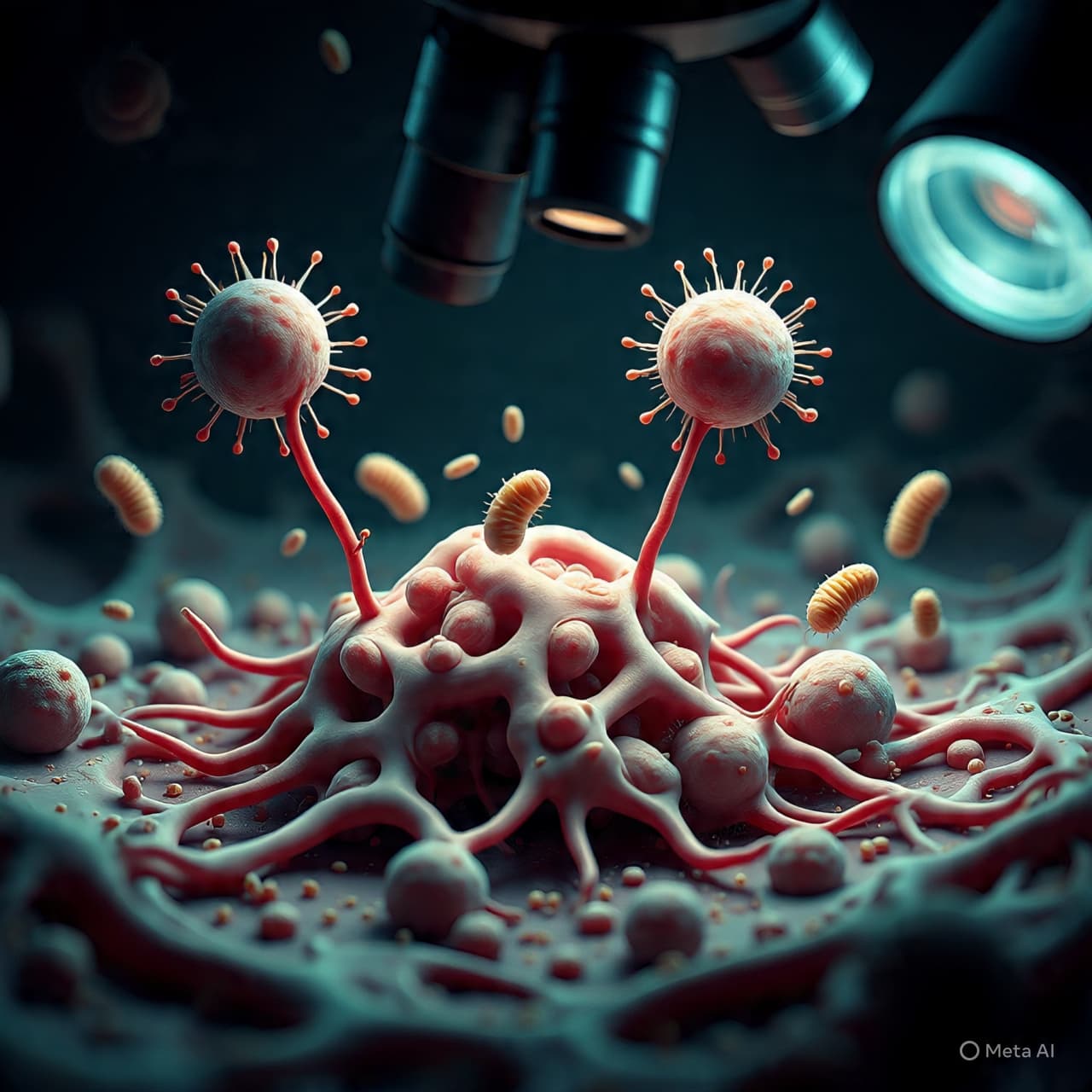
There is something almost paradoxical about the idea: that the smallest forms of life, once feared as agents of disease, might be invited into the body as allies. For generations, bacteria have been cast as invaders to be eliminated, sterilized, or subdued. Yet science, patient and persistent, has begun to reconsider their role. What if, instead of fighting them, we could guide them? What if microbes could be taught to move toward illness rather than cause it — to enter a tumor not as an enemy of the body, but as an instrument of healing?
Recent advances in synthetic biology suggest this possibility is no longer confined to imagination. Researchers have engineered strains of bacteria designed to seek out tumors, survive within their oxygen-poor cores, and release therapeutic compounds directly inside cancerous tissue. Findings reported in journals such as Nature and Science describe experimental systems in which bacteria are genetically modified to detect specific tumor environments and activate anti-cancer responses.
Tumors, particularly solid ones, often contain regions that are difficult for conventional drugs to penetrate. Their interiors can be hypoxic — low in oxygen — and shielded by irregular blood vessels. Paradoxically, these harsh conditions make tumors attractive habitats for certain bacteria, which naturally thrive in oxygen-deprived spaces. Scientists have harnessed this trait, reprogramming bacteria to colonize tumors selectively while limiting their ability to spread elsewhere in the body.
Some engineered strains are designed to produce toxins that kill nearby cancer cells. Others deliver immune-stimulating molecules, effectively turning the tumor into a site that alerts and recruits the body’s own defenses. In laboratory and early animal studies, these bacterial therapies have shown promise in shrinking tumors or enhancing the effects of existing treatments like chemotherapy and immunotherapy.
The approach is careful and incremental. Researchers attenuate, or weaken, bacterial strains to reduce the risk of uncontrolled infection. Genetic “kill switches” are sometimes built into the microbes, allowing them to self-destruct under specific conditions. According to reporting by STAT News, early-stage clinical trials are beginning to explore safety and dosage in humans, though the field remains in development.
This concept is not entirely new. Over a century ago, physicians observed that certain infections occasionally coincided with tumor regression, leading to experimental treatments that attempted to harness immune responses triggered by bacteria. Today’s efforts differ in precision. Modern genetic engineering allows scientists to design bacteria with targeted behaviors, turning them into programmable biological tools rather than blunt instruments.
Still, caution shapes every step. The human immune system is complex, and cancer itself is not a single disease but many. What works in one tumor type may not translate easily to another. Researchers must balance microbial potency with patient safety, ensuring that engineered organisms do not cause unintended harm. Regulatory pathways are rigorous, and long-term effects require careful monitoring.
Yet the broader implication is quietly transformative. Cancer therapy has increasingly moved toward personalization — treatments tailored to the molecular profile of a patient’s tumor. Engineered bacteria add another dimension: living therapeutics capable of sensing their environment and responding dynamically. Instead of delivering a static drug dose, they may adjust activity based on conditions within the tumor microenvironment.
In this reframing, bacteria are neither villains nor miracles. They are tools — powerful, adaptable, and deserving of respect. The science does not promise immediate cures, nor does it claim universal applicability. It offers a developing strategy that may complement existing therapies and expand the arsenal against difficult-to-treat cancers.
For now, clinical research continues in controlled settings, with investigators evaluating safety, immune response, and effectiveness. Results remain preliminary, and further trials will determine whether engineered bacteria become a standard component of cancer care. What is clear is that the boundary between microbiology and oncology is becoming more porous. In laboratories around the world, scientists are exploring how life at its smallest scale might help confront one of medicine’s greatest challenges — not by destroying from afar, but by entering quietly and working from within.
AI Image Disclaimer
Illustrations were produced with AI and serve as conceptual depictions.
---
Sources
Nature Science STAT News The Guardian National Institutes of Health
Published by Banx Network. This article is part of the Banx decentralized media programme, powered by the BXE token on the XRP Ledger.