
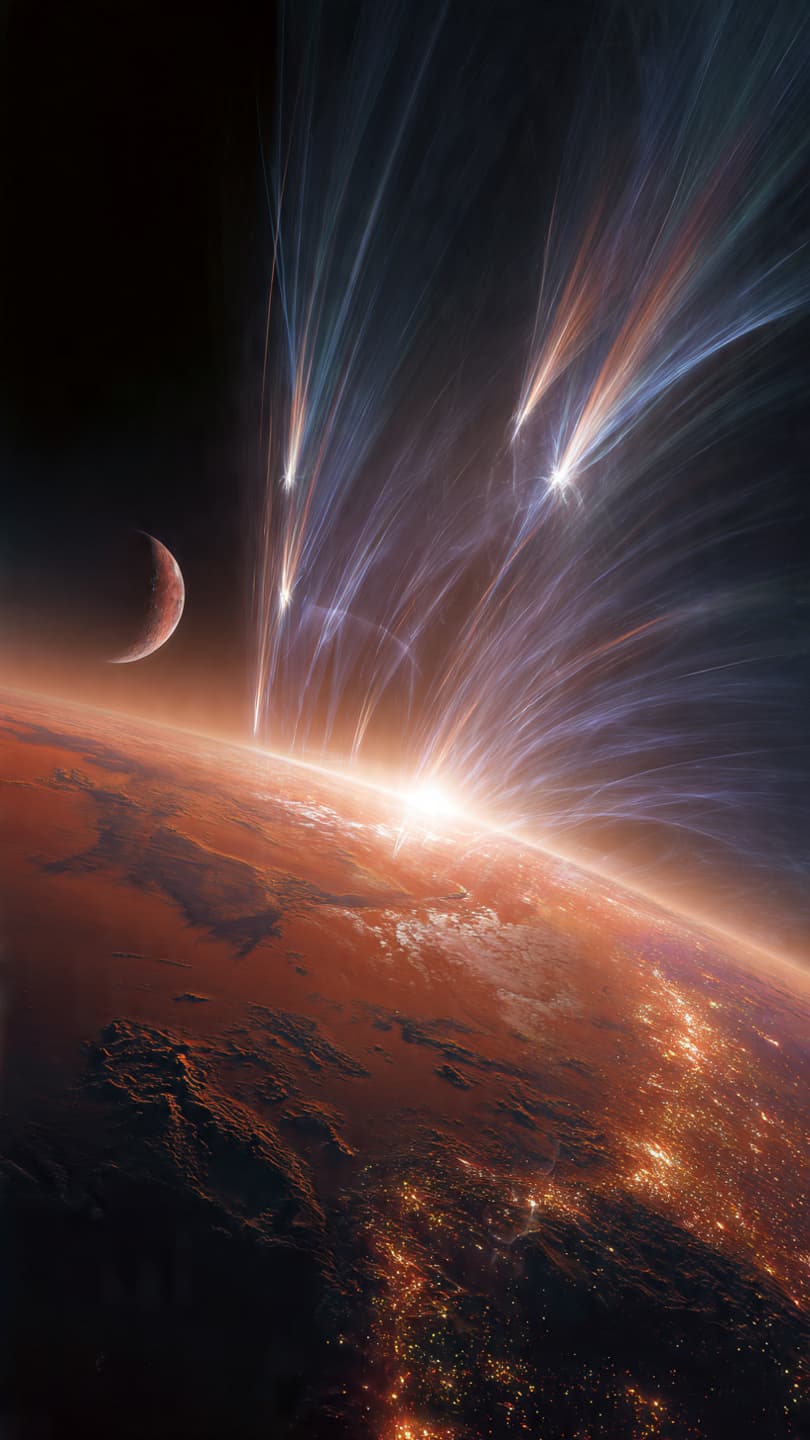
Mars has long been a planet of scientific intrigue, its thin atmosphere and dry surface offering clues about planetary evolution and climate history. Recent observations have identified an unusual atmospheric behavior described by researchers as an unexpected plasma-related interaction within the Martian environment.
This phenomenon appears to influence how charged particles interact with the upper layers of Mars’ atmosphere, suggesting dynamics that were not fully anticipated by existing models.
Scientists studying data from orbiting spacecraft have noted subtle changes in atmospheric density and energy distribution, which may point to complex interactions between solar wind and Martian atmospheric particles.
Unlike Earth, Mars lacks a strong global magnetic field, making its atmosphere more directly exposed to solar radiation. This exposure contributes to ongoing atmospheric loss over long timescales, but the newly observed effect suggests additional processes may be involved.
Researchers emphasize that further study is required to understand the full nature of these interactions, as current data provides only partial insight into a highly dynamic system.
The discovery highlights how planetary atmospheres can still hold surprises, even after decades of exploration and satellite observation.
Understanding these processes is important not only for planetary science but also for future exploration missions, where atmospheric conditions can affect entry, landing, and potential human activity.
In conclusion, the newly observed Martian atmospheric behavior adds another layer to our evolving understanding of the red planet’s complex environmental system.
AI Image Disclaimer: All visuals are AI-generated conceptual representations used for editorial purposes.
Source Verification Check: NASA Mars Missions, ESA Mars Express, Nature Geoscience, Science News, JPL Reports
Published by Banx Network. This article is part of the Banx decentralized media programme, powered by the BXE token on the XRP Ledger.



