There is a particular tension that arises when the future of a public space is contested not in a single dramatic moment but in the slow, incremental work of chainsaws and court filings. At East Potomac Golf Links, a 106-year-old public course near the National Mall, that tension has taken the form of tree removal—an act that the National Park Service describes as routine maintenance but that critics see as the quiet beginning of a larger transformation.
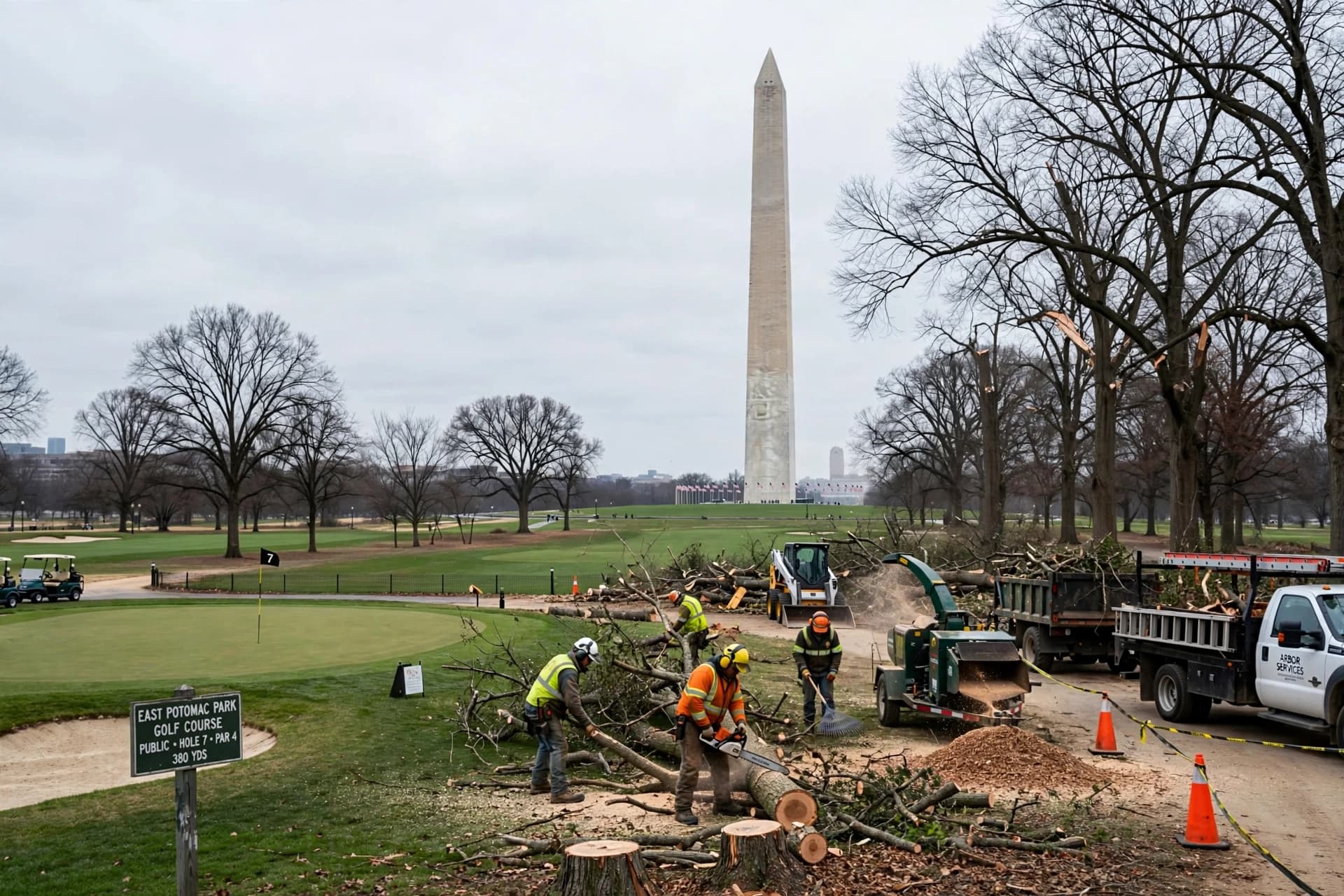
On Saturday, crews began removing 169 trees from a wooded section of the course known informally as “Trash Island” . The National Park Service has said it plans to remove as many as 529 trees in total, with another 90 slated for removal later . The agency has framed the work as part of a “landscape restoration project” separate from any redesign, stating in a court filing that the trees being removed “do not contribute to the historic landscape” and that no healthy, historic cherry trees will be cut .
The tree removal is unfolding against the backdrop of a larger controversy. President Trump, an avid golfer, has said he intends to transform East Potomac into a championship-caliber course capable of hosting major tournaments . The administration’s plans have drawn lawsuits from preservation groups, including the DC Preservation League, who argue that a redesign would violate the congressional act that created the park in 1897 . The plaintiffs contend that the maintenance work is being pursued as part of the broader renovation effort, a claim the Interior Department denies .
Some residents and golfers have expressed anger at the tree removal. At a hearing last month, U.S. District Judge Ana Reyes acknowledged that “people are pretty upset” and shared that she had received threats from someone who said they would remove her if she didn’t “save the trees” . Charles Birnbaum, president of the Cultural Landscape Foundation, argued that the tree removal should be subject to review under the National Historic Preservation Act, saying “the work is not routine maintenance” .
The park service has said the golf course will remain open to the public throughout the work, though individual holes may temporarily close . The agency has also said it will solicit bids to remake the course in January 2027 . For now, the tree-cutting continues—a process that, for some, represents the beginning of a long-awaited improvement, and for others, the slow erosion of a place they have known and loved for decades.
AI Image Disclaimer: The visuals in this article were generated using artificial intelligence for illustrative purposes only and do not depict the actual golf course or trees described.
Sources: CNN, AP News, DC News Now, Washington Post, The Mirror US, La Nación
Published by Banx Network. This article is part of the Banx decentralized media programme, powered by the BXE token on the XRP Ledger.