In the ornate halls of Davos, where winter light plays softly against glass and snow-dusted pines stand like sentinels just beyond the windows, there is a rhythm of conversation that moves from the distant past to the imagined future. Much like the wind that sweeps mountain ridges — sometimes whispering, sometimes vigorous — ideas find their way into dialogue here, crossing borders with ease and curiosity. In this spirit, a recent reflection by Palantir Technologies’ Chief Executive, Alex Karp, stirred attention: the suggestion that artificial intelligence might one day make large-scale immigration obsolete. It was a thought offered not as an abrupt decree, but as a contemplative riff on labour, opportunity, and movement in a world where machines transform work itself.
At a World Economic Forum panel in Switzerland, Karp contemplated how technological change reshapes human activity. He spoke of AI’s capacity to displace roles once filled by people and, in turn, create others — particularly where vocational skills are prized — suggesting that if abundant opportunities arise domestically, the traditional economic rationale for mass movement between countries might fade. Among his words was the notion that “there will be more than enough jobs for the citizens of your nation, especially those with vocational training” — a portrait of possibility that sidesteps some usual fears about rapid automation, instead pointing toward a future where local labour markets might suffice.
Such thinking invites comparison with the image of a well-tended garden. Just as a gardener anticipates periods of bloom and dormancy, society nurtures its workforce with training, adaptation, and education — tending each generation of skills to suit the soil of tomorrow’s economy. Yet this metaphor also hints at complexity: gardens do not flourish simply because seeds are sown; they require conditions, stewardship, sunlight, and time. In the case of AI and labour, the soil is still being measured, its yield still emerging from roots of investment, policy, and social adaptation.
Underlying these remarks is a broader narrative about the future of work and human movement. Traditional large-scale immigration has often been driven by the promise of economic opportunity, hardship at home, and the pull of brighter prospects abroad. If digital technologies reframe where and how work happens, that could influence the calculus of migration for a generation. Yet, as many observers note, human movement has never been shaped by economics alone. Political instability, environmental pressures, family reunification, and the search for safety are forces as old as history itself — currents that do not ebb simply because a new technology reshapes labour markets.
At the same time, Karp’s comments are embedded in another layer of conversation about AI’s broader effects: how it influences job categories, the value of vocational versus academic skills, and the readiness of societies to adapt. He pointed to a transition in the kinds of roles that might be most in demand, with hands-on, technically oriented skills gaining prominence as AI takes on more routine cognitive tasks. This too reflects a vision of the future that is not strictly about displacement, but about evolving human purpose in an automated age.
There are, naturally, diverse views on this type of futurism. Some economists and ethicists emphasize that work — meaningful engagement, creative thought, and community contribution — cannot be reduced to algorithms or mechanized output alone. Others highlight that migration has moral and familial dimensions, and that policy must account for a wide array of human experiences beyond labour statistics. Such nuances often follow big ideas like those offered at global forums, inviting deeper thought well after panel discussions conclude.
What emerges from these gentle reflections is not a forecast carved in stone, but a tableau of possible futures — a reminder that human life unfolds in many dimensions, shaped by tools of every era, yet grounded in timeless pursuits of dignity, purpose, and connection.
In Davos, the point made by Alex Karp was straightforward in policy terms: AI’s expanding role in automating work could, in his view, diminish the economic impetus for mass immigration unless highly specialized skills are involved. This view was presented during discussions at the World Economic Forum and reflects one perspective among many on the intersection of technology, labour markets, and population movement.
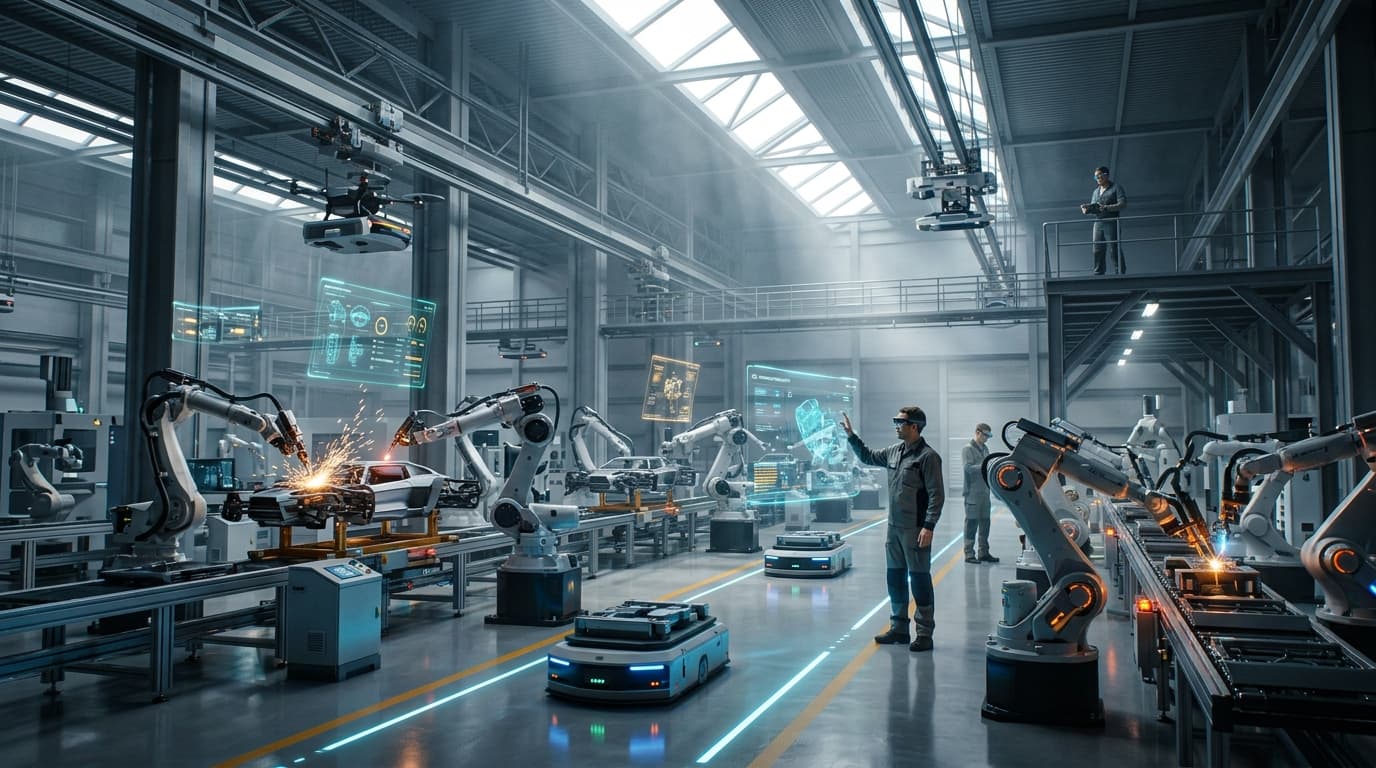
AI Image Disclaimer “Visuals are created with AI tools and are not real photographs.”
Source Check
Bloomberg SiliconANGLE IndexBox summarizing Davos comments on AI’s broader impacts Bluewin/Keystone-SDA Bloomberg Law coverage
Published by Banx Network. This article is part of the Banx decentralized media programme, powered by the BXE token on the XRP Ledger.