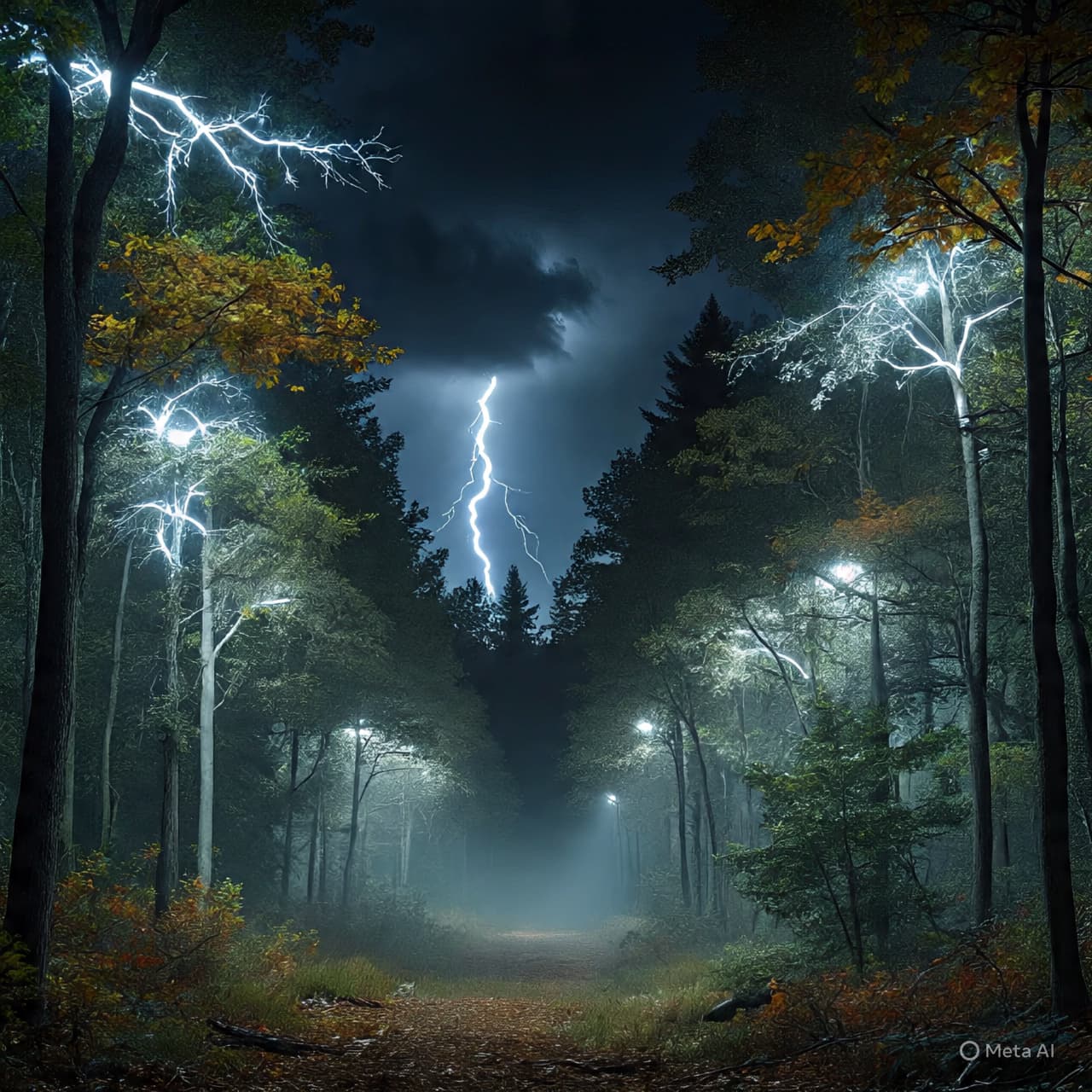
There are moments when the sky seems to rehearse its oldest dramas. Thunder gathers, clouds thicken into darkened towers, and lightning begins to sketch white veins across the horizon. We often look upward expecting thunder’s roar or rain’s percussion. Yet, beyond what the eye can see, something quieter — and perhaps more wondrous — is happening among the trees below. In the instant lightning tears through the sky, forests answer in a language invisible to us: brief ultraviolet sparkles, flickering like whispered replies to the storm.
Scientists have now confirmed that trees emit faint bursts of ultraviolet light during thunderstorms. These emissions, triggered by intense electric fields generated by lightning, are not the romantic glow of myth but measurable physical events. When lightning discharges, it produces powerful electromagnetic pulses. Those pulses interact with objects on the ground — including trees — inducing electrical currents within their structures. The result is a fleeting flash of ultraviolet radiation, subtle and unseen without specialized instruments.
Researchers detected these emissions using sensitive optical sensors capable of capturing ultraviolet wavelengths beyond human vision. The phenomenon appears to occur at the very moment lightning strikes or when the electric field in the surrounding air intensifies sharply. In some observations, trees produced small corona discharges — faint electrical glows that form when the air around sharp points becomes ionized under strong electric fields. Branch tips and leaves, with their intricate geometry, provide ideal sites for such effects.
This finding adds another layer to our understanding of how forests interact with atmospheric electricity. Trees are not passive witnesses to storms; they participate in complex exchanges of charge and energy. During a thunderstorm, the electric field between cloud and ground can rise dramatically. Tall objects like trees help shape how that field distributes itself. In doing so, they become temporary actors in the electrical drama overhead.
The ultraviolet sparkles themselves are brief and harmless to observers at ground level, but their discovery opens scientific pathways. Understanding how vegetation responds to strong electric fields could refine models of lightning behavior and improve assessments of wildfire risk. Lightning remains a major natural ignition source for forest fires, and any insight into how trees channel or dissipate electrical energy may prove valuable.
There is also quiet wonder in realizing that storms illuminate forests in ways we cannot see. Nature’s processes often unfold beyond our senses — in ultraviolet, in infrared, in magnetic fluctuations — reminding us that reality is richer than perception alone. What appears as a simple flash across the sky is, in truth, an intricate exchange between atmosphere and earth.
As scientists continue to observe thunderstorms with increasingly precise instruments, more hidden conversations may come to light. For now, the confirmation that trees fire off ultraviolet sparkles during lightning strikes invites us to look at storms with renewed curiosity. Beneath the thunder’s familiar rumble, forests shimmer briefly in invisible light — a reminder that even in chaos, there is structure, and even in darkness, there is a flicker of quiet brilliance.
AI Image Disclaimer Visuals are created with AI tools and are not real photographs.
Source Check — Credible Media Coverage Found:
ScienceAlert Live Science New Scientist The Guardian Smithsonian Magazine
Published by Banx Network. This article is part of the Banx decentralized media programme, powered by the BXE token on the XRP Ledger.