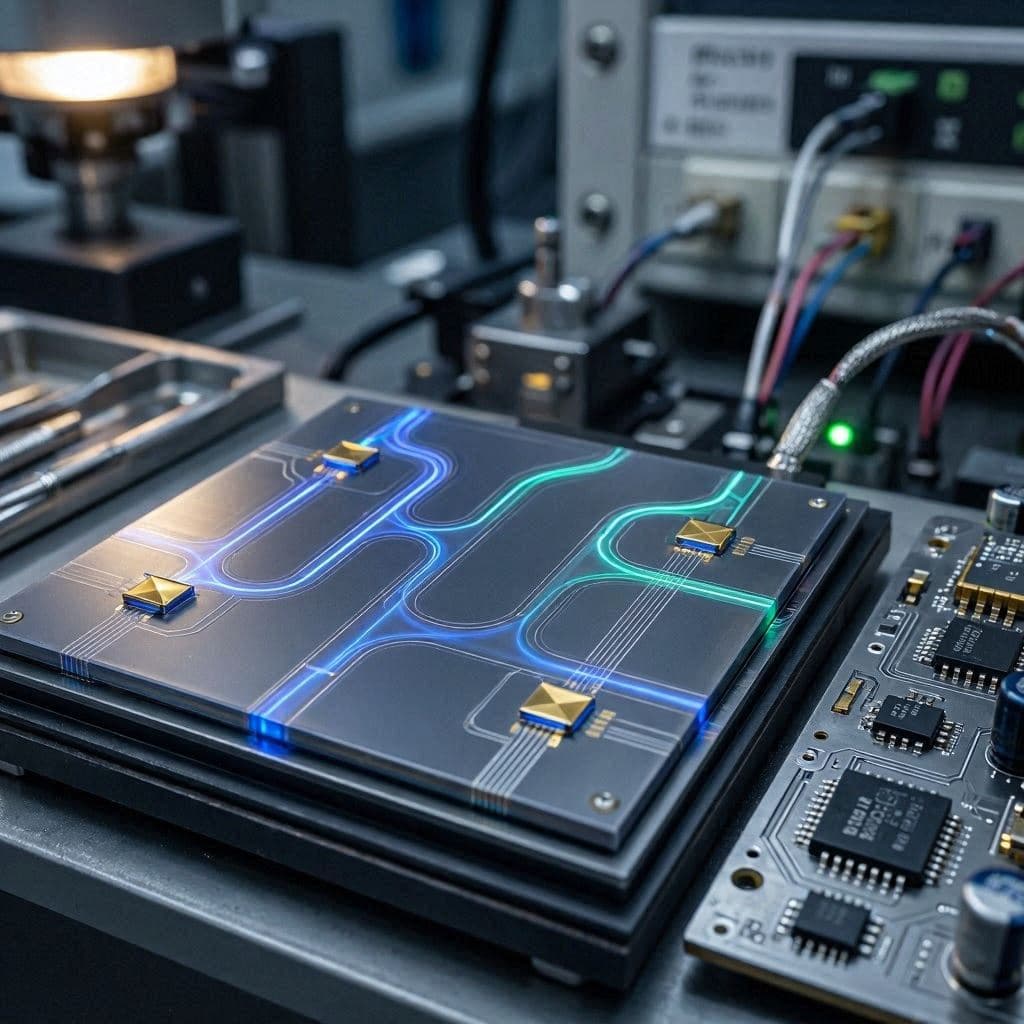
Photonic circuits often resemble quiet rivers, carrying streams of light with remarkable precision and speed. Beneath that calm surface, however, researchers have long sought ways to introduce richer and more adaptable behavior without sacrificing the inherent advantages of light-based technologies. A recent study suggests that this balance may be achievable through measurement-based feedback, offering a fresh perspective on how photonic systems can evolve beyond their conventional limits.
The research demonstrates that carefully measuring optical signals and immediately feeding the resulting information back into a photonic circuit can generate effective nonlinear dynamics. Rather than relying solely on materials that naturally exhibit nonlinear optical properties, the approach uses continuous measurement and controlled feedback to influence how light behaves within the system. This strategy broadens the possibilities for designing photonic devices while reducing dependence on specialized materials.
Nonlinear behavior plays an important role in many advanced optical technologies. It enables light waves to interact in ways that support signal processing, sensing, optimization, and emerging computing architectures. Traditionally, achieving these interactions has required materials or operating conditions that can be difficult to integrate into compact photonic platforms. The new method offers an alternative path by producing comparable effects through intelligent control rather than material properties alone.
The researchers developed theoretical models and experimental demonstrations showing that measurement-based feedback can produce stable and controllable nonlinear responses. As optical signals travel through the circuit, detectors capture information about their state. Electronic feedback systems then process that information and adjust the circuit in real time, creating a dynamic interaction between measurement and optical propagation. The result is behavior that would otherwise be difficult to achieve using passive photonic components.
Beyond the immediate scientific achievement, the work highlights a growing convergence between photonics, electronics, and control engineering. Modern optical systems increasingly rely on close coordination between these fields, allowing devices to adapt to changing conditions while maintaining high performance. Such integration may become increasingly valuable as researchers pursue scalable photonic technologies for communications and information processing.
The findings may also influence future efforts in photonic computing and quantum technologies. Adaptive optical circuits capable of responding dynamically to measured information could support more flexible computational architectures, improve precision measurements, and contribute to advanced sensing platforms. While additional research is needed before practical applications become widespread, the demonstrated principles establish a promising foundation for continued exploration.
As with many advances in fundamental science, the significance of this work lies not only in its immediate results but also in the questions it opens for future investigation. Measurement, once viewed primarily as a means of observing a system, is increasingly becoming an active tool for shaping its behavior. In photonics, that subtle shift transforms observation into participation, expanding the range of possibilities available to researchers and engineers alike.
The study illustrates how innovative control strategies can extend the capabilities of photonic circuits without abandoning the strengths that make light-based technologies attractive. As research continues, measurement-based feedback may become an important building block in the next generation of adaptive optical systems, supporting scientific discovery and technological innovation across multiple disciplines.
AI Image Disclaimer: The accompanying illustrations for this article are AI-generated visual interpretations created to represent the research concept and are not actual images from the scientific study.
Sources (Verified):
Nature Photonics Nature Communications Physical Review A ACS Photonics IEEE Photonics Journal
Published by Banx Network. This article is part of the Banx decentralized media programme, powered by the BXE token on the XRP Ledger.