In the silent depths of the cosmos, a distant light has traveled for more than twelve billion years to arrive at our telescopes — and with it, a quiet shock. Alaknanda, a majestic spiral galaxy with sweeping arms and a bright central bulge, turns out to have existed when the universe was barely 1.5 billion years old. In that infancy, galaxies were expected to be chaotic, clumpy, unsettled. Instead, here is one that already carries the calm symmetry we associate with mature spiral systems.
Alaknanda spans roughly thirty thousand light-years and already hosts a massive galactic disk and two symmetric spiral arms — characteristics that resemble those of our own galaxy. Even more surprising: it is forming stars at a furious pace, many times faster than our modern Milky Way, suggesting that its stellar mass grew rapidly during a brief early epoch. In essence, this galaxy appears not as a cosmic toddler, but as a fast-maturing veteran, challenging the established wisdom that such well-structured disks take billions of years to form.
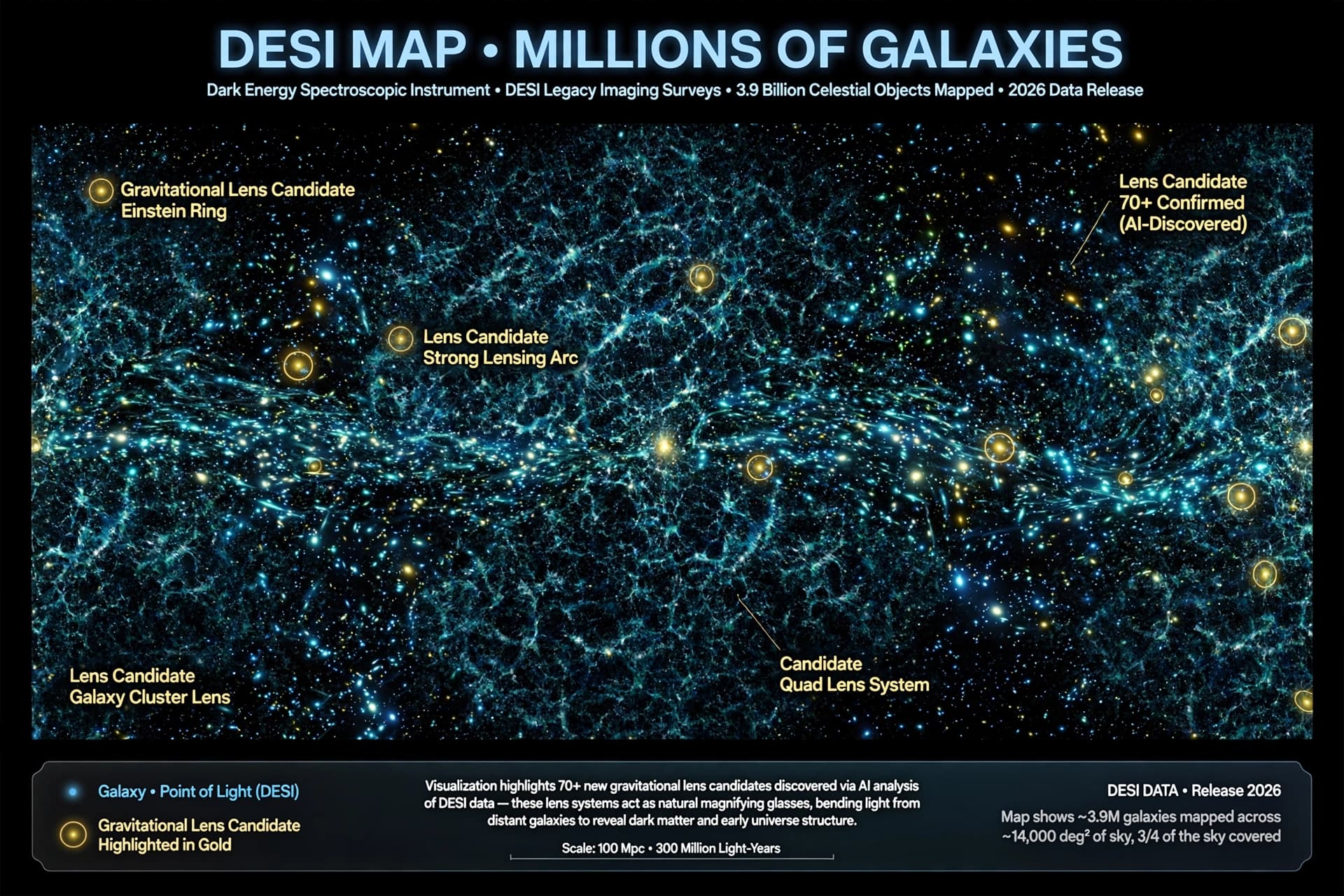
The galaxy’s discovery relied on two serendipities. First: the extraordinary sensitivity of modern space telescopes, which can peer in infrared through dust and across cosmic time. Second: a natural cosmic magnifier — a massive galaxy cluster acting as a gravitational lens, bending and amplifying Alaknanda’s faint light so astronomers could resolve its structure. Without both, this grand-design spiral might have remained invisible, hidden in blurry smudges of early-universe clutter.
Alaknanda forces a reckoning with cosmic timelines. Models of galaxy formation presumed that early galaxies would be messy, unstable — gathering bits over eons, settling gradually into ordered disks. But here is evidence that, under the right conditions, the universe can organize complexity with astonishing speed. It implies that gas accretion, disk settling, and the processes that sculpt spiral arms — possibly density waves — can operate far sooner than thought.
Yet mysteries remain. Astronomers are not yet certain how Alaknanda’s arms formed. Were they born out of smooth, calm gas flows, or stirred by early interactions with other galaxies? Are its stars orbiting in a calm, ordered disk — or a turbulent maelstrom? Planned follow-up observations may reveal rotation, gas dynamics, and internal structure. Whatever the outcome, Alaknanda stands as a stark reminder: the early universe may have been far less primitive than our theories assumed.
As we gaze at the night sky, we assume the calm beauty of spiral galaxies is a late cosmic indulgence. But Alaknanda suggests otherwise. That gentle curve, the glowing bulge, the swarming newborn stars — they are not latecomers. They are among the earliest acts in a universe ever busy, ever inventive, ever surprising.
Published by Banx Network. This article is part of the Banx decentralized media programme, powered by the BXE token on the XRP Ledger.