In the world of light, where photons glide with a grace invisible to the eye, there are stories that unfold more like poetry than mechanics. Imagine two dancers, each with their own steps, yet bound together in an intricate duet — sometimes moving in harmony, sometimes pulling away, yet always connected. In recent optical physics research, scientists have found a phenomenon equally graceful and surprising: non‑reciprocal optical solitary waves, whose response to external impulses seems almost lyrical, bending the usual expectations of momentum in subtle and unexpected ways. This discovery, at the intersection of light and nonlinear interaction, offers a fresh lens through which we might view the dance of waves in complex media.
At the heart of this work is the concept of optical solitons — stable, self‑sustaining packets of light that travel through nonlinear materials without changing shape. These solitary waves have been a staple of optical physics for decades, known for their ability to resist dispersion and maintain their form over distance. In a new study published in Light: Science & Applications, researchers explored what happens when solitons are not governed by reciprocal interactions, meaning that the internal forces between their components are not symmetric. Rather than behaving like a simple, single entity, these non‑reciprocal optical solitons act more like two dancers responding differently if one leads instead of the other.
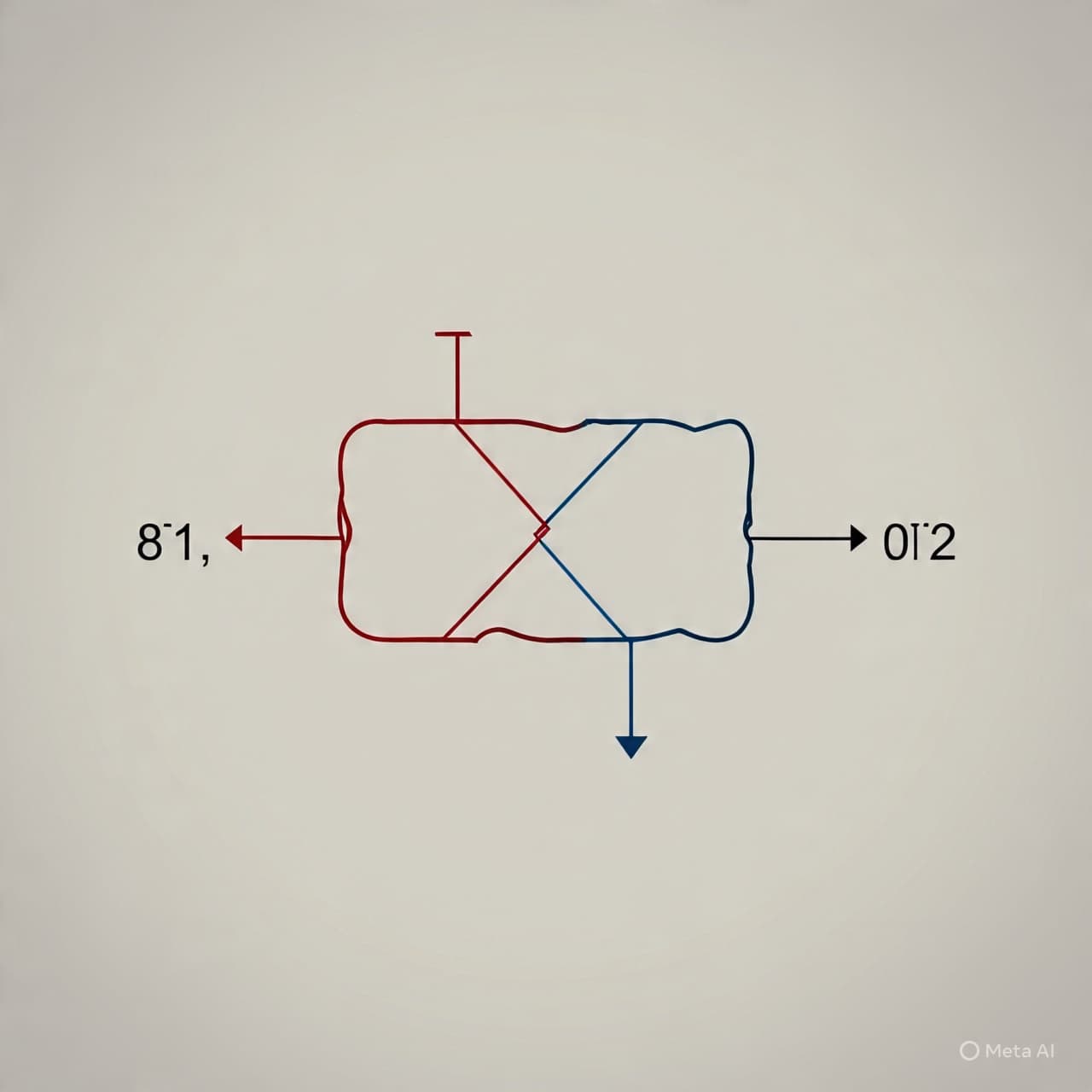
When an external impulse — that is, a small “kick” or tilt — is applied to one component of the solitary wave, the resulting change in momentum does not follow our everyday intuition. In classical physics, we expect momentum to change in proportion to the applied force: push forward and the object moves forward with corresponding momentum. However, in these non‑reciprocal optical systems, the total momentum of the composite soliton can exceed the expected response, and when the impulse is applied to the other beam component, the momentum can even reverse direction relative to the applied force. It’s as if the duet interprets the nudge not just as a push but as a cue to change direction, exceeding or inverting the expected motion.
This effect arises from the asymmetric internal interactions within the two‑component optical wave. One beam experiences self‑focusing nonlinearity while the other undergoes self‑defocusing. Their mutual influence — one acting like a waveguide drawing the other toward it, the other acting like an anti‑waveguide pushing back — creates dynamics that defy simple reciprocity. In material systems such as a biased strontium barium niobate crystal, these competing nonlinearities can be tuned and studied experimentally, confirming theoretical predictions about how momentum can behave in unconventional ways.
What makes these findings especially fascinating is how they challenge long‑held assumptions about impulse and momentum in wave physics. The classic impulse–momentum relationship — that the momentum gained equals the impulse applied — serves as a foundational principle in mechanics. Yet in this specially engineered optical platform, the relationship can stretch beyond that rule, showing coefficients greater than one or even negative, depending on which internal beam receives the impulse. It’s as if the dance between components redefines the steps mid‑performance.
Beyond the elegant physics, this research may inspire new directions toward non‑Hermitian photonic devices and advanced control over light propagation, where asymmetric interactions are not a nuisance but a design feature. By harnessing non‑reciprocal interactions, future technologies might leverage unusual momentum responses for signal routing, optical isolation, or enhanced light control in complex photonic systems.
In straightforward terms, scientists have identified that non‑reciprocal optical solitary waves can exhibit unexpected impulse‑momentum relationships, with momentum changes that exceed or reverse relative to the applied impulse. This arises from asymmetric internal forces within the composite wave structure and has been modeled and confirmed experimentally in nonlinear optical media.
AI Image Disclaimer “Visuals are created with AI tools and are not real photographs, intended for representation only.”
Sources AZoOptics, Nature (Light: Science & Applications), ScienceDaily, Medical Xpress, Yahoo News
Published by Banx Network. This article is part of the Banx decentralized media programme, powered by the BXE token on the XRP Ledger.