On certain nights, the sky seems to remember its old ceremonies. The moon rises not merely as a satellite of stone and dust, but as a quiet participant in human ritual. Lanterns drift upward, candles flicker along ancient streets, and somewhere between earth and sky, light answers light. In Beijing, such a night arrived when a rare total lunar eclipse unfolded in gentle synchrony with the Lantern Festival.
The Lantern Festival, known as Yuanxiao Festival, marks the close of Lunar New Year celebrations. It is a time when families gather beneath glowing lanterns, when riddles are written on silk, and when the full moon is admired as a symbol of reunion and wholeness. This year, that full moon did more than shine—it dimmed, slowly and deliberately, as the Earth’s shadow crossed its face.
A total lunar eclipse occurs when the Earth aligns directly between the sun and the moon, casting a shadow that gradually envelops the lunar surface. Unlike a solar eclipse, it requires no special glasses and no hurried glances. It invites patience. Over the course of several hours, the moon shifts from bright silver to coppery red, a transformation caused by sunlight filtering through Earth’s atmosphere and bending toward the lunar surface.
In Beijing, the timing carried particular resonance. As lanterns illuminated parks, courtyards, and historic districts, the moon above transitioned into its eclipse phase. Observers gathered in open spaces and along city landmarks, watching as tradition and astronomy briefly shared the same frame.
Cultural historians note that lunar eclipses have long held symbolic meaning in Chinese history. Ancient records describe careful observations by court astronomers, who interpreted celestial changes as messages about harmony between heaven and earth. Today, the interpretation is scientific rather than mystical, yet the sense of wonder remains intact.
Astronomers explained that such coincidences are uncommon but not impossible. The Lantern Festival always falls on the first full moon of the lunar year. Total lunar eclipses, however, occur only when orbital geometry aligns precisely. When those cycles overlap, the result is a convergence that feels both accidental and poetic.
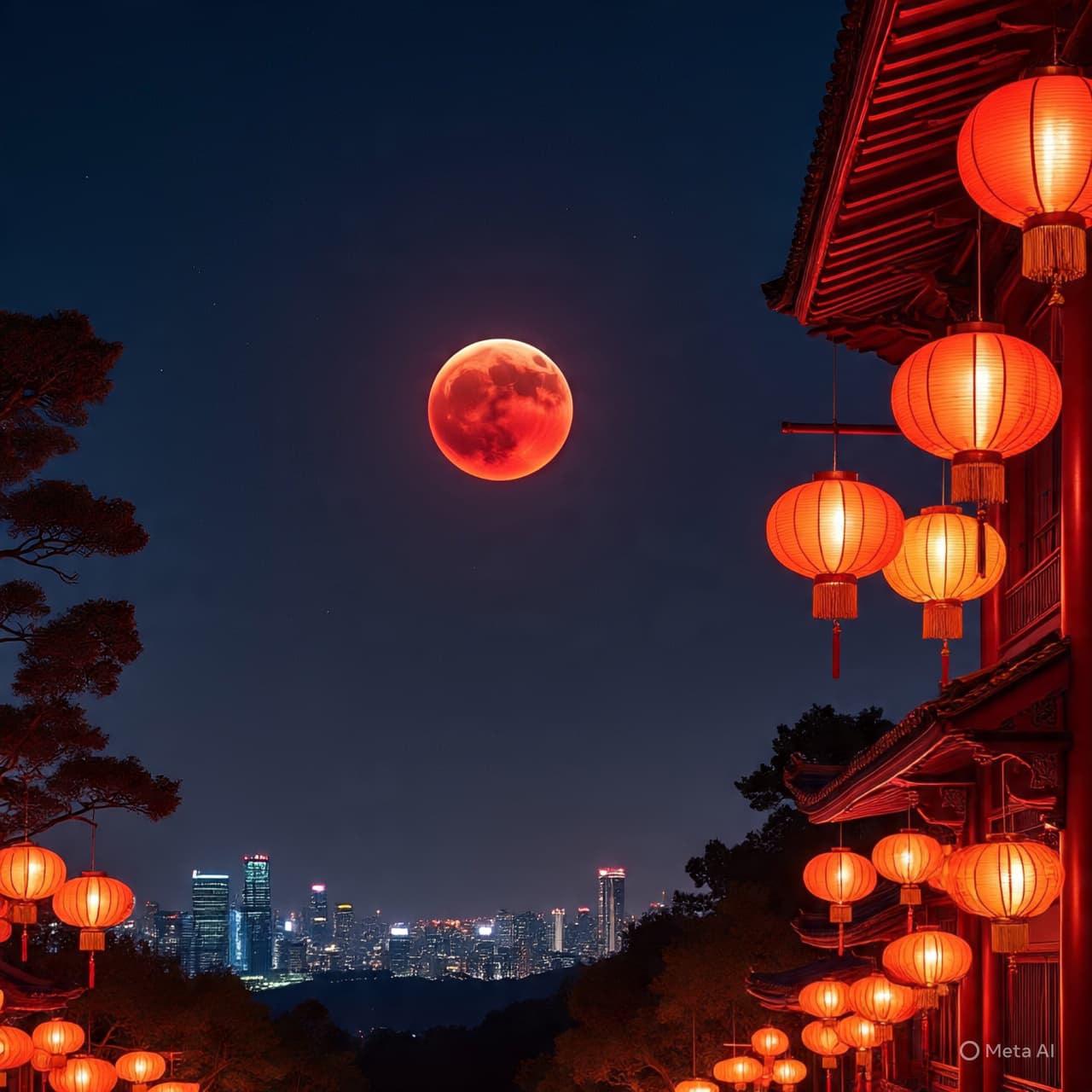
Across social media and local news outlets, images emerged of red-tinted moonlight hovering above lantern-lined streets. Families paused their celebrations to look upward. Children pointed. Elders recalled earlier eclipses witnessed decades ago. In a modern metropolis known for its scale and speed, the shared gaze toward the sky created a moment of collective stillness.
Experts emphasized that the eclipse posed no danger and required no protective measures. The reddish hue—often called a “blood moon”—is a predictable optical effect. Yet predictable does not mean ordinary. Even in an age of satellites and space stations, celestial mechanics continue to inspire quiet reflection.
There is something gently reassuring about such alignments. The Lantern Festival speaks of reunion, of cycles completed and renewed. The lunar eclipse speaks of cosmic order, of shadows that pass and light that returns. Together, they formed a reminder that human calendars and celestial rhythms, though calculated differently, occasionally intersect with striking harmony.
As the Earth’s shadow slowly receded and the moon regained its brightness, celebrations in Beijing continued. Lanterns swayed in the night air. Fireworks echoed softly beyond the city’s historic walls. And the moon, restored to silver, resumed its familiar watch over rooftops and riverbanks.
In measured terms, astronomers confirmed the rarity of the timing and the clarity of the viewing conditions in parts of northern China. Cultural officials noted strong public interest in festival events across the capital. The eclipse has now passed, but its memory lingers—an evening when science and tradition briefly shared the same luminous stage.
AI Image Disclaimer Graphics are AI-generated and intended for representation, not reality.
Sources BBC CNN The Guardian Reuters Associated Press
Published by Banx Network. This article is part of the Banx decentralized media programme, powered by the BXE token on the XRP Ledger.