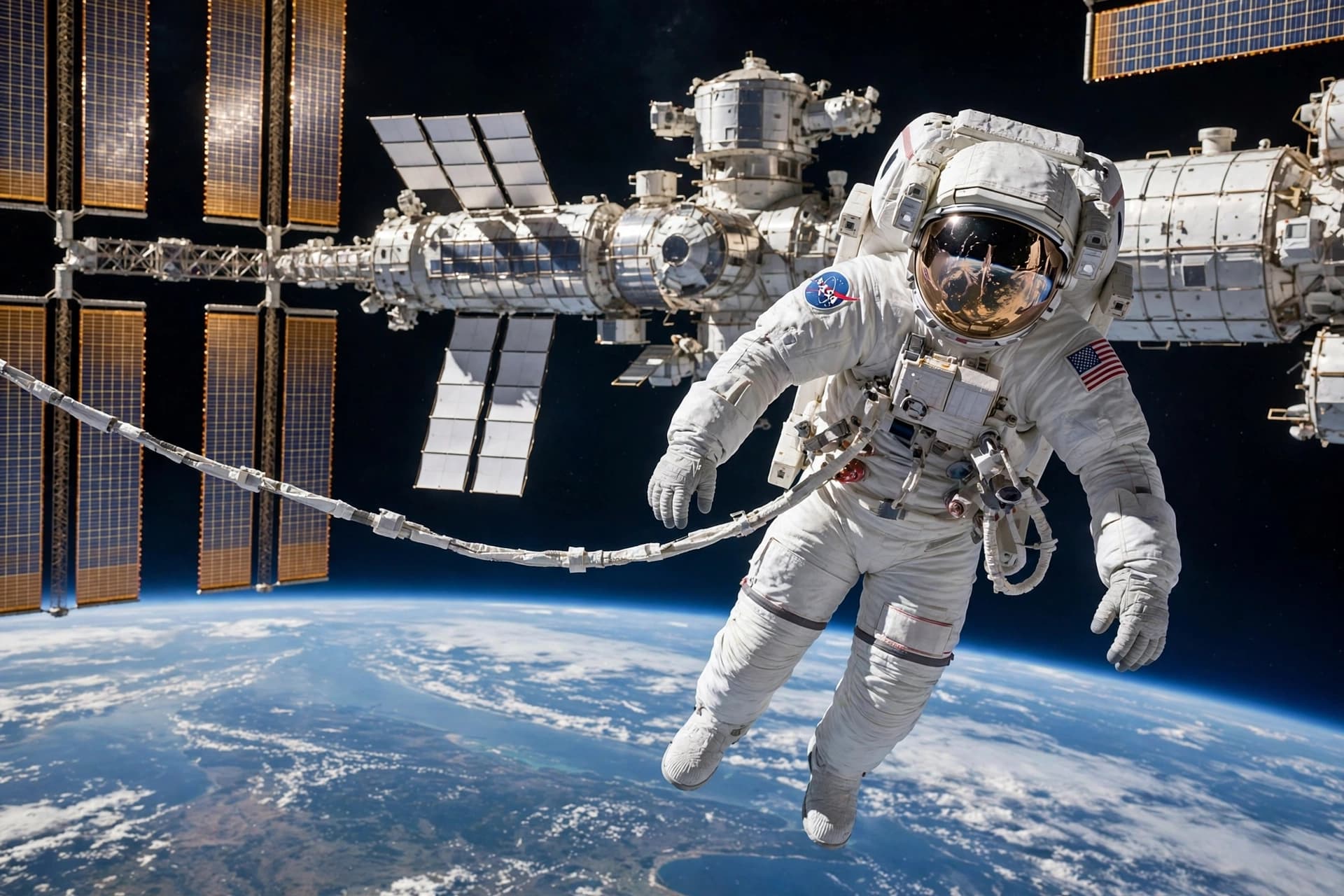
There is a moment, before a first step outside, when the world narrows to the suit and the tether and the quiet voice of someone on the ground. For Canadian Space Agency astronaut Joshua Kutryk, that moment is approaching. Onboard the International Space Station since October 1, Kutryk is scheduled to perform his first two spacewalks on October 29 and November 5, joining NASA astronaut Anil Menon to install the final roll-out solar arrays that will complete the station's power augmentation upgrades .
The task is specific and consequential. The two spacewalks will install and deploy the seventh and eighth International Space Station Roll-Out Solar Arrays, known as IROSAs, on the station's truss structure. When the work is done, the station's power generation capacity will have increased from 160 kilowatts to approximately 215 kilowatts, an increase of up to 30 percent . The additional power will support ongoing scientific operations and, in the longer view, the systems needed for the station's eventual safe deorbiting .
For Kutryk, the spacewalks represent a milestone both personal and national. He will become the fifth Canadian astronaut to venture outside a spacecraft while in orbit . The preparation has been meticulous. Last week, he and Menon spent time in the Quest airlock organizing tools, inspecting tethers, and cleaning spacesuit helmets. They outfitted suits with communications gear and medical monitoring hardware, and they reviewed the procedures they will use to maneuver outside the station, retrieve the solar arrays, and install them .
The operation is a collaboration that extends beyond the two astronauts in the suits. NASA astronauts Jessica Watkins and Luke Delaney will operate Canadarm2 from inside the station, using the robotic arm to move the rolled-up arrays from the Dragon cargo spacecraft's trunk to their installation locations . The Canadian Space Agency's flight control and engineering teams have designed the unique sequence required from Canadarm2, and they will be on console in Longueuil, monitoring the operations in real time. CSA astronaut Jenni Gibbons will serve as capcom from NASA's Johnson Space Center, the primary voice linking the crew to the ground .
The IROSA arrays themselves are a clever piece of engineering. Unlike the station's original solar panels, which were designed to be fully deployed at launch, the roll-out arrays are compact during transport and unfurl once in orbit. This allows new capacity to be integrated onto an existing infrastructure without replacing the original system entirely . The first six IROSAs have already been installed over the past several years, and the two remaining arrays will complete a program that has been methodically extending the station's life and capabilities.
There is a quiet symbolism in the timing. The station is entering the final phase of its operational life, and the power upgrades are not only for current science but for the controlled end that will eventually come. The additional energy will help sustain the systems needed for a safe deorbit, a reminder that even in its twilight, the station requires care and investment . Kutryk's first steps outside will thus be part of a longer story, one that began with the station's assembly and will end with its deliberate, graceful return to Earth.
For now, the preparations continue. The suits are being fitted, the procedures reviewed, the teams on the ground are in place. On October 29, a hatch will open, and a Canadian will step into the vacuum for the first time. The work will be careful and deliberate, the product of years of training and the collaboration of many hands. And when the arrays are finally deployed, the station will have a little more power, a little more capacity, and a little more time to do the work it was built to do.
---
Image Disclaimer: The images in this article are AI-generated and are not photographs of actual spaceflight operations.
Sources: Canadian Space Agency, NASA, Economia dello Spazio Magazine
Published by Banx Network. This article is part of the Banx decentralized media programme, powered by the BXE token on the XRP Ledger.