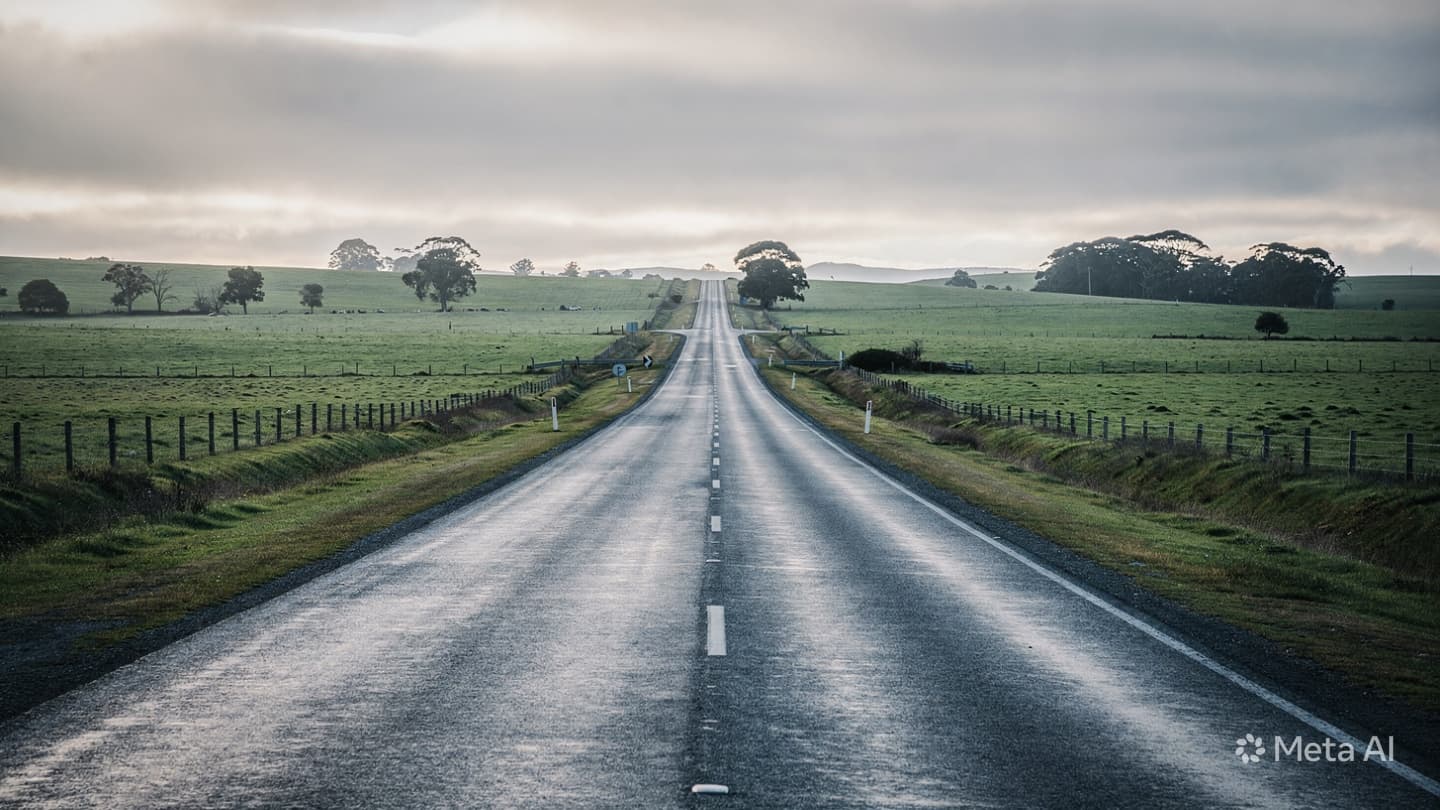
The morning light stretched thin across the Hauraki landscape, painting the horizon in soft, muted tones that promised a standard, uneventful day. The air held that peculiar, crisp stillness often found in the rural stretches where the land gives way to the sea. It was a scene composed of steady rhythms—the gentle rustle of wind through grass, the distant hum of progress, and the predictable flow of life moving along the veins of the earth. Everything appeared to exist in its customary, undisturbed state until the sudden, sharp fracture of silence that redefined the morning.
In the span of a single heartbeat, the world shifted. Motion halted, and the ordinary trajectory of the road became a site of profound interruption. Where there was once the steady movement of a vehicle traversing the landscape, there was suddenly the stark, unyielding presence of a scene transformed by tragedy. The passage of time seemed to thicken, pressing against the surroundings as emergency responders converged, their presence a somber punctuation mark on the open expanse of the highway.
The road itself, usually a vessel for the mundane rituals of travel, bore witness to an event that stripped away the triviality of the daily commute. There is a specific, haunting quality to these moments—a sudden cessation of the ordinary that forces the observer to acknowledge the fragility of the paths we tread. The surrounding geography, quiet and indifferent, offered no solace to the sudden reality of loss. It simply remained, a backdrop to the unfolding narrative of a life abruptly concluded in the early hours of a Saturday.
As authorities began the methodical, delicate work of examination, the highway became a place of containment. Barriers were placed with precision, effectively isolating the space from the flow of the world beyond. The closure of the route was more than a logistical necessity; it was a physical boundary between the life that had been and the silence that now occupied that stretch of bitumen. The Hauraki plains, vast and expansive, seemed to shrink to the singular focal point of the crash site.
There is a quiet, heavy gravity inherent in these investigations. Specialists moved with a measured pace, their actions dictated by the solemn responsibility of understanding the final moments of a journey. Every measurement and every assessment was a silent acknowledgment of the person lost, a testament to the fact that a narrative had been cut short. The wind continued to stir the landscape, unaware of the stillness that had settled over this particular patch of earth.
In the aftermath of such events, the atmosphere becomes heavy with unspoken questions. The mechanics of a collision are often simple, yet the implications remain vast and deeply unsettling. We move through our days with the assumption of continuity, forgetting how easily the fabric of our existence can be torn by a brief deviation or an unforeseen circumstance. The road, which acts as a bridge between points, became, for a time, a destination of profound, irreversible finality.
The community, gathered at a distance or observing from the periphery, felt the ripple of this event. In the small, interconnected spaces of the region, news of a fatality travels with a quiet, somber weight. It is a reminder that these incidents are not merely data points in an official report, but are woven into the collective memory of the area. Each individual passing through the vicinity carried the awareness of the tragedy, a shared knowledge that softened the usual pace of the day.
As the sun tracked across the sky, the investigation continued in the shadow of the Hauraki hills. The investigators, tasked with articulating the story of the crash, moved through their duties with a focused, professional silence. They were the bridge between the sudden chaos of the morning and the necessary, clinical clarity that follows. Behind their work lay the fundamental human urge to comprehend, to make sense of the senseless, and to provide answers where there is mostly just the echoing silence of a life ended too soon.
The collision, occurring in the vicinity of Maramarua, has resulted in a single fatality. State Highway 25 was closed between Canal East Road and Pouarua Road North to allow the Serious Crash Unit to conduct a scene examination. Police are investigating the circumstances surrounding the incident, and the road has since been cleared for public use following the completion of the formal on-site inquiry.
Published by Banx Network. This article is part of the Banx decentralized media programme, powered by the BXE token on the XRP Ledger.