
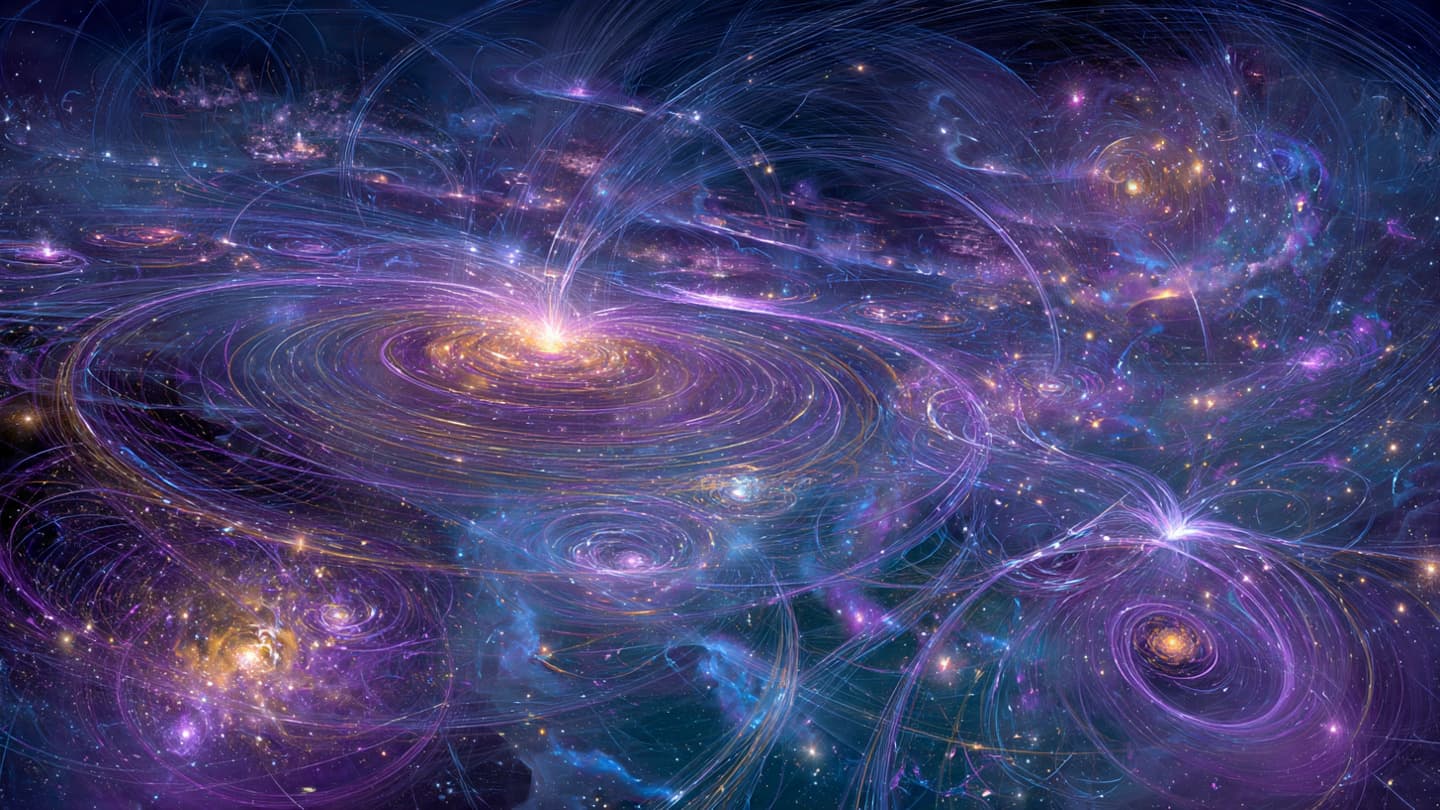
The universe is often imagined as a vast darkness punctuated by light, yet between those points of light lies an unseen structure that shapes motion, energy, and form. Magnetic fields, though invisible to the eye, weave through this expanse like faint threads holding galaxies within a larger cosmic fabric.
A new large-scale mapping effort, supported by radio and observational data, has significantly expanded understanding of interstellar and intergalactic magnetic fields. Projects involving facilities such as the and the have contributed to this growing picture of cosmic magnetism.
The resulting map, described as several times larger than previous compilations, reveals how magnetic fields extend far beyond individual galaxies, connecting regions of space in complex and often subtle ways. These fields influence the movement of charged particles and help shape the evolution of cosmic structures over time.
By analyzing polarized light and radio emissions, researchers can infer the strength and orientation of these magnetic fields. This technique allows scientists to reconstruct structures that cannot be seen directly, turning indirect signals into a coherent spatial model.
The expanded dataset also provides new opportunities to study how galaxies interact with their surrounding environments. Magnetic fields may play a role in regulating star formation and guiding cosmic rays as they travel across intergalactic distances.
As observational tools improve, the resolution of these magnetic maps continues to sharpen, revealing finer patterns that were previously indistinguishable. Each improvement adds depth to the understanding of how matter and energy move through the universe.
This work builds on decades of research published in journals such as Nature Astronomy and The Astrophysical Journal, reflecting a long-term effort to chart not only visible space, but also its hidden forces.
The latest magnetic field map offers a reminder that even the most distant regions of the universe are connected by structures that remain largely invisible, yet fundamentally influential in shaping cosmic evolution.
AI Image Disclaimer Some visual representations of cosmic magnetic structures may be AI-generated for illustrative clarity.
Source Verification Check Nature Astronomy, Science, The Astrophysical Journal, ESO publications, LOFAR collaboration reports
Published by Banx Network. This article is part of the Banx decentralized media programme, powered by the BXE token on the XRP Ledger.



