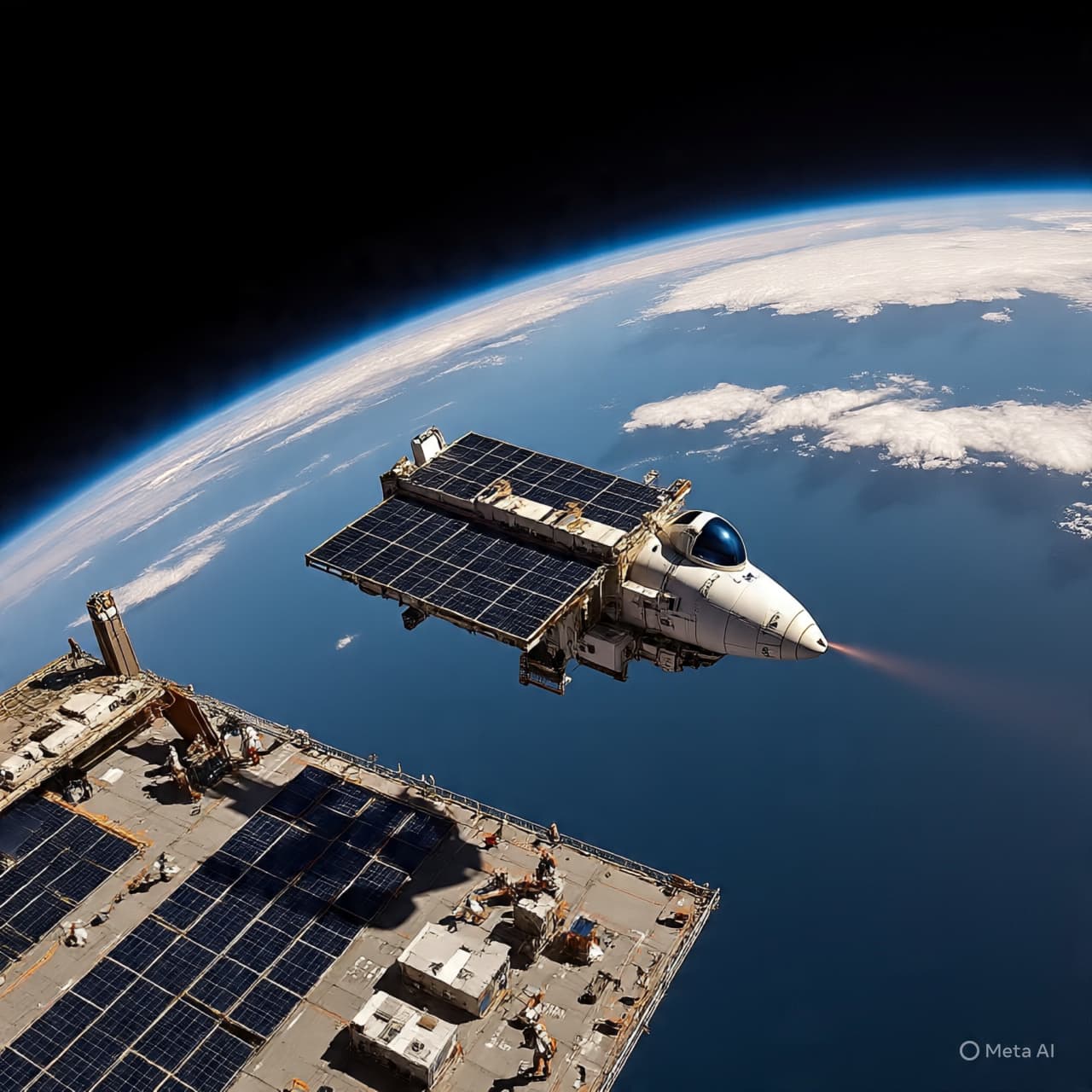
There is a certain anticipation that builds not with noise, but with alignment. In orbit, milestones do not announce themselves with fireworks; they arrive in measured increments, guided by physics and patience. Docking day is one of those moments — quiet in sound, immense in significance — when a journey through fire and atmosphere gives way to the delicate art of approach.
Today marks docking day for the astronauts of the mission, traveling aboard a capsule launched by . After liftoff atop a Falcon 9 rocket and a carefully calculated orbital chase, the spacecraft is set to rendezvous with the , where a new chapter of scientific work awaits.
The hours leading up to docking are defined by precision. Dragon performs a series of engine burns, gradually raising and refining its orbit to match that of the ISS. Both vehicles travel at roughly 17,500 miles per hour, circling Earth every 90 minutes. To meet in such motion requires choreography shaped by years of engineering and rehearsed countless times in simulation.
For the Crew-12 astronauts, docking represents transition. Launch carries the drama of ascent; docking carries the discipline of arrival. Once the spacecraft reaches the station’s vicinity, onboard systems take over much of the alignment process, while mission control teams monitor telemetry from the ground. Every step — from approach to soft capture to hard mate — follows established protocols designed to ensure safety and reliability.
The International Space Station remains a hub of multinational collaboration, supported by NASA and its global partners. Each new crew rotation sustains research that spans biology, medicine, materials science, and Earth observation. Experiments conducted in microgravity often explore questions difficult to answer under gravity’s constant pull, offering insights with applications both in space and on Earth.
Crew-12 will relieve colleagues who have spent months aboard the station, maintaining its systems and advancing ongoing investigations. The handover period allows for continuity, with overlapping crews sharing knowledge before departing astronauts return home aboard a separate capsule.
In recent years, SpaceX missions have established a steady cadence of human spaceflight under NASA’s Commercial Crew Program. Reusable rockets and spacecraft have helped shape a new era in which launches, once rare, now follow a more regular rhythm. Yet even in that rhythm, docking day retains a sense of ceremony — a reminder that the margin between distance and contact is measured in inches.
As Dragon closes the final gap, cameras aboard the ISS are expected to capture the moment of contact. Once docking is confirmed and pressure equalization is complete, hatches will open and greetings will follow in microgravity, where embraces drift and flags float weightlessly.
NASA and SpaceX officials indicate that operations are proceeding as planned, with docking scheduled within the designated window. Barring unexpected developments, the Crew-12 astronauts will soon begin their integration into station activities. Above the turning Earth, another careful arrival is set to become part of the quiet continuum of exploration.
AI Image Disclaimer: Graphics are AI-generated and intended for representation, not reality.
Sources: Reuters BBC CNN The New York Times Politico
Published by Banx Network. This article is part of the Banx decentralized media programme, powered by the BXE token on the XRP Ledger.