There are moments in exploration when humanity seems to hold its breath — when a drill bit piercing ice becomes more than an instrument of science, and instead feels like a key turning slowly in a lock that guards Earth’s deep past. Far from the bustle of everyday life, deep within the frozen reaches of Antarctica, a remarkable scientific milestone has unfolded, one that is helping researchers listen to Earth’s ancient whispers.
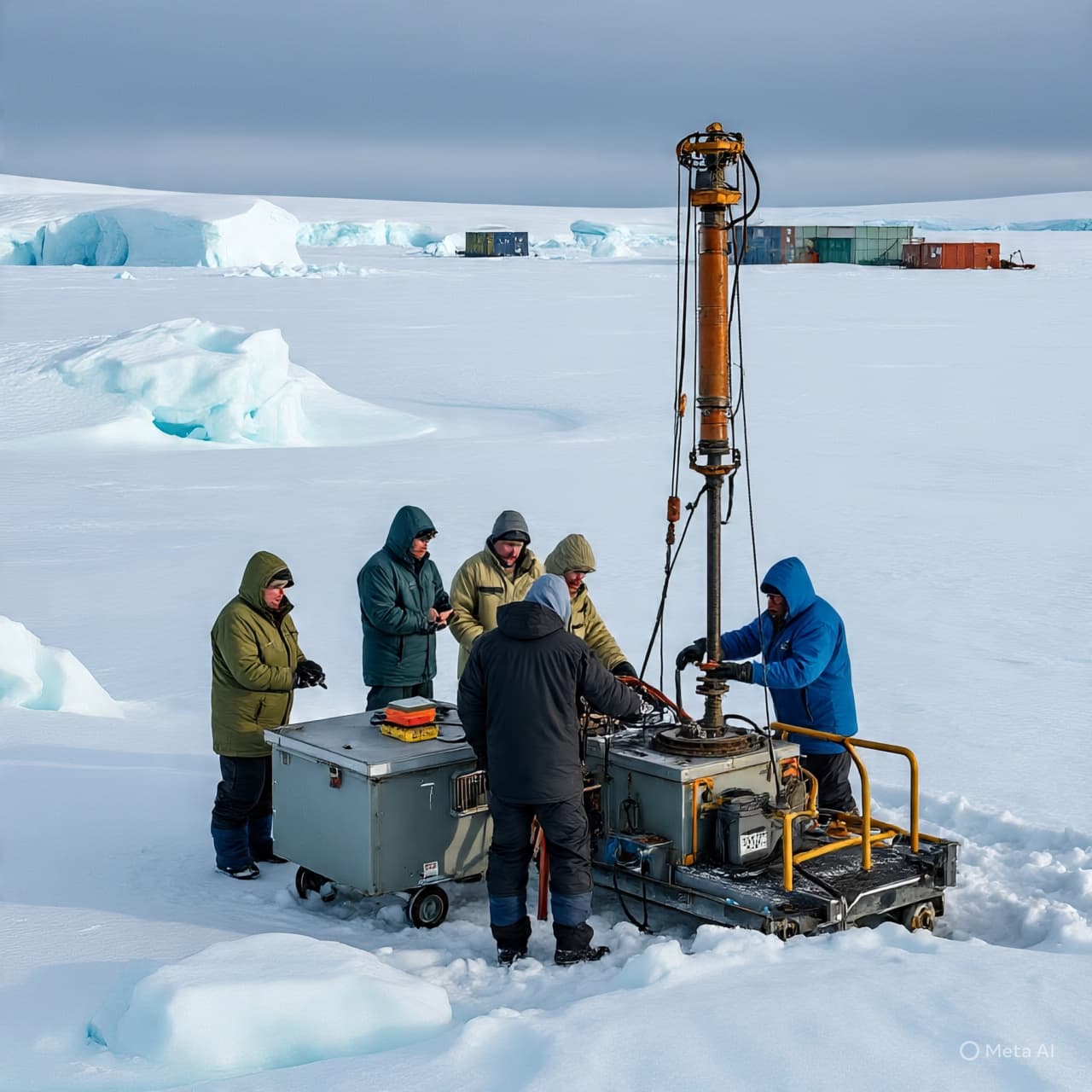
In a remote and wind‑swept field camp at Crary Ice Rise along the edge of the West Antarctic Ice Sheet, an international team of scientists has achieved what many thought nearly impossible: drilling deeper beneath the ice than ever before to retrieve a sediment core that stretches back millions of years. This historic effort pierced over 523 meters of ice and more than 200 meters of ancient sediment, creating a continuous archive of environmental change dating as far back as 23 million years ago.
The achievement is not simply one of engineering endurance in one of Earth’s harshest climates. Beneath the layers of ice and rock locked there are remnants of past worlds — traces of ancient oceans, fragments of shells and microscopic fossils that tell a story of times when this now glacial landscape was, at least in part, open to the sea. These sediments serve as nature’s own recording system, capturing conditions of warmth and relative chill, ebb and flow, that occurred long before humans walked the planet.
Scientists involved in the Sensitivity of the West Antarctic Ice Sheet to 2°C (SWAIS2C) project describe the find as a kind of geological Rosetta Stone. By comparing the layers of sediment with known periods of Earth’s climatic past, researchers hope to uncover how the vast West Antarctic Ice Sheet responded to rising temperatures — and how it might respond again in a warming future. Temperature thresholds, melt patterns, and the presence or absence of ice shelves in ancient eras could provide valuable benchmarks for understanding today’s accelerating changes.
One of the early surprises from the project was the direct evidence within the core of environmental conditions that included open ocean environments beneath regions now cloaked in ice, suggesting that parts of the ice sheet once retreated far more than previously confirmed. For scientists seeking to improve models of future sea‑level rise — potentially as much as 4 to 5 meters if the entire West Antarctic Ice Sheet melts — this empirical evidence offers an invaluable reality check on theoretical projections.
Such drilling required meticulous planning and collaboration among researchers from ten countries, as well as innovative use of hot‑water drilling techniques to melt through millennia of accumulated ice. The remote location — over 700 kilometers from the nearest staffed research station — added layers of logistical complexity, from transporting equipment across the frozen plateau to managing field conditions that can shift rapidly with the Antarctic weather.
While the initial core samples are already being analyzed, they will soon be transported to laboratories for detailed study. There, scientists will use fossil records, sediment composition, and advanced dating techniques to refine their understanding of ancient climates and the timing of ice retreats. Each layer of sediment is a chapter in Earth’s long story, waiting to be read.
For climate scientists, this project represents both a leap forward and a reminder of how much remains unknown. Early indications that warm periods in the past drove ice retreat in ways similar to projections for the future underscore the urgency of understanding thresholds in Earth’s climate system. The more we understand about natural variability and past transitions, the better equipped humanity may be to anticipate and perhaps mitigate dramatic shifts ahead.
Yet beyond its scientific promise, there is something deeply human about this achievement: the persistent curiosity that drives people to seek knowledge in the world’s most unforgiving places, and the humility to let nature’s record speak where human memory cannot reach.
In summary, a record‑breaking drilling project beneath the West Antarctic Ice Sheet has yielded a sediment core dating back millions of years. The discovery of ancient ocean indicators beneath the ice offers new clues about past climate conditions and could help refine predictions of how ice sheets respond to future warming. The project’s findings will inform ongoing research into climate change and sea‑level rise.
AI Image Disclaimer Illustrations were produced with AI and serve as conceptual depictions.
Sources ScienceAlert (AFP) Nature (Nature.com) Swissinfo.ch National Today Surf Coast News
Published by Banx Network. This article is part of the Banx decentralized media programme, powered by the BXE token on the XRP Ledger.