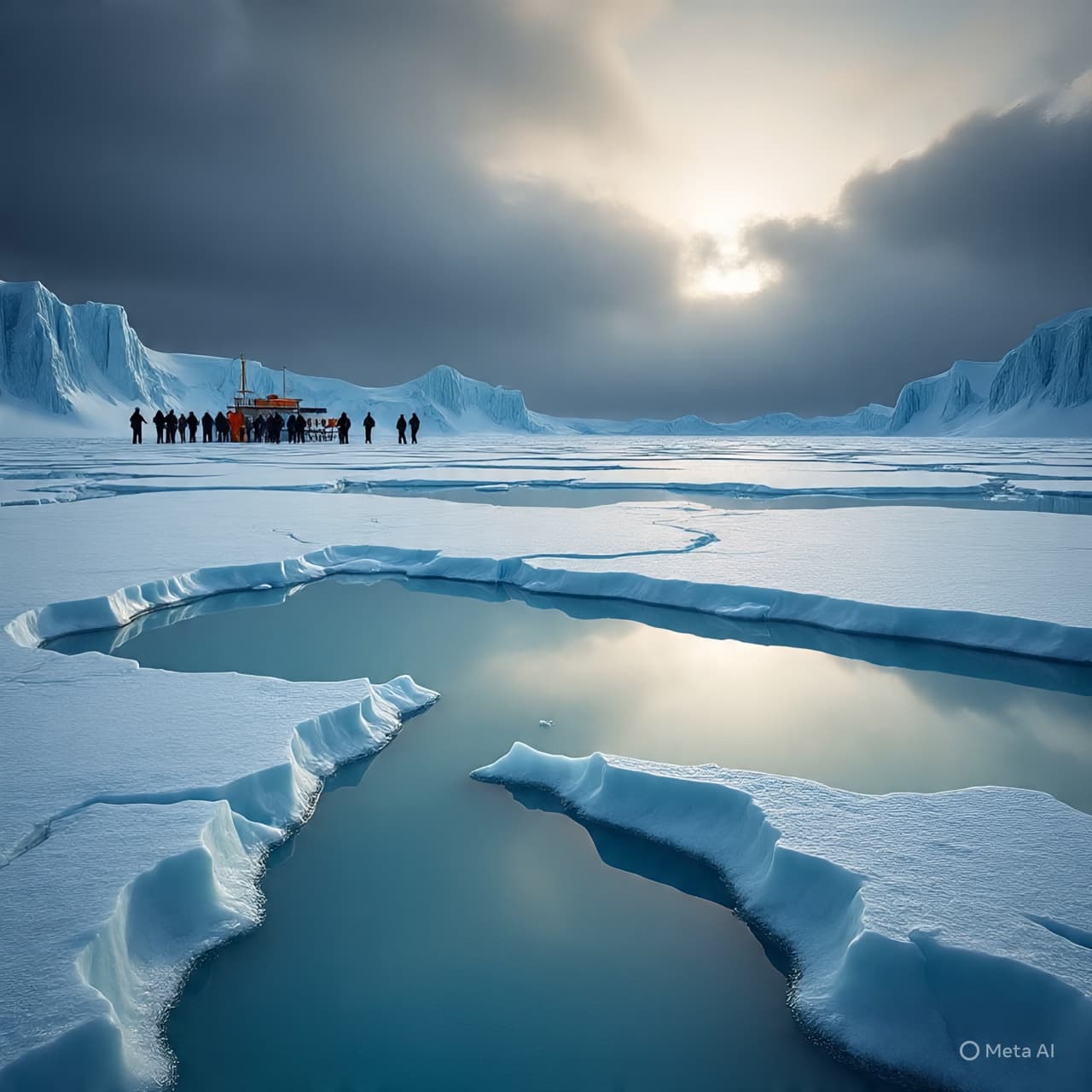
There are places on Earth that feel almost timeless. Antarctica is one of them. Vast, white, and silent, the continent has long stood apart from the restless pace of the rest of the planet—a frozen archive where snow falls slowly and the rhythms of nature seem to move at a different speed.
For generations, Antarctica has been imagined as the ultimate world of ice. Snow settles gently across its enormous landscape, winds carve patterns across glaciers, and temperatures remain so low that liquid rain is nearly unknown across most of the continent.
Yet scientists are beginning to observe subtle signs that even this distant place may not remain untouched by a warming world.
Recent research suggests that rising global temperatures could bring an unexpected change to Antarctica’s climate: more rain. While snow will remain the dominant form of precipitation across the continent, warmer conditions may increasingly allow rainfall to occur, particularly along the Antarctic Peninsula and coastal regions.
In a place defined by ice, the difference between snow and rain carries consequences far beyond the sky.
Snow tends to accumulate quietly on the surface of glaciers and ice shelves, gradually compressing into layers that help maintain Antarctica’s immense ice sheet. Rain, however, behaves differently. Liquid water can seep into cracks, pool on the surface, and in some cases accelerate the weakening of ice structures that have remained stable for centuries.
Scientists studying Antarctic climate patterns say that warming air temperatures make rain events more likely, especially during the summer months. Even small increases in temperature can push atmospheric conditions above the freezing point, allowing precipitation that once fell as snow to arrive instead as rain.
These shifts are already being recorded in certain regions. The Antarctic Peninsula—one of the fastest-warming areas on Earth—has experienced occasional rainfall events in recent decades. While still relatively rare, such episodes provide clues about how the continent’s climate may evolve as global temperatures continue to rise.
The implications extend beyond individual storms.
Rainfall can darken the surface of snow and ice, reducing its natural ability to reflect sunlight. This effect, known as reduced albedo, allows more solar energy to be absorbed by the surface, potentially accelerating melting in localized areas. Pools of meltwater can also form on ice shelves, sometimes leading to structural weakening.
Researchers often point to the dramatic collapse of the Larsen B Ice Shelf in 2002 as an example of how meltwater can destabilize large sections of ice. While many factors contributed to that event, surface water played a role in widening fractures that eventually caused the shelf to break apart.
If rainfall becomes more common, scientists say similar processes could occur more frequently.
At the same time, Antarctica remains a vast and complex system. Conditions vary dramatically between the continent’s interior plateau, where temperatures remain far below freezing year-round, and its outer coastal regions, where ocean influences bring milder conditions.
For this reason, researchers emphasize that rainfall will not suddenly transform Antarctica into a rainy landscape. Snow will continue to dominate across most of the continent for the foreseeable future. Instead, scientists expect gradual changes that unfold unevenly across different regions.
Understanding those changes is one of the central challenges for climate science today.
Antarctica holds roughly 90 percent of the world’s ice and around 70 percent of its freshwater. The stability of its ice sheets plays a major role in regulating global sea levels. Even modest shifts in how ice forms, melts, or flows can ripple outward through the global climate system.
Researchers are therefore closely monitoring atmospheric patterns, ocean temperatures, and precipitation trends across the continent. Satellites, weather stations, and long-term climate models help scientists track how Antarctica responds to the broader warming of the planet.
For now, the continent remains largely what it has always been: a vast landscape of ice shaped by cold winds and falling snow.
But in a warmer world, even the quietest places can change in subtle ways.
As scientists continue observing the skies above Antarctica, the appearance of rain—once nearly unthinkable there—may become one of the signals that the planet’s most remote continent is slowly entering a new chapter of its climate story.
AI Image Disclaimer Illustrations were produced with AI and serve as conceptual depictions.
Source Check Credible mainstream / niche media covering this issue:
The Guardian BBC News National Geographic Scientific American Nature
Published by Banx Network. This article is part of the Banx decentralized media programme, powered by the BXE token on the XRP Ledger.