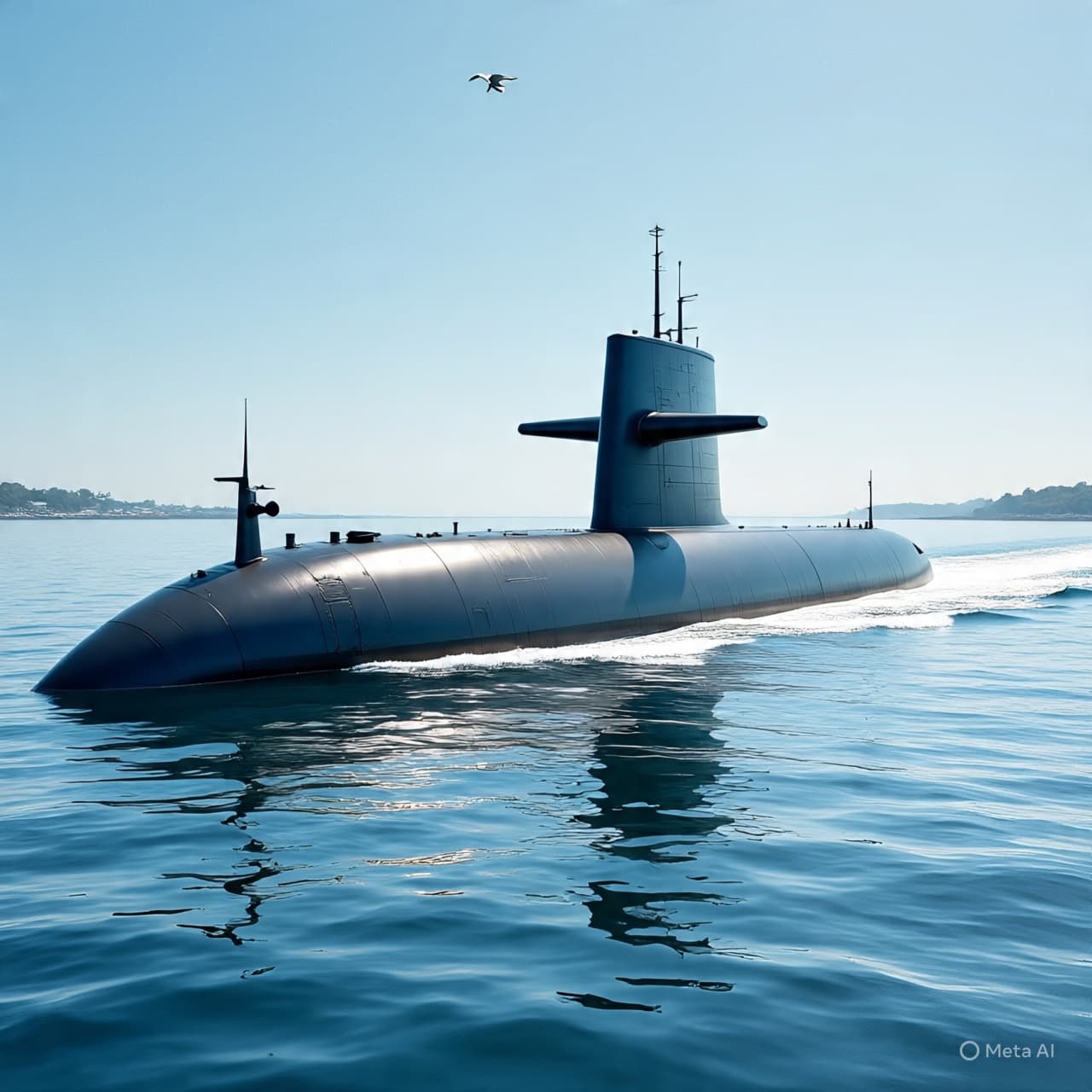
In the calm before a long voyage, sailors often turn their eyes to the horizon and reflect on the course ahead. The sea may be placid, but the promise of distant waters invites both anticipation and contemplation. In much the same way, a new report in Washington has stirred a moment of reflection about one of the most ambitious defence partnerships of recent decades — AUKUS, the trilateral pact binding Australia, the United Kingdom, and the United States in a shared vision of security beneath the waves.
For years, AUKUS has promised to reshape naval might in the Indo-Pacific by helping Australia acquire nuclear-powered submarines — first by buying U.S. Virginia-class boats and later building a new class of submarines with British and Australian cooperation. Yet, a report prepared by the U.S. Congressional Research Service has quietly raised a striking notion: what if, under certain circumstances, no Virginia-class nuclear submarines were delivered to Australia at all? The idea is not a call for immediate policy change, but rather one of several options laid out in discussions in Washington about how best to balance strategic needs with industrial capacity.
At its heart, the report underscores a practical concern that has shadowed the AUKUS submarine plan almost from the start. The United States, the world’s most experienced operator of nuclear-powered submarines, has a finite shipbuilding industrial base — and that base is already stretched. With its own submarine fleet priorities, along with concerns about regional tensions, particularly over Taiwan, lawmakers and defence analysts have begun to ask whether diverting submarines to Canberra could leave the U.S. Navy short-handed in times of crisis. One option explored in the congressional research is keeping the submarines under American command while operating them from Australian ports, or redirecting Australian funds toward other defence capabilities such as long-range missiles or drones.
This line of inquiry may feel like a gentle shift of course rather than a sharp turn. Like captains weighing competing currents, lawmakers are considering a range of scenarios that reflect both alliance commitments and emerging realities. The AUKUS deal itself was designed not just as a submarine transfer programme but as a long-term partnership to foster deeper integration in technology, training, and deterrence. In that spirit, the discussion in Congress does not reject AUKUS outright, but rather invites thoughtful debate about how best to implement it under changing strategic and industrial conditions.
For Canberra, this moment of reflection has been met with measured reassurance. Australian officials have acknowledged receiving a U.S. review of the AUKUS submarine programme, while affirming that the broader partnership remains on track and continues to be pursued as envisioned. There remains a shared recognition among the allies that deterrence in the Indo-Pacific is a complex, multifaceted endeavour — and submarines are but one part of a larger tapestry of military capability.
Yet the very fact that alternatives to the submarine deliveries are being publicly discussed by a U.S. congressional arm speaks to the balancing act that modern defence policy must perform: respecting alliance commitments while confronting industrial capacity limits, fiscal constraints, and evolving geopolitical pressures. The notion of not delivering the submarines is not a declaration of abandonment, but rather part of a broader conversation about strategic flexibility and shared burden-sharing.
As policy-makers in capitals and parliaments weigh these threads, the wider tapestry of security cooperation remains intact. Australia continues its commitments to build its own future submarine force under the trilateral partnership, and the United States and the United Kingdom reaffirm their collective intent to enhance regional stability. In this gentle moment of reassessment, both the promise of AUKUS and the realities of global politics remind us that alliances evolve not through fixed scripts, but through ongoing dialogue and mutual adaptation.
In straightforward terms, a recent U.S. Congressional Research Service report has explored the possibility that the United States might not deliver any Virginia-class nuclear submarines to Australia under the AUKUS agreement, citing concerns about U.S. industrial capacity and strategic priorities. The report presents this as one option among several for lawmakers to consider, including alternative uses of defence resources and shared operational arrangements. Australian officials have acknowledged receipt of a U.S. review of the AUKUS submarine programme and continue to affirm their commitment to the broader security partnership.
AI Image Disclaimer (Rotated Wording)
Graphics are AI-generated and intended for representation, not reality.
Sources (news media names only):
• The Guardian
• Reuters (background on AUKUS challenges)
• ABC News (context on AUKUS review)
• The Guardian Australia Politics Live (live updates integrating the report)
• Taipei Times (reflecting allied reporting on AUKUS submarines)
Published by Banx Network. This article is part of the Banx decentralized media programme, powered by the BXE token on the XRP Ledger.