
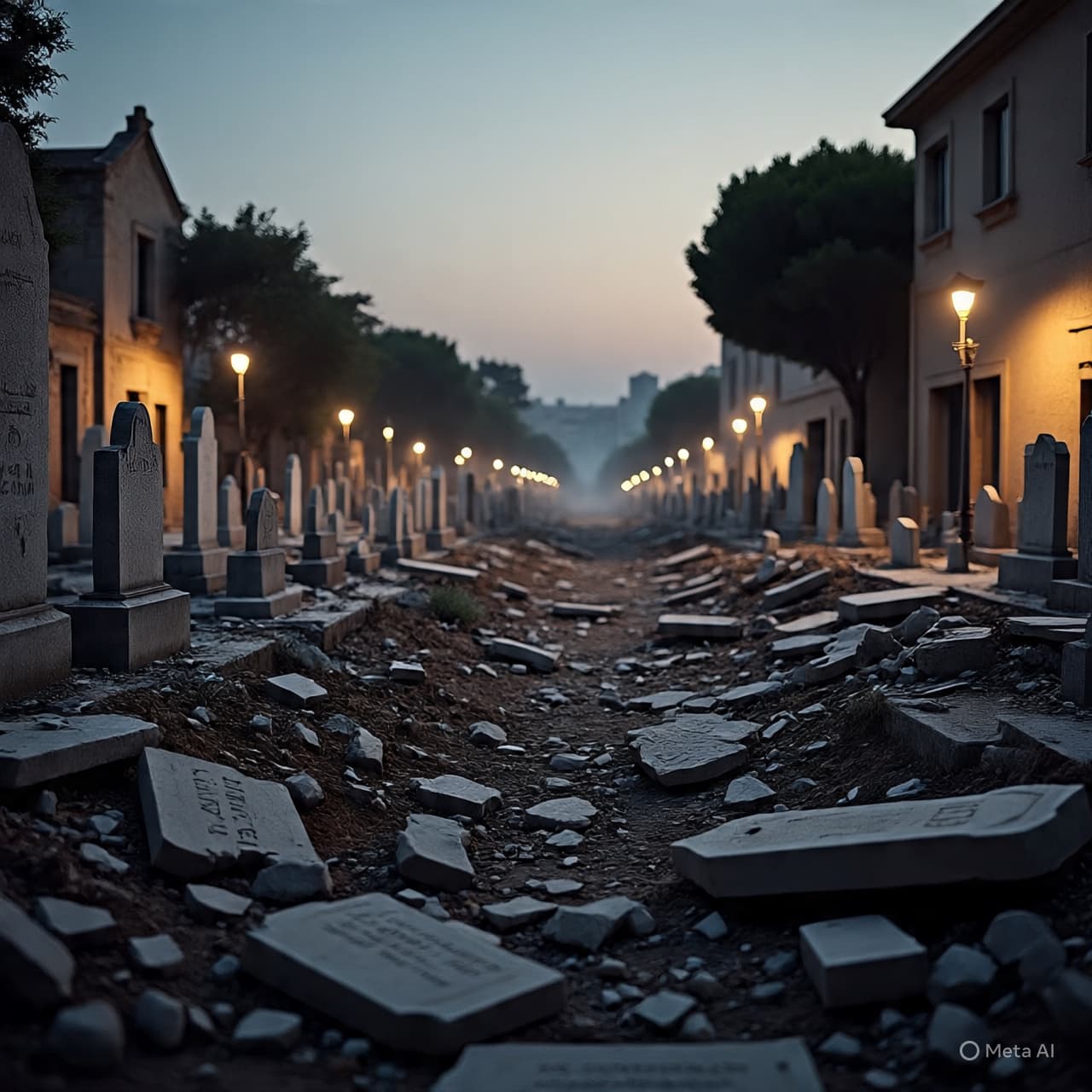
In Gaza, grief is rarely allowed to settle. It moves instead, disturbed by new sounds, new losses, new absences. Even the rituals meant to mark an ending — a burial, a prayer, a quiet moment at the earth — have become unstable, subject to the same violence that reshapes streets and homes.
In recent days, Palestinians have reported damage to cemeteries and burial sites amid Israel’s ongoing military operations in Gaza. Graves were torn open by heavy machinery and explosions, remains exposed or displaced, compounding a sense that not even the dead were spared the reach of war. For families already stretched beyond endurance, the violation cut deeper than physical destruction alone.
International humanitarian law treats the dead with particular care, recognizing burial grounds as spaces of dignity, memory, and restraint. In Gaza, where land is scarce and cemeteries often sit close to homes, schools, and roads, those protections have proved fragile. Military operations have swept through neighborhoods where generations lie buried, folding the past into the present conflict.
Israel has said its actions are driven by security needs, including operations against militant infrastructure allegedly embedded in civilian areas. Palestinian officials and human rights groups dispute the scope and necessity of the damage, arguing that the destruction of graves serves no military purpose and inflicts collective trauma on a population already living with unrelenting loss.
For families, the pain is intimate and unresolved. In Gaza, burial is not merely a final act; it is a promise that the dead will be left in peace. When that promise is broken, mourning is forced to restart. Parents return to places they thought were settled. Names once spoken softly are pulled back into fear and anger.
The war has already erased homes, neighborhoods, and bloodlines. The disturbance of burial grounds has added another layer to the devastation — one that reaches backward as well as forward. It signals a collapse of boundaries that once separated the living from the dead, the battlefield from memory.
As Gaza continues to endure bombardment, displacement, and scarcity, the damage to its cemeteries stands as a stark symbol. Not of strategy or territory, but of a grief multiplied — where even the final resting place becomes another site of loss.
AI Image Disclaimer Images are AI-generated and intended as conceptual representations.
Sources Reuters United Nations agencies Palestinian civil authorities International human rights organizations
Published by Banx Network. This article is part of the Banx decentralized media programme, powered by the BXE token on the XRP Ledger.


