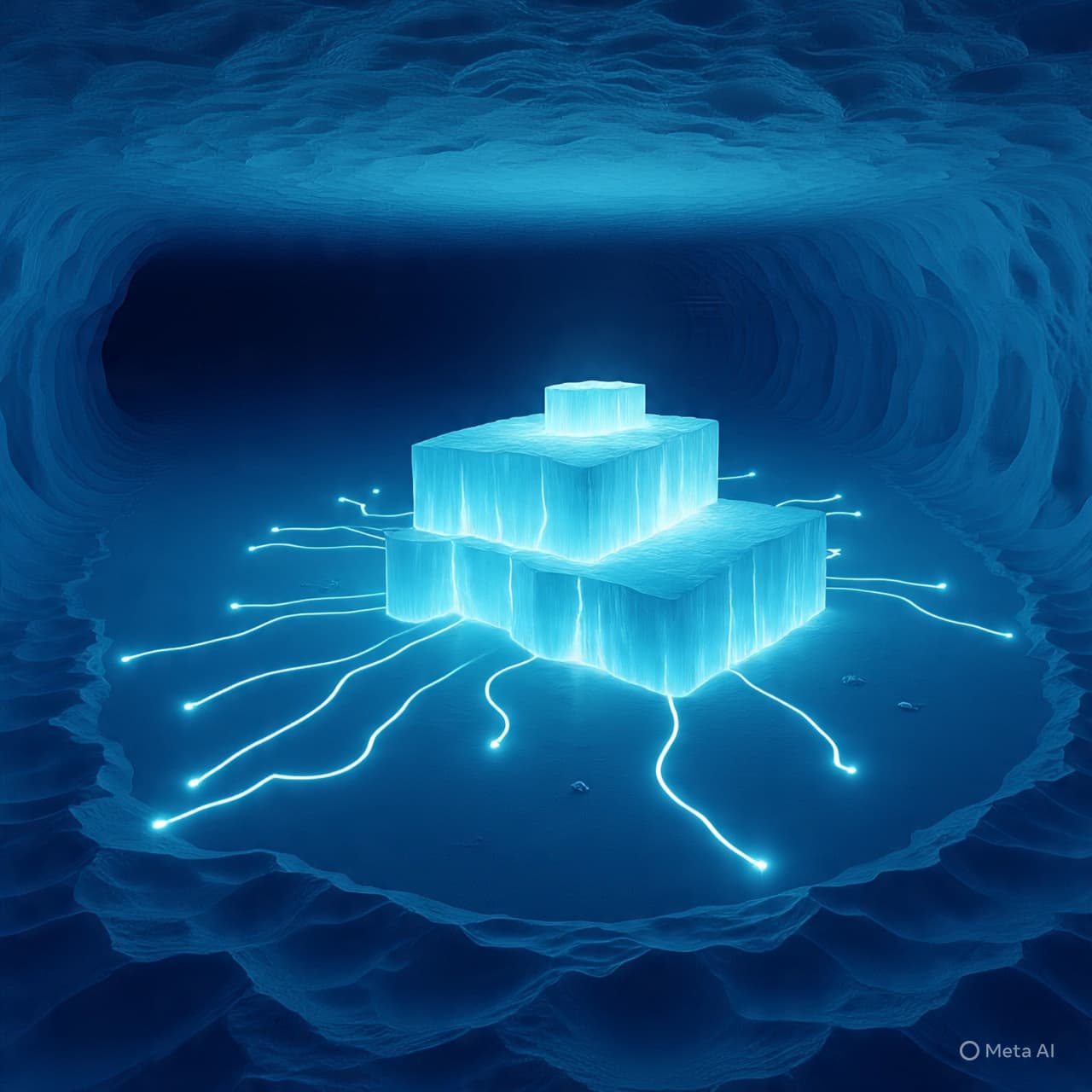
Far beneath the frozen surface of Antarctica, a unique scientific instrument listens to the universe in ways that few other observatories can — not with mirrors, lenses, or radio dishes, but with ice. The IceCube Neutrino Observatory, a vast array of light sensors embedded deep in Antarctic ice, has spent years detecting tiny, ghost-like particles called neutrinos that travel across space from the most energetic and distant corners of the cosmos. Now, after recent upgrades and analytical improvements, IceCube scientists say the experiment is poised to uncover yet more secrets about the universe — from elusive cosmic sources to the fundamental nature of matter itself.
Neutrinos are extraordinarily hard to catch. Produced in nuclear reactions inside stars, in supernovae, around black holes and during cosmic ray collisions, they interact so weakly with ordinary matter that trillions pass through your body every second without a trace. IceCube’s mission is to spot the rare occasions when a high-energy neutrino does interact with a molecule of ice, producing a flash of light that sensors deep in the ice can record. Over time, these flashes become a map of particles arriving from all directions, carrying information about phenomena far beyond Earth.
The observatory’s location is no accident. Antarctica’s clear, stable ice provides an ideal medium for tracking the faint light left by neutrino interactions. Thousands of optical modules — each roughly the size of a basketball — are buried at depths between 1.5 and 2.5 kilometers, forming a cubic kilometer of instrumented ice. This “transparent telescope” allows scientists to reconstruct the paths of neutrinos and infer their energies and possible origins.
Since its first detection of high-energy cosmic neutrinos, IceCube has already reshaped how astronomers think about the universe’s most powerful accelerators. In 2018, the experiment collaborated with other observatories to link a specific class of neutrinos to a known active galaxy, suggesting that distant supermassive black holes might act as cosmic particle engines. That moment marked one of the first times neutrinos helped point back to a source, rather than simply being counted statistically.
With updated analysis techniques and enhanced data collection, the IceCube team now seeks to go even further. Among the goals are identifying more cosmic neutrino sources, probing the mechanisms that generate extreme energies in the universe, and testing whether neutrinos behave in ways that challenge current physics models. For example, scientists are curious about whether neutrinos violate certain symmetries — subtle fingerprints of new physics that could explain mysteries like the imbalance of matter and antimatter in the universe.
But the story is not just about particles or charts. It is about how human ingenuity can turn the most unlikely corner of the planet into a window on phenomena billions of light-years away. The same ice that feels so still and silent to explorers on the surface becomes, in the depths, a canvas for cosmic messages waiting to be read.
Even for those who may never visit the frozen expanse, IceCube’s work connects us to the larger universe. Each neutrino detected is a messenger that has journeyed across vast reaches of space and time, carrying clues about places we cannot see with ordinary light. As the experiment continues, scientists and the public alike watch with anticipation, wondering what new cosmic stories these tiny particles will whisper next.
AI Image Disclaimer Visuals are AI-generated illustrations and meant for concept only.
Sources
• Reporting from BBC News, Reuters, and Scientific American on the IceCube Neutrino Observatory’s ongoing research and upgrade efforts.
• Commentary from scientists and astrophysics communities on IceCube’s role in multimessenger astronomy.
Published by Banx Network. This article is part of the Banx decentralized media programme, powered by the BXE token on the XRP Ledger.