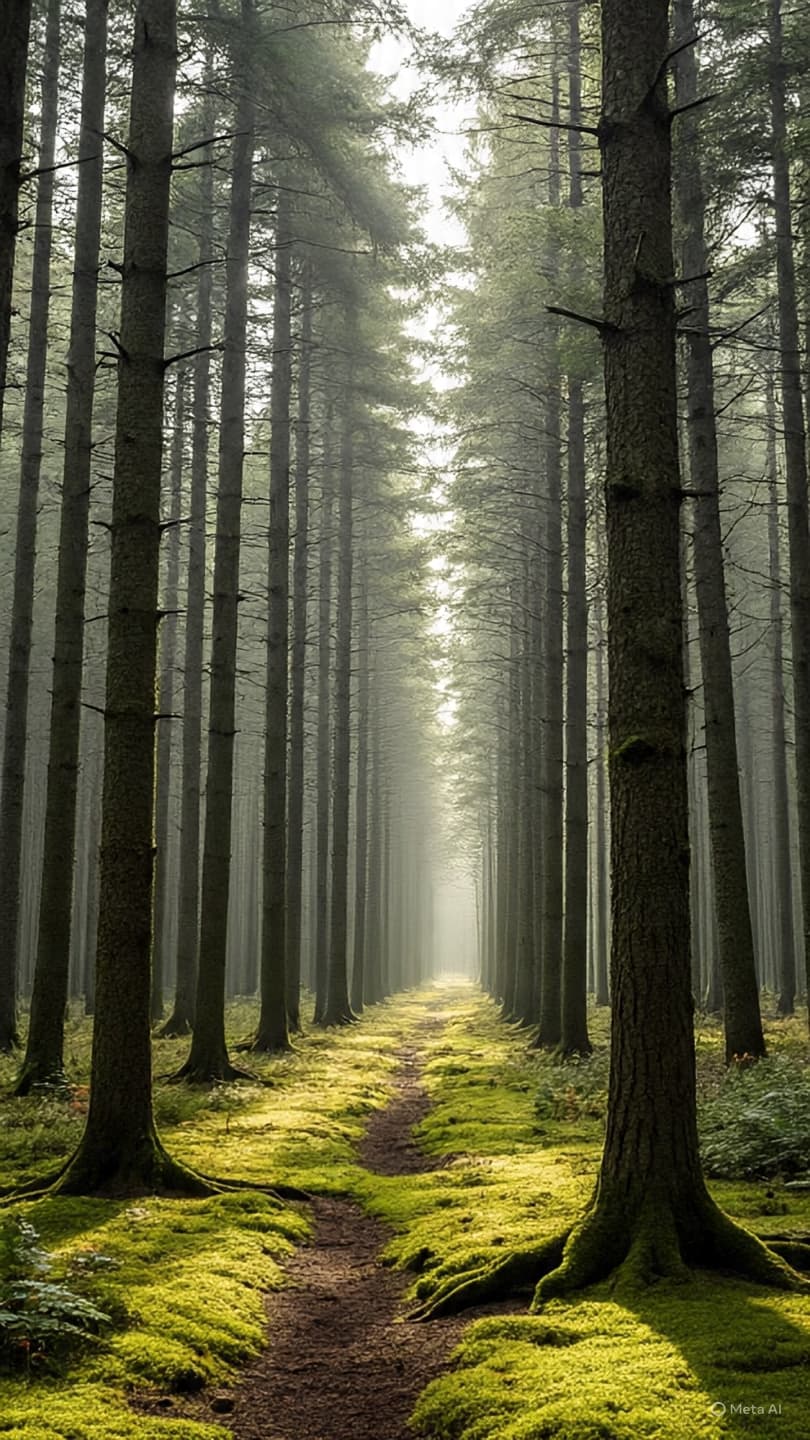
There are moments in science that arrive not with thunder, but with a quiet shift in how we listen to the world. A forest, after all, has always seemed like a place of steady rhythms—trees breathing in carbon, exhaling life, and holding the balance we so often take for granted. Yet sometimes, beneath that calm canopy, the story changes. And when it does, it invites us not to panic, but to pause and reconsider what we thought we understood.
In the forests of Sweden, researchers have recently encountered something that feels less like a sudden rupture and more like a subtle contradiction. For decades, forests have been regarded as reliable carbon sinks—vast, living reservoirs that absorb more carbon dioxide than they release. This assumption has shaped not only environmental policy but also the quiet hope that nature, if left undisturbed, will continue to steady the climate’s pulse.
But new observations suggest a more complicated narrative. In certain Swedish forest regions, the balance appears to be shifting. Instead of acting purely as absorbers, some forest ecosystems are releasing more carbon than expected. The change is not dramatic in appearance—there are no immediate visual cues, no fallen giants or scorched earth—but the measurements tell a different story, one carried in invisible exchanges between soil, air, and root.
At the heart of this discovery lies a delicate interplay of factors. Warmer temperatures, subtle shifts in soil moisture, and the decomposition of organic material all contribute to how carbon moves through a forest. When the ground warms, microbes become more active, breaking down stored organic matter and releasing carbon dioxide back into the atmosphere. What once lay quietly preserved beneath layers of moss and soil begins, slowly, to re-enter the cycle.
This does not mean the forest has ceased to function, nor does it suggest a collapse. Rather, it points to a dynamic system responding to changing conditions—one that does not always behave in the linear ways our models might prefer. The forest is still alive, still growing, still absorbing carbon through its leaves. But alongside that absorption, a quieter release is taking place, one that complicates the overall balance.
For scientists, the surprise lies not only in the observation itself, but in its implications. If forests—long considered dependable allies in climate mitigation—can shift their role under certain conditions, then the margin for error in global carbon calculations becomes narrower. It encourages a more careful accounting, one that recognizes variability rather than assuming uniform stability.
There is also a broader reflection embedded in this finding. Nature does not operate on promises; it responds to pressures, adapts to circumstances, and occasionally reveals that our categories—sink or source, stable or changing—are more fluid than they seem. The Swedish forests are not defying expectation so much as reminding us that expectation itself must evolve.
In the quiet of these northern landscapes, where the light lingers long in summer and retreats gently in winter, the message is not one of alarm but of attention. The forest continues its work, but it asks to be observed with greater care, its subtle signals taken seriously rather than smoothed over by assumption.
As research continues, scientists are likely to refine their understanding of how widespread this phenomenon may be and what it means for future climate projections. For now, the discovery stands as a thoughtful interruption—a moment that invites both humility and curiosity.
And perhaps that is its most enduring value. Not the shock it initially carries, but the way it gently reshapes the conversation, reminding us that even in places we believe we know well, there are still stories unfolding beneath the surface.
AI Image Disclaimer Graphics are AI-generated and intended for representation, not reality.
Source Check (Credible Media Mentions)
Nature Science BBC Reuters The Guardian
Published by Banx Network. This article is part of the Banx decentralized media programme, powered by the BXE token on the XRP Ledger.