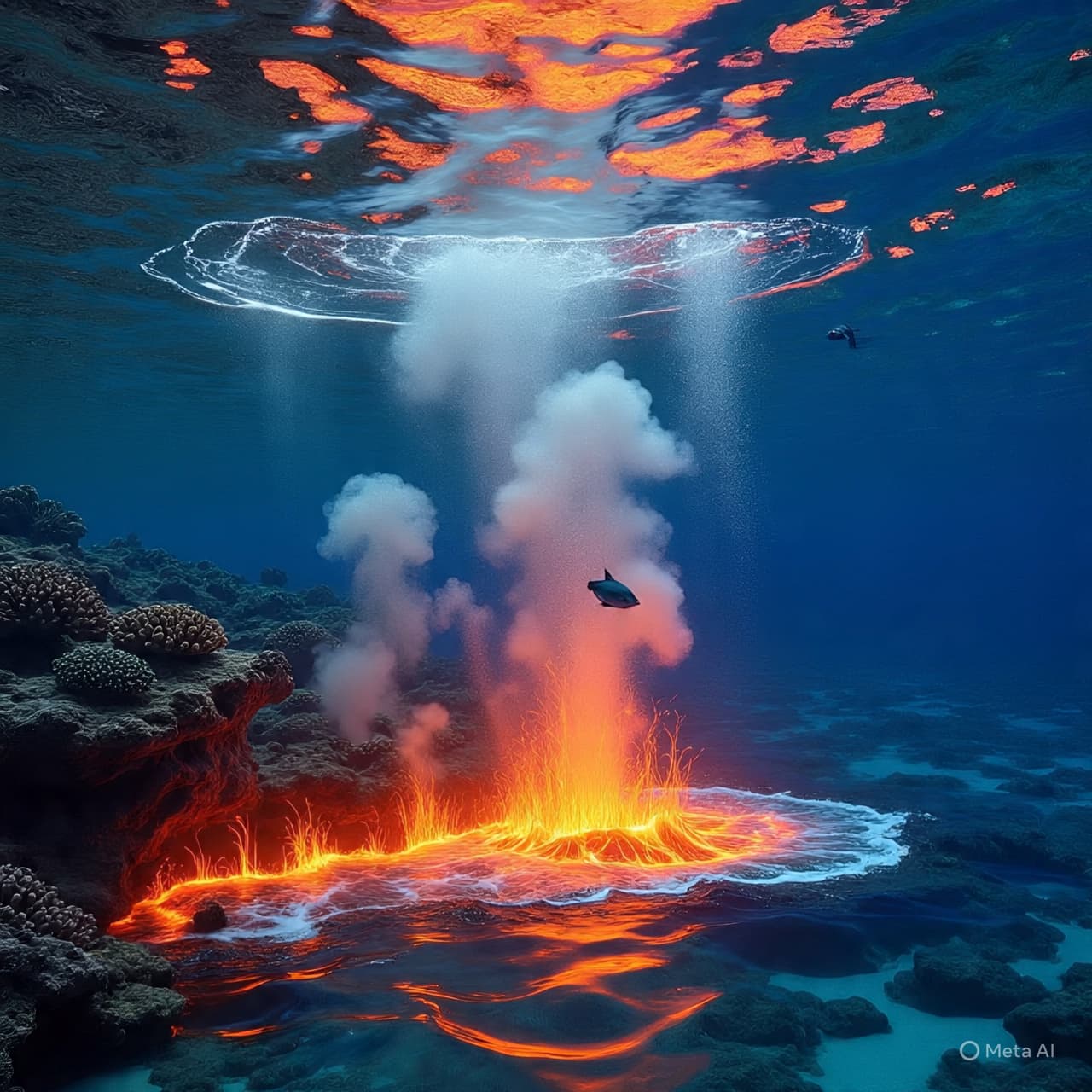
The ocean often appears calm from afar, a sheet of blue that reflects the sky and keeps its deeper stories hidden. Yet beneath its surface, silence can glow. Near the island of La Palma, where land meets the Atlantic, molten rock once slipped quietly into the sea, turning water into steam and darkness into light. It was not an explosion of drama, but a slow, elemental meeting — fire learning how to breathe underwater.
La Palma’s volcanic history is written not only on its slopes but also beneath the waves. When lava from the Cumbre Vieja eruption reached the ocean, it did not end its journey. Instead, it transformed. As incandescent rock poured into cold seawater, it fractured and cooled, forming new underwater landscapes that remain largely unseen. These submarine lava flows expanded the island’s footprint invisibly, shaping terrain that only technology and patience can now reveal.
Scientists describe this underwater lava as both destructive and creative. The instant cooling creates pillow-like rock formations, rounded and layered, resembling stacked cushions resting on the seafloor. Each form is a record of pressure, temperature, and time. Around them, the chemistry of the water briefly changed, warming currents and releasing minerals that altered local marine conditions. For a moment, the sea itself adapted, responding to the presence of fire.
Life, as it often does, watched and waited. In the immediate aftermath, the ocean floor was barren, coated in fresh volcanic rock. But months later, signs of return appeared. Microorganisms settled first, followed by algae and small invertebrates. These early arrivals did not erase the violence of the eruption, but they softened its edges, reminding researchers that recovery does not always announce itself loudly.
Studying these submerged lava fields is not simple. Visibility is limited, conditions are unstable, and exploration depends on remotely operated vehicles and sonar mapping. Yet each survey adds a layer of understanding, helping volcanologists and marine scientists trace how eruptions reshape not just land, but entire ecosystems. La Palma’s underwater lava offers a rare, recent case study of how Earth builds itself in real time, away from human eyes.
There is a quiet humility in observing these processes. The lava no longer burns, the steam has faded, and the ocean has reclaimed its surface calm. What remains below is not a scar alone, but a foundation — raw, cooling, and slowly becoming part of a larger whole. La Palma’s story continues underwater, unwitnessed by most, but deeply connected to the rhythms that shape the planet.
In the end, the meeting of lava and sea near La Palma was neither an ending nor a beginning in isolation. It was a continuation. A reminder that Earth’s most profound changes often happen slowly, beneath the surface, where fire learns patience and the ocean learns to carry stone.
AI Image Disclaimer Visuals in this article were created using AI tools and are intended as conceptual illustrations, not real photographs.
Verified media sources include:
BBC News National Geographic NASA Reuters Scientific American
Published by Banx Network. This article is part of the Banx decentralized media programme, powered by the BXE token on the XRP Ledger.