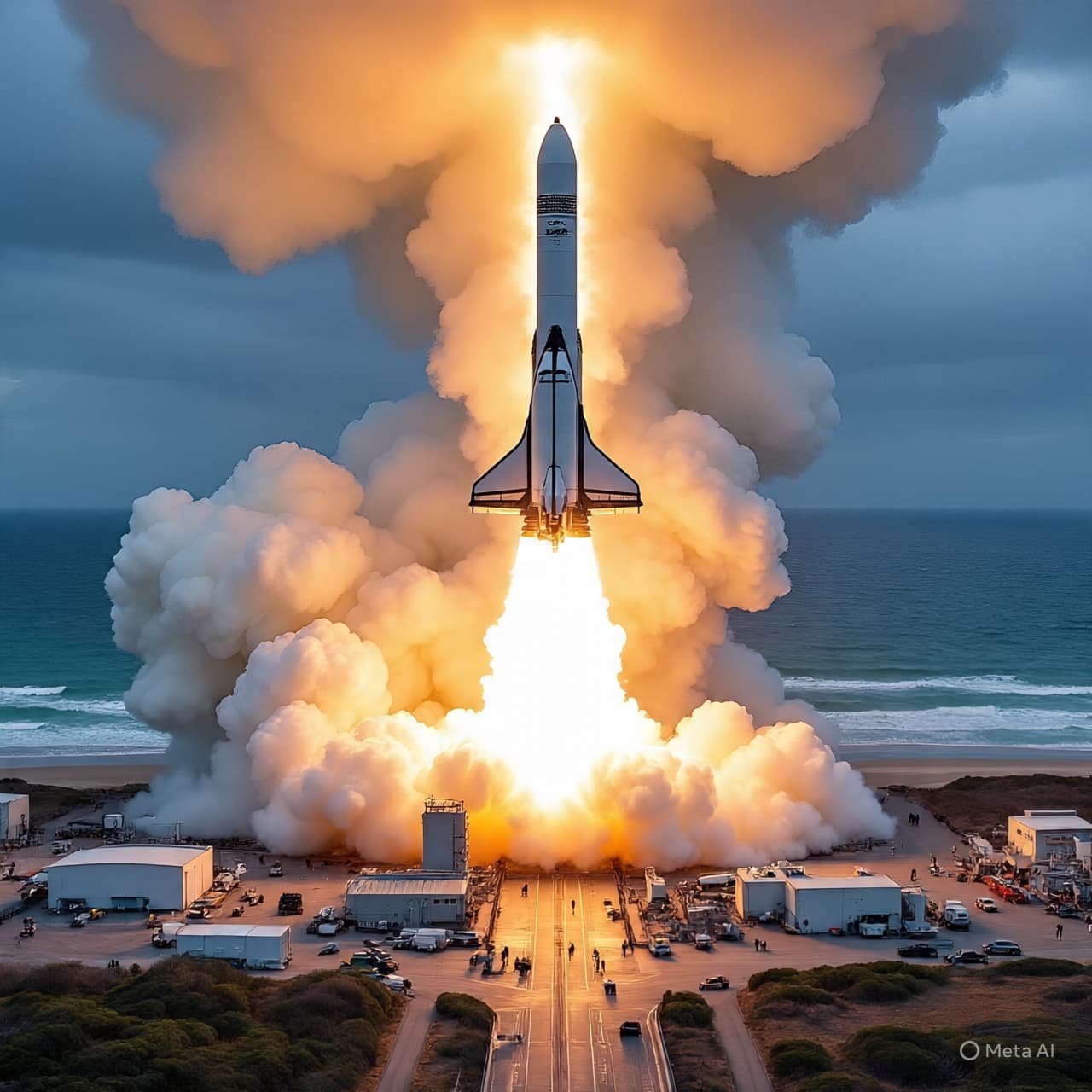
There is a particular stillness in the moments before a rocket leaves the ground — a pause that feels almost ceremonial, as though the Earth itself is taking a breath. Then comes the ignition, a column of fire and purpose, and with it the quiet understanding that humanity is once again reaching beyond its immediate horizon. Spaceflight has become more frequent in recent years, yet each launch retains that gentle gravity of meaning.
This week, four new astronauts arrived at the after launching aboard a rocket operated by . Their spacecraft completed its orbital journey and docked with the station, where they were welcomed by the existing crew in a carefully choreographed exchange that has become both routine and quietly remarkable.
The mission represents another chapter in the partnership between NASA and private industry. In recent years, SpaceX has carried multiple crews to and from the ISS under NASA’s Commercial Crew Program, marking a shift in how the United States approaches human spaceflight. What once required exclusively government-operated vehicles now unfolds through a blend of public oversight and commercial innovation.
For the four astronauts, the journey is the culmination of years of preparation. Training for life aboard the ISS involves mastering complex systems, conducting simulated emergencies, and adapting to the disorienting realities of microgravity. Yet beyond the technical demands lies a subtler adjustment — learning to live and work in close quarters while orbiting Earth roughly every 90 minutes.
Their mission is expected to include scientific research spanning biology, physics, and Earth observation. The ISS remains a laboratory suspended in motion, where experiments are conducted in an environment free from gravity’s pull. Researchers hope such studies will deepen understanding of human health, materials science, and long-duration space travel, all while offering insights that may benefit life back on Earth.
The arrival also underscores the evolving rhythm of international cooperation in orbit. The ISS, a collaboration among the United States, Russia, Europe, Japan, and Canada, continues to operate despite geopolitical tensions on the ground. In space, coordination and mutual reliance remain essential. Docking procedures, safety protocols, and daily operations depend on trust as much as technology.
SpaceX’s role in transporting astronauts has become increasingly familiar to the public, with its reusable rockets symbolizing a new era of accessibility in spaceflight. Each successful mission reinforces confidence in commercial partnerships, even as space agencies look ahead to more distant ambitions, including lunar exploration and missions beyond.
For now, the focus is closer to home — roughly 250 miles above it. The newly arrived crew members will spend months aboard the ISS, contributing to ongoing research and maintaining the station’s systems. Their presence ensures continuity, as outgoing astronauts prepare to return to Earth in the coming weeks.
According to NASA and SpaceX officials, the launch, flight, and docking were completed without incident. The crew has begun the process of acclimating to microgravity and transitioning into their operational roles. Above the shifting weather patterns and borders below, the station continues its steady orbit — a reminder that exploration, like the planet it circles, moves forward in cycles.
AI Image Disclaimer: Graphics are AI-generated and intended for representation, not reality.
Sources: Reuters BBC CNN The New York Times Politico
Published by Banx Network. This article is part of the Banx decentralized media programme, powered by the BXE token on the XRP Ledger.