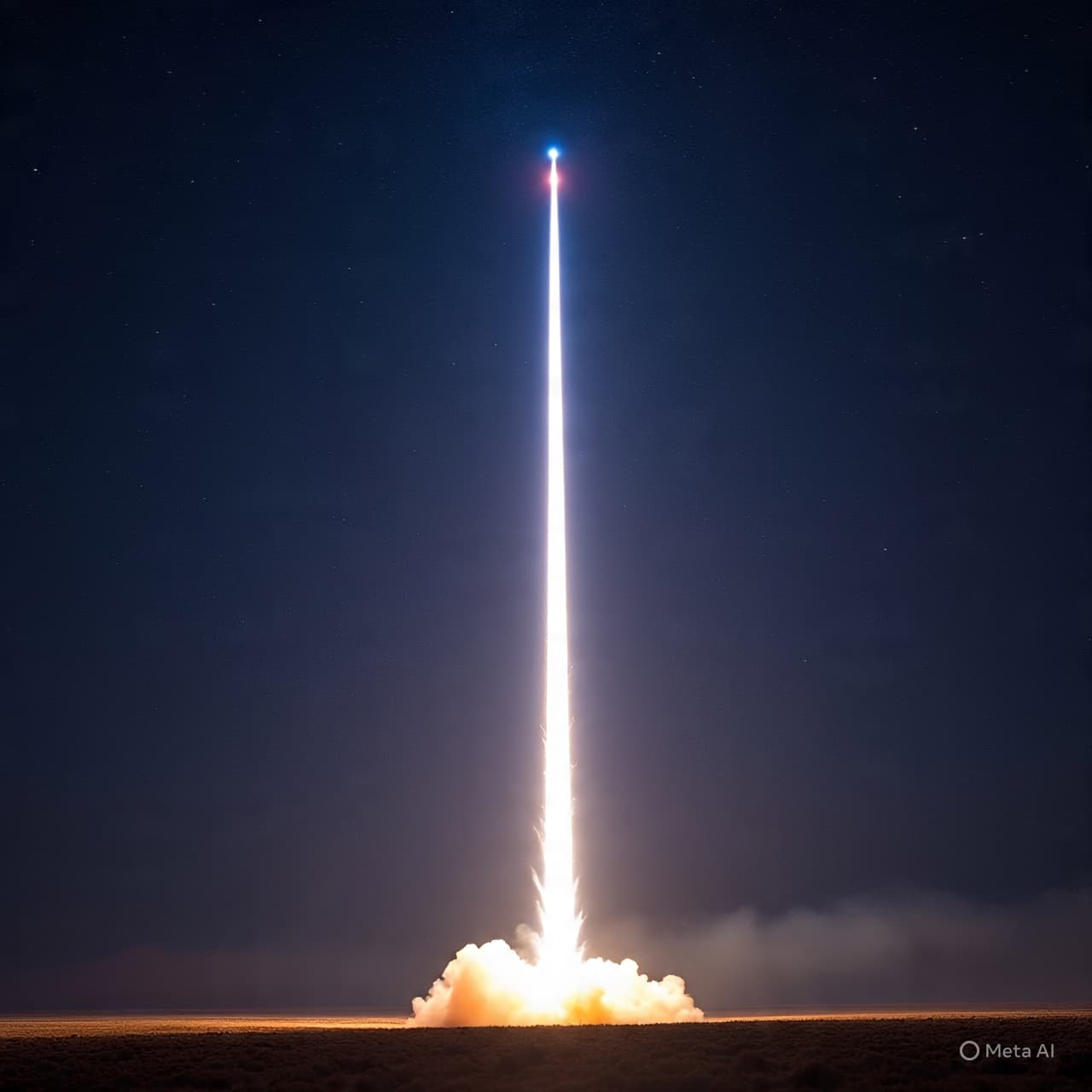
There are streaks in the night sky that last only seconds, yet leave behind questions that linger far longer. A returning rocket, luminous against the dark canvas of the upper atmosphere, may appear as a brief spectacle—an arc of fire dissolving into silence. But sometimes, what fades from sight continues to drift, unseen yet measurable, across the highest layers of air that cradle our planet.
Scientists now say a recently detected lithium plume in Earth’s upper atmosphere has been traced to the reentry of a rocket stage launched by SpaceX. The finding emerged after atmospheric monitoring instruments recorded unusual concentrations of lithium at high altitudes. Initially puzzling, the chemical signature prompted researchers to examine recent space activity.
Lithium is not commonly found in significant amounts in the upper atmosphere. While trace elements can arrive through natural processes—such as micrometeorite ablation—this plume displayed characteristics that suggested a more localized and recent source. By comparing orbital data and reentry trajectories, scientists linked the timing and location of the anomaly to the controlled descent of a Falcon 9 upper stage.
When rocket components reenter Earth’s atmosphere, they encounter extreme heat generated by friction with atmospheric gases. Materials vaporize and ionize, creating luminous trails visible from the ground. In this case, lithium compounds believed to be present in onboard batteries or other systems likely vaporized during reentry, dispersing into the upper atmosphere and forming a detectable plume.
Researchers emphasize that such plumes are typically temporary and disperse quickly. The upper atmosphere is a dynamic region shaped by solar radiation, geomagnetic forces, and atmospheric circulation. While the detected lithium concentration was notable for its clarity in measurement, experts describe it as localized and short-lived.
The discovery, however, contributes to a growing conversation about the environmental footprint of increasing space activity. As commercial launches become more frequent, scientists are working to better understand how rocket emissions interact with atmospheric chemistry. While current research indicates that the impact of individual reentries remains limited, cumulative effects are still under study.
The identification of the plume also highlights the precision of modern atmospheric monitoring. Instruments capable of detecting subtle chemical changes can now trace them back to specific events in near-Earth space. In doing so, they bridge two realms once considered separate—the domain of spaceflight and the fragile layers of air above us.
In measured terms, researchers report that the lithium plume has dissipated and poses no known long-term atmospheric risk. The findings have been discussed in scientific briefings and reported by major media outlets. As launch frequency continues to grow globally, scientists say ongoing monitoring will remain essential to understanding how space technology intersects with Earth’s atmospheric systems.
AI Image Disclaimer Graphics are AI-generated and intended for representation, not reality.
Source Check (Credible Media Coverage Found): BBC News The Guardian Space.com Live Science CNN
Published by Banx Network. This article is part of the Banx decentralized media programme, powered by the BXE token on the XRP Ledger.