
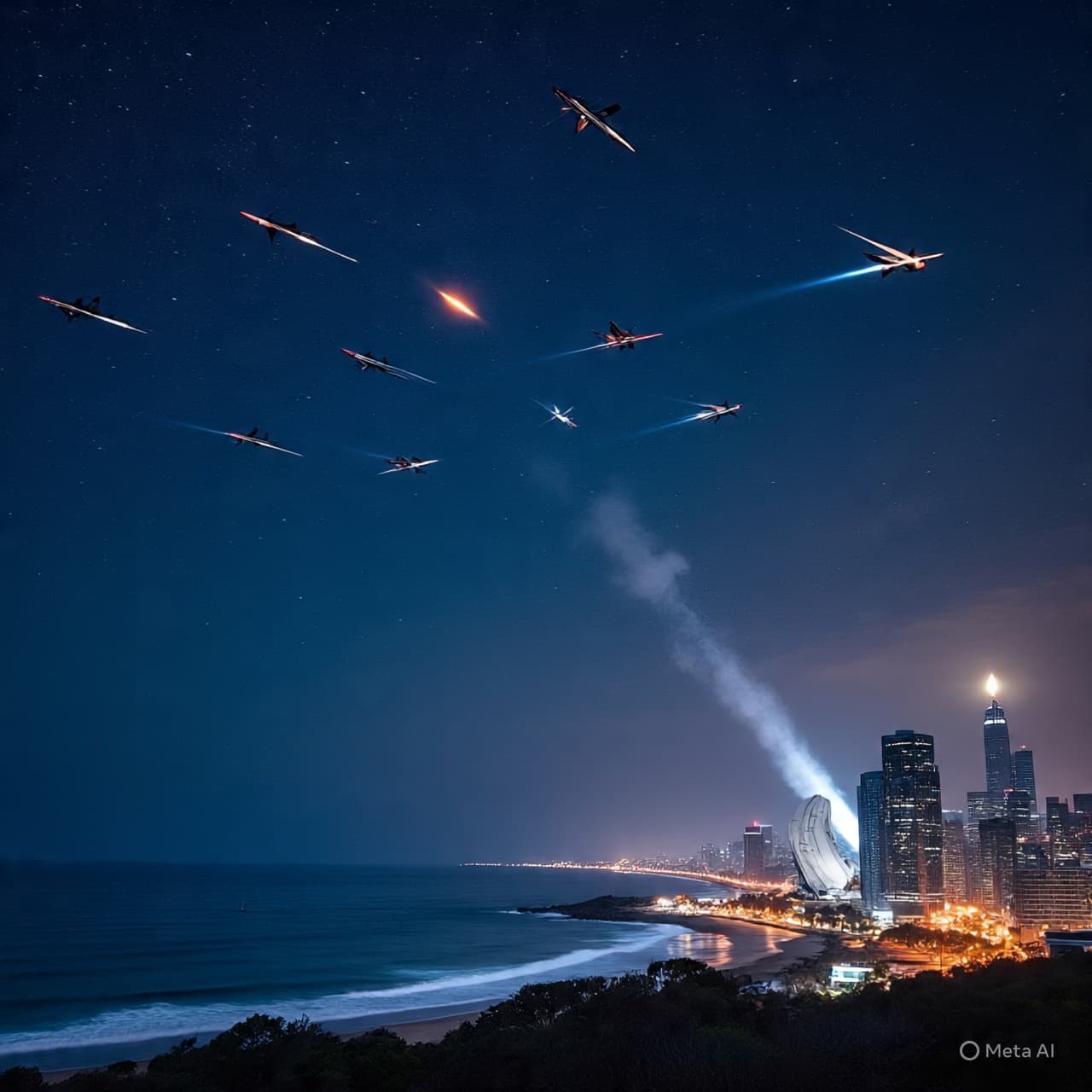
Key Highlights
- Recent Houthi attack on Israel signifies a new phase in regional conflict.
- The Houthis, backed by Iran, have expanded their military capabilities.
- The evolving nature of warfare blurs the lines between separate conflicts.
The recent attack by Houthi forces on Israel has introduced a new layer of complexity to an already intricate regional conflict. This incident not only highlights the Houthis' growing military capabilities but also underscores the interconnectedness of modern warfare, where geographical distances are increasingly irrelevant. The Houthis, who have been aligned with Iran, have demonstrated their ability to project power beyond Yemen, marking a significant shift in the dynamics of the Middle East.
The strike against Israel, which occurred amidst rising tensions, reflects a broader trend where various actors are drawn into conflicts that were once perceived as localized. The Houthis' use of missiles and drones to reach targets far from their base in Yemen illustrates how technological advancements have compressed the spatial dimensions of warfare. This development raises critical questions about deterrence and the nature of responses from nations like Israel, which has long been on high alert for threats from its neighbors.
In Israel, the response to such threats has become a routine part of life, with air defense systems actively intercepting incoming missiles. The integration of these systems into daily security protocols speaks to the resilience of the Israeli populace, but it also highlights the persistent uncertainty that accompanies living in a conflict zone. The psychological impact of constant alerts and the need for readiness cannot be understated, as citizens adapt to a reality where the threat of escalation is ever-present.
For the Houthis, their involvement in this broader regional confrontation is a continuation of a conflict that has devastated Yemen. The ongoing war has already led to a humanitarian crisis, and the Houthis' actions now resonate beyond their borders, linking local struggles to global geopolitical tensions. Analysts suggest that Iran's support for the Houthis is part of a larger strategy to exert influence across the region, complicating the already intricate web of alliances and enmities.
The implications of the Houthi attack extend beyond immediate military concerns. It signals a shift in the balance of power and introduces new calculations for all parties involved. As different fronts in this conflict intersect, the lines that once defined separate wars become increasingly blurred. The potential for escalation grows as each new participant alters the dynamics, making it difficult to predict future developments.
As the situation evolves, the international community watches closely, aware that the consequences of this attack could reverberate far beyond the immediate region. The interconnected nature of modern conflicts means that actions taken in one area can have cascading effects elsewhere, challenging traditional notions of sovereignty and territorial integrity.
In conclusion, the Houthi attack on Israel serves as a stark reminder of the complexities of contemporary warfare. As the wind continues to blow across the seas, the invisible lines that separate nations and conflicts are increasingly challenged, revealing a world where distance offers little in the way of true separation.
Published by Banx Network. This article is part of the Banx decentralized media programme, powered by the BXE token on the XRP Ledger.



