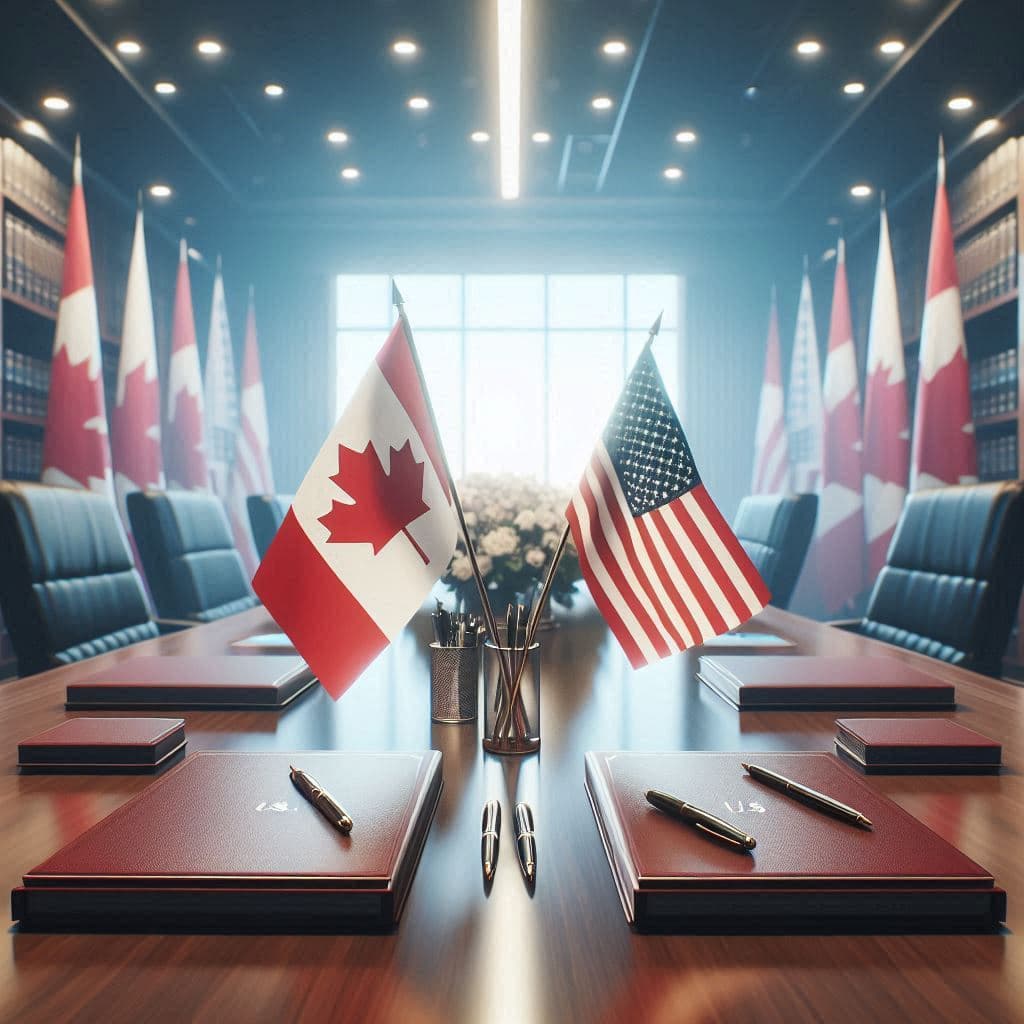
In the soft glow of a late winter morning, where political conversations often feel as distant as snowfall on a quiet street, a single phrase can seem like an unexpected echo. Canadian Prime Minister Mark Carney’s recent observation that “almost nothing is normal in the United States” arrived much like a line of poetry dropped into parliamentary debate, inviting reflection on how familiar landscapes have shifted beneath our feet. It was not an outburst, but a reflective comment — a point of pause in a conversation about trade, alliances, and what it means to navigate change when the old certainties seem to tilt. In a world where the familiar can quickly seem unfamiliar, Carney’s words carry a particular weight, not as a sharp accusation, but as a mirror held gently up to the present moment.
There is a natural rhythm to trade talks between long-standing partners like Canada and the United States, one that generations of merchants, lawmakers, and travelers have long taken for granted. Yet, in recent months, that rhythm has felt different — slower, more tentative, and punctuated by moments that surprise both observers and participants alike. Carney’s remark to Canada’s House of Commons captured this sense of dislocation, echoing comments he made at the World Economic Forum, and highlighting the complexities at play as Ottawa prepares for the formal review of the United States–Mexico–Canada Agreement (USMCA) later this year.
This forthcoming review, a procedural moment embedded within the pact’s structure, is approaching at a time when the contours of international commerce feel, in many ways, unsettled. The relationships forged through decades of negotiated tariffs and shared markets — the invisible threads tying Canada’s industries to U.S. demand and markets — are now being examined against a backdrop of shifting policies and rhetoric. Carney’s choice of words invites readers to look beyond political headlines, to imagine these economic threads as part of a tapestry being gently unraveled and rewoven — not in anger, but with consideration for evolving realities.
In returning to Ottawa after his global engagements, Carney reaffirmed to reporters that his remarks at Davos were not retracted, despite some interpretations from the U.S. side suggesting otherwise. He described lengthy conversations with U.S. leaders, emphasizing that Canada is responding positively by diversifying partnerships and reinforcing its economic foundations. In this narrative, there is no abrupt rejection of dialogue, but an acknowledgement that trade relationships are dynamic and require care and mutual respect.
Through it all, one is reminded that diplomacy — like any enduring conversation — can feel at times unfamiliar even when grounded in long-standing bonds. What Carney’s words evoke is not a collapse of connection, but an invitation to reassess and to prepare for what comes next, with a calm acknowledgment of complexity rather than a rush to judgment. The image of “normal” in this context becomes less a fixed ideal and more a beckoning horizon, something to approach thoughtfully as conditions evolve.
As the USMCA review draws nearer, Canada and its partners find themselves in a familiar yet altered landscape — negotiating not only economic terms, but the trust that trade has long symbolized. Carney’s reflections serve as a poetic reminder that in times of change, the language we use shapes how we see what lies ahead, and how we journey forward together.
In Ottawa on Tuesday, Prime Minister Mark Carney told lawmakers that he stands by comments he made earlier at the World Economic Forum, where he suggested that conventional relations with the U.S. felt disrupted. Carney denied retracting those remarks following a phone conversation with U.S. officials, and reaffirmed that discussions with Washington about the USMCA review will begin in the coming weeks. His remarks come amid broader conversations around tariff threats, trade diversification, and efforts by Canada to strengthen economic ties beyond its southern neighbor.
AI Image Disclaimer
Illustrations were produced with AI and serve as conceptual depictions.
---
Sources
Reuters Associated Press (via news agencies) AP News Parliamentary reporting (Yahoo/AP aggregators) Global Times
Published by Banx Network. This article is part of the Banx decentralized media programme, powered by the BXE token on the XRP Ledger.