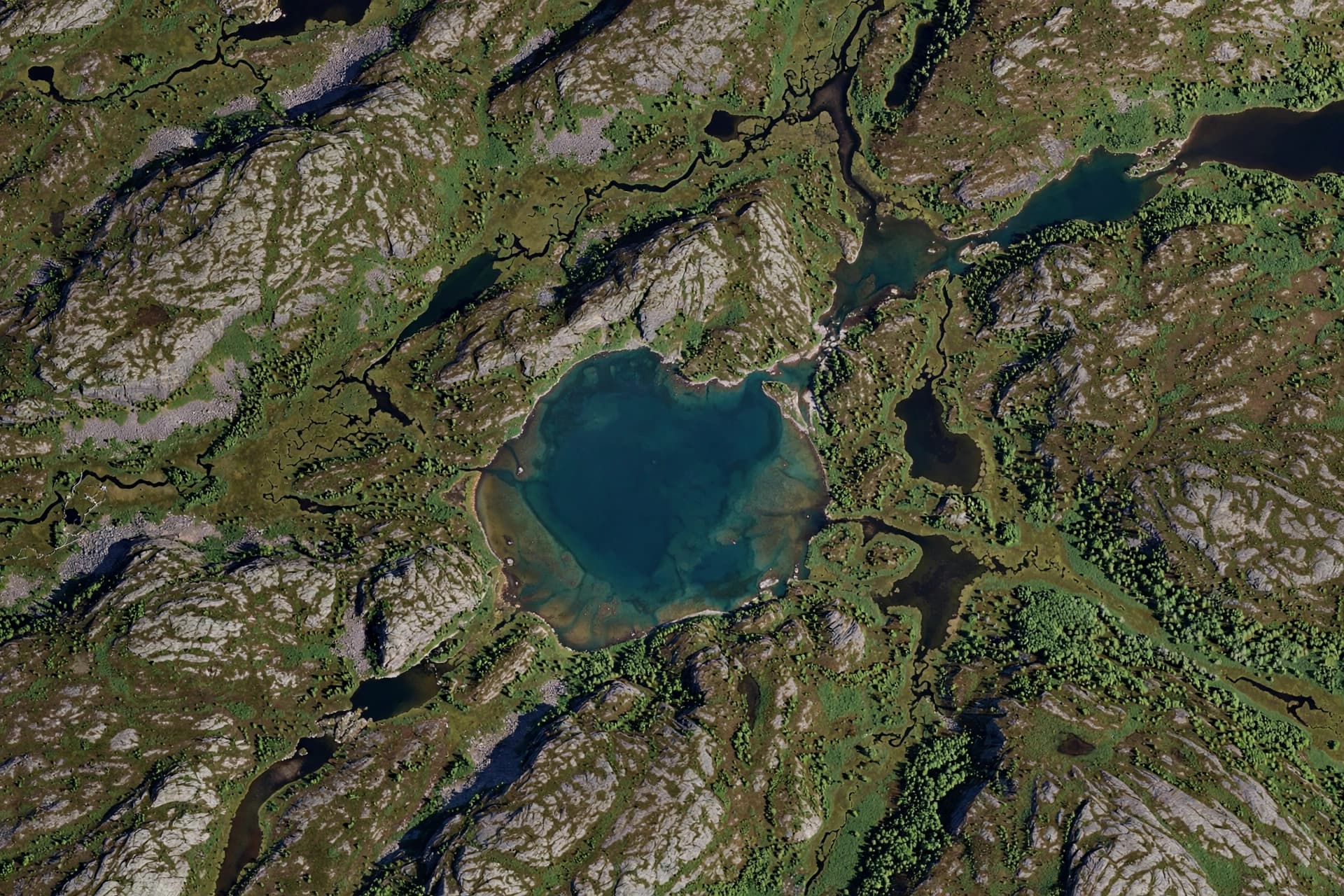
The quarry sits quietly in southern China, its stone layers exposed like pages left open to weather and time. What looks, at first glance, like ordinary rock has proven to be something far more enduring: a refuge for life that refused to disappear when much of the planet did.
Scientists studying fossils from the site have identified a previously unknown animal species that survived a mass extinction event roughly half a billion years ago. The period was one of Earth’s earliest biological crises, a time when rapid environmental change erased large portions of marine life and reshaped evolution’s direction. What remains from that era is usually absence. Here, unexpectedly, there is continuity.
The newly described species lived during the Cambrian period, when complex life was still experimenting with form. It belonged to a group of soft-bodied animals rarely preserved in the fossil record, making its survival—and its eventual discovery—all the more striking. Its anatomy suggests a simple but resilient design, adapted to low-oxygen waters that may have shielded it when more delicate ecosystems collapsed.
Mass extinctions are often described in terms of endings, but they are also filters. Survival favors not brilliance, but adaptability. In this case, the quarry’s ancient environment may have acted as a biological shelter, buffering organisms from the worst effects of ocean chemistry changes occurring elsewhere. Life here did not flourish dramatically; it endured.
The fossils were uncovered in finely layered sediment, deposited slowly enough to capture details usually lost to time. Researchers believe the site represents a localized ecosystem that persisted while surrounding regions struggled. Such pockets complicate the idea of extinction as a single, uniform catastrophe, revealing instead a patchwork of losses and survivals.
This discovery adds nuance to how scientists understand early animal evolution. Rather than resetting life entirely, ancient extinctions may have preserved unexpected lineages, quietly carrying forward genetic experiments that would otherwise seem erased. The animal’s survival suggests that evolutionary history is not a clean sequence of replacements, but a braided story of persistence and chance.
Today, the quarry is no longer a place of shelter, but of exposure—its rocks split open to light after hundreds of millions of years underground. What emerges is not just a new species, but a reminder that life’s history is written unevenly. Some stories vanish entirely. Others wait, compressed in stone, until the right moment to be read.
AI Image Disclaimer Visuals are AI-generated and serve as conceptual representations.
Sources Chinese Academy of Sciences Nature Ecology & Evolution Science National Natural History Museum
Published by Banx Network. This article is part of the Banx decentralized media programme, powered by the BXE token on the XRP Ledger.