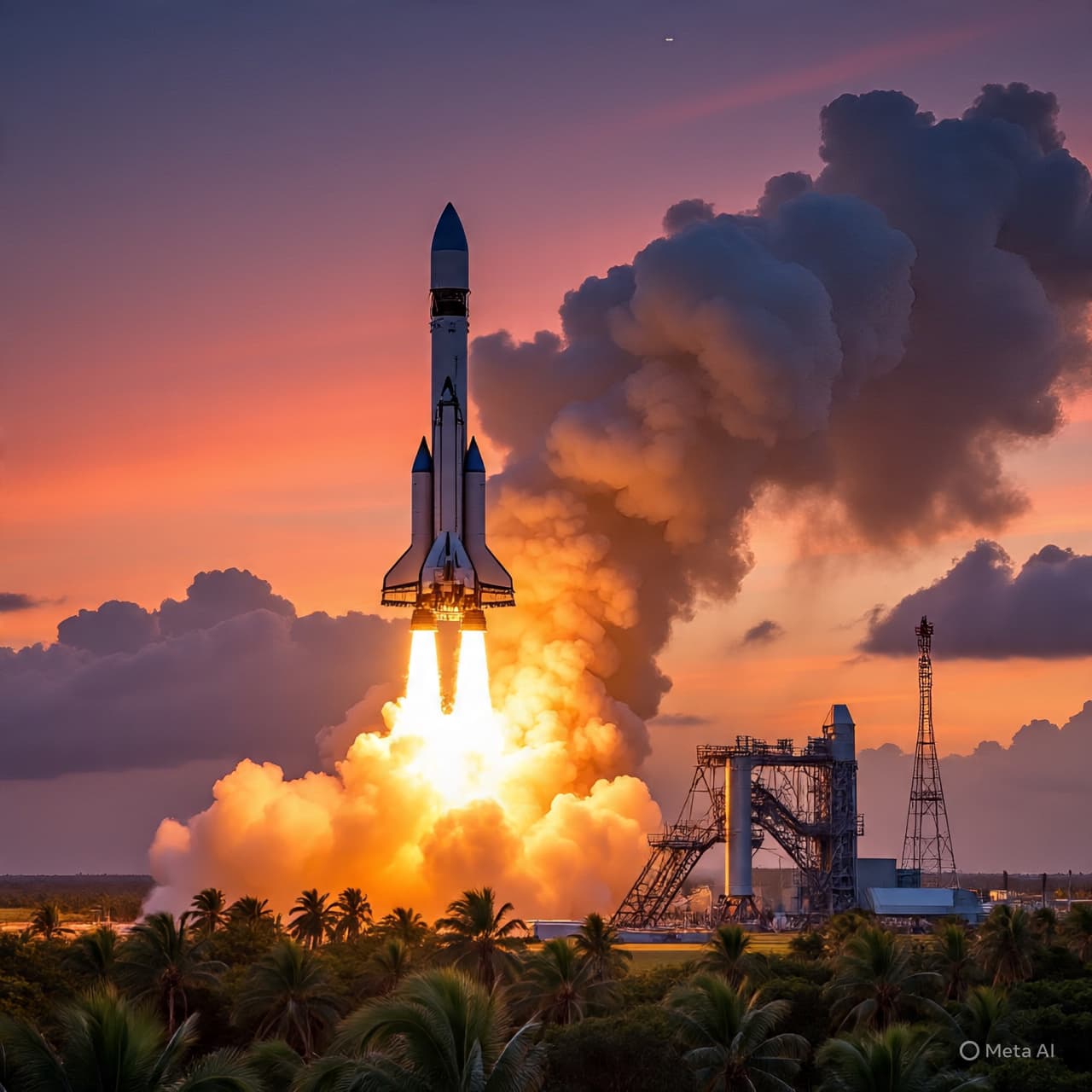
There are moments when the sky itself seems to pause—waiting, silent, as if holding its breath for what is to come. On 4 November 2025, from the lush green shores of French Guiana, that expectant hush broke as the Ariane 6 rocket ignited, rising in a plume of flame and ambition. In that ascent, Europe’s vision of autonomous access to space found fresh momentum.
The rocket lifted off at 18:02 local time (21:02 UTC) from the Guiana Space Centre, carrying aboard it the Sentinel-1D satellite for the Copernicus Earth observation programme. Roughly 34 minutes later, the satellite was safely placed into sun-synchronous orbit, sending back its first signal.
Sentinel-1D joins its twin, Sentinel-1C, in orbit so that, together, they can provide day-and-night, all-weather radar imagery of Earth’s surface. With its C-band synthetic aperture radar (SAR) instrument and onboard Automatic Identification System (AIS) for tracking ships, the satellite will support environmental monitoring, maritime surveillance, disaster response, and ground-motion measurement.
For Europe, the successful launch of Ariane 6 on this mission is more than a technical milestone—it is a reaffirmation of sovereign space access. The launcher, developed by ArianeGroup under the oversight of ESA, represents a strategic investment in ensuring that European institutions can reach orbit without relying on external providers.
In practical terms, the Sentinel-1D satellite will extend the operational lifespan and capabilities of the Sentinel-1 constellation. It replaces Sentinel-1A, which had served for over 11 years—well beyond its original design life. The synergy of Sentinel-1C and -1D, orbiting 180° apart, improves global revisit time and enhances the delivery of vital data to users worldwide.
Beyond the numbers and the engineering, there is an underlying story of Earth observation in the age of climate uncertainty. As wildfires scorch forests, as glaciers recede and coastal regions face rising seas, satellites like Sentinel-1D provide a kind of ear and eye to the planet. They offer radar visions when cloud or darkness would otherwise obstruct. The scene of the rocket’s thunderous departure is a reminder: what happens above influences what happens below—in forests, in oceans, in cities.
At the same time, the mission underscores the interplay of ambition and humility. Building and launching rockets and satellites takes years of cooperation across nations, industry and science. In this case, teams spanning multiple European countries, companies and agencies came together to deliver this mission. The rocket’s ascent is thus both a technical achievement and a testament to collaborative resolve.
As Sentinel-1D begins its commissioning phase, engineers will validate its instruments and prepare it for operational status. Meanwhile, the data it will send back promises to deepen our understanding of dynamic Earth processes—subsidence, ice-sheet movement, oil slicks, maritime traffic, forest change. And in its deployment, Ariane 6 continues to establish its record, following previous flights, helping Europe build its cadence of launch operations.
In the silence after launch, one imagines the quiet hum of ground stations, the relay of signals, the steady creation of imagery that will matter for governments, scientists and communities alike. The rocket’s flame fades, but the mission’s potential endures.
AI Image Disclaimer “Images are created with AI tools and are meant for conceptual representation only.”
Sources European Space Agency (ESA) Arianespace Space.com Wikipedia Wikipedia
Published by Banx Network. This article is part of the Banx decentralized media programme, powered by the BXE token on the XRP Ledger.