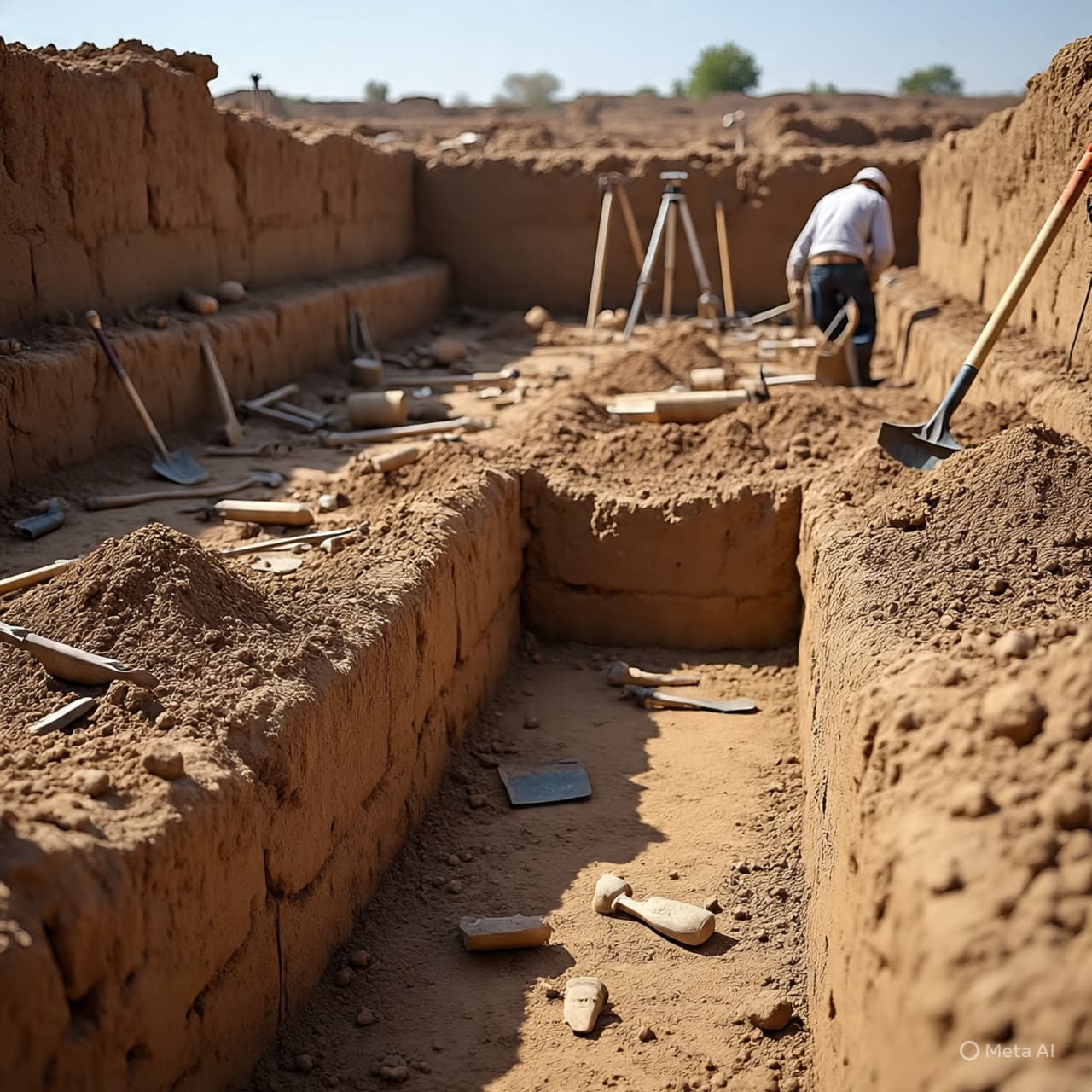
There are places where the earth seems to remember more than it reveals. A shallow rise, a scatter of stones, a quiet field under a pale sky—nothing in the present suggests the force of what once unfolded there. Yet beneath the soil, time gathers its fragments. Bone, ash, and the faint outline of walls become the slow handwriting of another age.
New archaeological research into an Iron Age site has brought forward evidence of a massacre that appears to have disproportionately affected women and children. The findings, drawn from detailed analysis of skeletal remains, suggest that the violence was not an indiscriminate clash between armed groups but a targeted assault on a vulnerable population. For years, the site was understood as one more settlement destroyed in a turbulent era. Now, closer examination of trauma patterns and burial arrangements has altered that understanding.
The Iron Age, spanning roughly from 1200 BCE to 600 BCE in many parts of Europe and the Near East, was marked by shifting alliances, fortified towns, and periodic warfare. Archaeological layers from that period often show signs of burning and abrupt abandonment. Yet within this newly studied site, researchers identified a concentration of female and juvenile remains bearing evidence of lethal injuries—blunt force trauma, fractures consistent with close-range violence, and in some cases, defensive wounds.
What is striking, according to the study, is the demographic imbalance. Adult male remains were either scarce or absent among the dead, suggesting they may have been away—perhaps engaged in battle elsewhere—or that they were selectively spared, captured, or removed. The pattern has led researchers to conclude that the attack may have deliberately targeted those left behind when conflict reached the settlement’s gates.
The physical evidence speaks in quiet detail. Skulls fractured by heavy blows. Limbs bearing marks of force applied at close quarters. The bodies appear to have been left where they fell, rather than ceremonially buried, implying the community did not recover to perform customary rites. Over centuries, debris and sediment sealed the scene, preserving it as an unintended archive of violence.
Such discoveries do not easily fit into heroic narratives of ancient warfare. They instead suggest that Iron Age conflict, like many conflicts across history, extended beyond battlefields. Raids on settlements, the destruction of households, and the targeting of noncombatants appear to have been part of the social and military landscape in some regions.
The researchers emphasize that interpretations remain grounded in osteological analysis and archaeological context. Radiocarbon dating places the event firmly within the Iron Age, and comparative studies with other sites indicate that while massacres were not unheard of, the concentration of women and children among the victims here is unusually pronounced. Further laboratory work, including isotopic and DNA testing, is expected to shed light on whether the victims were local residents or part of a displaced group.
As the excavation concludes for this season, the site returns to stillness. Wind moves across it as it likely did centuries ago. Yet the findings reshape the story beneath that quiet surface. They suggest that the violence of the Iron Age did not always unfold in open combat between rival warriors. At times, it entered homes and courtyards, leaving marks that endured long after walls collapsed.
The study’s authors state that their findings contribute to a broader reassessment of conflict patterns during the Iron Age and highlight the importance of demographic analysis in interpreting archaeological mass death sites. Further peer review and comparative research are ongoing.
AI Image Disclaimer Illustrations were created using AI tools and are not real photographs.
Sources (Media Names Only)
BBC News Reuters The Guardian National Geographic Smithsonian Magazine
Published by Banx Network. This article is part of the Banx decentralized media programme, powered by the BXE token on the XRP Ledger.