
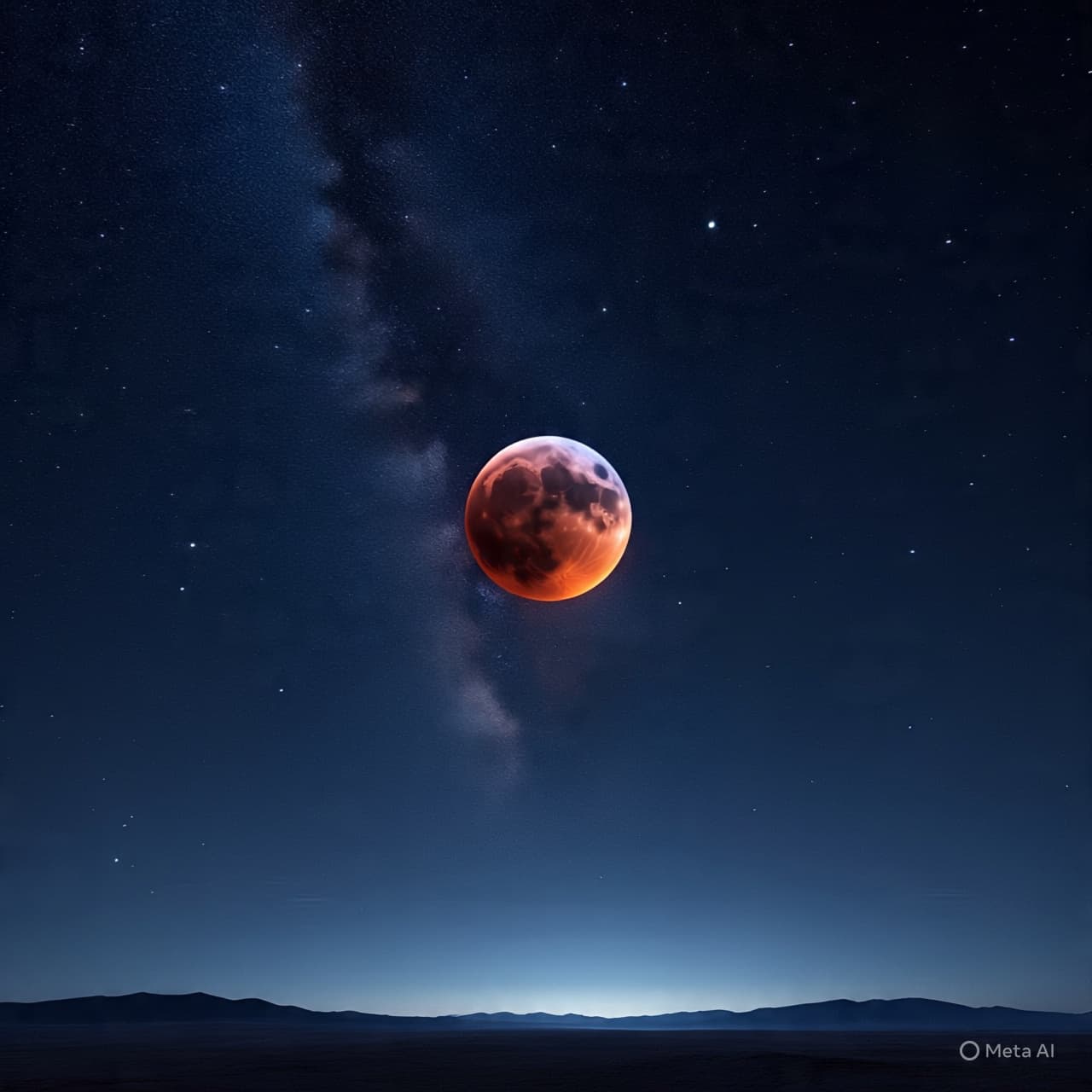
There are nights when the Moon feels like a quiet companion—steady, pale, predictable. And then there are nights when it changes.
On Tuesday, skywatchers across parts of North America, South America, Europe, Africa, and portions of Asia will look up to find the familiar lunar glow dimming, then deepening into a coppery red. A total lunar eclipse will pass across several continents, briefly turning the Moon what many call “blood red,” a transformation born not of omen but of geometry.
A total lunar eclipse occurs when the Earth moves directly between the Sun and the Moon. As Earth’s shadow stretches into space, it gradually covers the Moon’s surface. Unlike a solar eclipse, which demands protective eyewear, this event unfolds gently and safely. For those within the viewing path, no special equipment is required—only clear skies and patience.
As the eclipse progresses into totality, the Moon does not disappear. Instead, it glows in shades of rust, crimson, or burnt orange. The color emerges from sunlight filtering through Earth’s atmosphere. Shorter blue wavelengths scatter, while longer red wavelengths bend around the planet and spill into the shadow, softly illuminating the lunar surface. In that sense, every sunrise and sunset on Earth contributes to the Moon’s temporary hue.
According to guidance from NASA and the American Astronomical Society, the eclipse will unfold over several hours. The penumbral phase begins subtly, often barely noticeable. The partial phase follows, as a dark curve advances across the Moon. Totality—the moment of full immersion in Earth’s shadow—lasts longer, offering ample time for observation. Exact timing varies by region, but much of the Western Hemisphere will see the event during nighttime hours, while parts of Europe and Africa may witness it closer to moonset or moonrise.
Cloud cover, of course, remains the only real obstacle. Urban observers may find that even city lights cannot compete with the dimmed but visible lunar disk. Binoculars can enhance detail, revealing subtle shading across craters and maria, yet the naked eye remains more than sufficient. Unlike fleeting celestial phenomena, a total lunar eclipse moves at an almost contemplative pace.
Eclipses follow cycles tied to the Moon’s orbit and Earth’s tilt. While not rare, they are spaced in ways that make each one feel distinct—shaped by location, timing, and the clarity of the night. For some, it will be a shared moment on balconies and beaches. For others, a solitary glance upward between routines.
As Tuesday’s shadow approaches and then recedes, the Moon will return to its familiar brightness. The red glow will fade, replaced once more by silver light. What remains is the memory of alignment: Sun, Earth, and Moon arranged in quiet precision.
And for a few measured hours, across continents and coastlines, the night sky will remind its observers that even the most constant celestial body can briefly wear a different color.
Published by Banx Network. This article is part of the Banx decentralized media programme, powered by the BXE token on the XRP Ledger.



