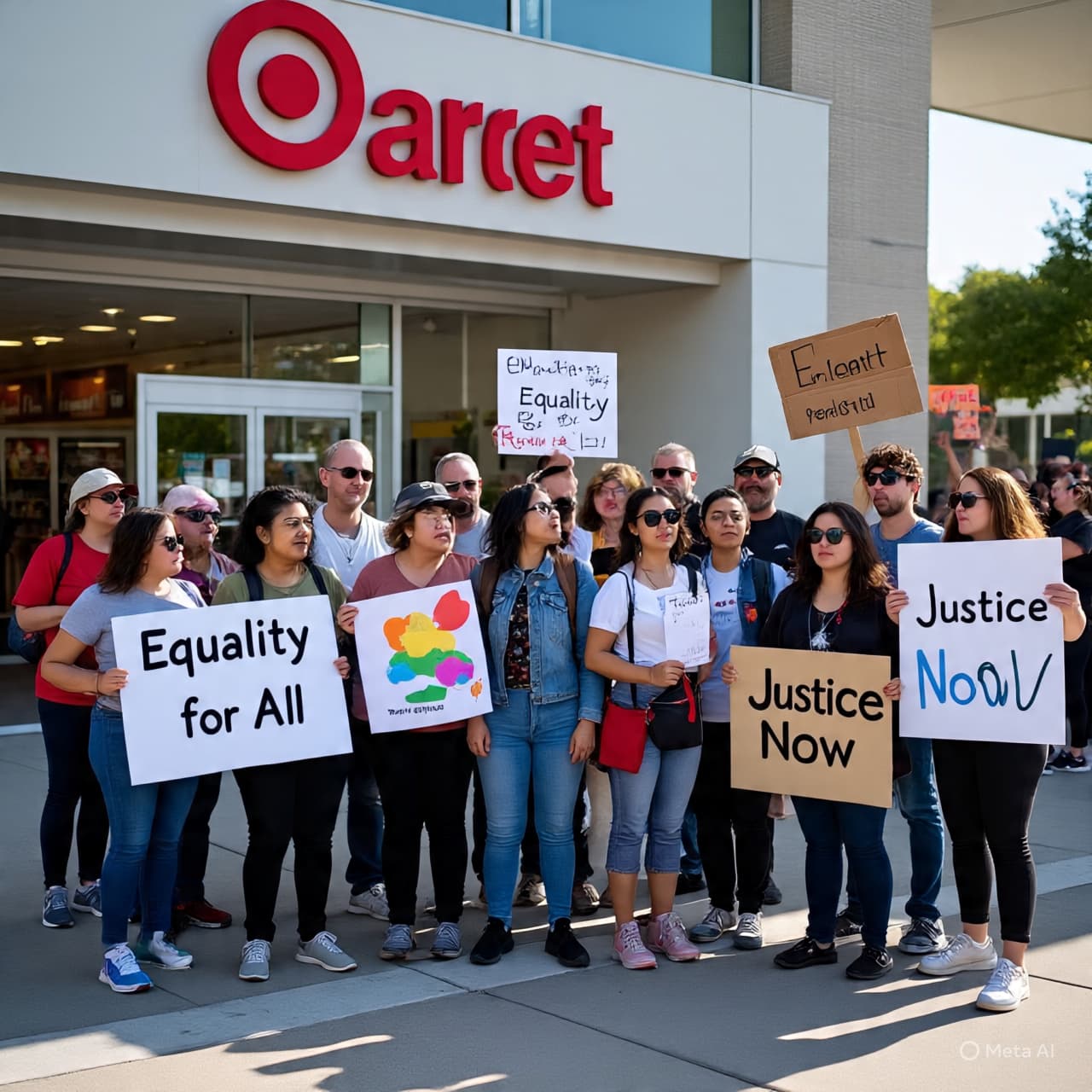
There are days when a quiet rhythm suddenly seems to shift, much like the gentle ripple spreading outward on a still lake. In recent weeks, that ripple has carried a chorus of voices across city streets, sidewalks, and storefronts from coast to coast. What began as protests in Minneapolis against a contentious federal immigration enforcement operation has now found an unusual stage: the red-trimmed doorways of Target stores in towns and cities across the United States.
For many of those who gathered on Wednesday, the act of walking up to a familiar store front, signs in hand, felt like more than a demonstration — it was a reminder of how deeply interwoven everyday places and political life can be. Target is headquartered in Minneapolis, the city at the heart of a five-week-old immigration crackdown in Minnesota that has drawn sustained criticism from community groups, religious leaders, labor unions, and others who oppose the federal operation. Activists from that coalition, known as ICE Out Minnesota, have called on Target to use its influence and public voice to oppose the crackdown and protect immigrant communities they say are at risk.
The protests — planned for more than two dozen Target locations from St. Paul and Boston to San Diego and Raleigh — represent a coordinated effort to broaden attention beyond Minnesota’s borders. In cities large and small, demonstrators staged sit-ins, held signs, and chanted messages urging the retail giant to take a stand. In Minneapolis’ Dinkytown district, organizers said they were there because they believed a major employer and cultural presence in the community should reflect the values of its neighbors and customers.
Many of the protesters referenced scenes from recent weeks in the Twin Cities: videos of federal agents detaining people near and inside Target stores, and the deaths of local residents during confrontations with immigration officers. These incidents have been a focal point for criticism of the broader enforcement campaign and have sparked large marches, sit-ins, and even legal challenges to federal actions.
Yet for all the emotion on display, the tone of the demonstrations has also reflected community intertwining of values and place. Religious and grassroots groups, including Mennonite congregations in several cities, have added singing and prayer to their calls for solidarity with immigrant neighbors. These gatherings — hymn-singing within parking lots, gospel music outside store entrances — drew on traditions of peaceful protest and collective unity, evoking a sense of warmth within public spaces often dominated by commerce.
At the same time, the protests reflect a broader heartbeat of dissent across America this year. The sustained opposition to immigration policies has not been confined to streets in Minneapolis alone; demonstrations of varied size and focus have appeared in regions from California to Massachusetts, expressing concern not only about enforcement tactics but also about the human implications of federal policy in communities with deep immigrant roots.
In prompting actions at Target stores, activists are also pressing a larger question: what role should major corporations play in moments of civic contention? Target’s leadership has offered general condolences after violent incidents around enforcement actions, but has stopped short of taking a direct position on the immigration crackdown. That neutrality has become a point of critique for protesters who believe influential institutions have a responsibility to advocate for vulnerable populations.
In straightforward reporting, activists from the coalition ICE Out Minnesota and allied community groups organized protests at more than two dozen Target stores across several U.S. states on Wednesday, calling on the company to publicly oppose the ongoing federal immigration enforcement crackdown in Minnesota. Demonstrators held sit-ins and other demonstrations in cities including Minneapolis, St. Paul, Boston, Chicago, San Diego, and Raleigh, urging Target to refuse entry to federal immigration agents without judicial warrants and to speak out against the enforcement operation. Target declined to comment on the protests.
AI Image Disclaimer
Visuals are created with AI tools and are not real photographs.
Source Check — Credible Mainstream/Niche Media Associated Press (AP News) — national reporting on protests at Target stores. WRAL News (AP) — further national context on demonstrations. Yahoo! News (AP reprint) — coverage of the nationwide protest wave. ABC News (AP Wire) — Reuters/Associated Press syndicated coverage. Times Union (AP) — additional details on protest locations and demands.
Published by Banx Network. This article is part of the Banx decentralized media programme, powered by the BXE token on the XRP Ledger.