There are moments in science when the universe seems to whisper that we may have underestimated it. Like an ancient manuscript whose margins reveal unexpected annotations, the early cosmos continues to surprise those who patiently read its light. For decades, astronomers imagined the infant universe as turbulent and unfinished—a workshop still assembling the graceful forms we see in galaxies today. Yet through the watchful gaze of the James Webb Space Telescope, a barred spiral galaxy has emerged from an era so early that it gently unsettles our long-held expectations.
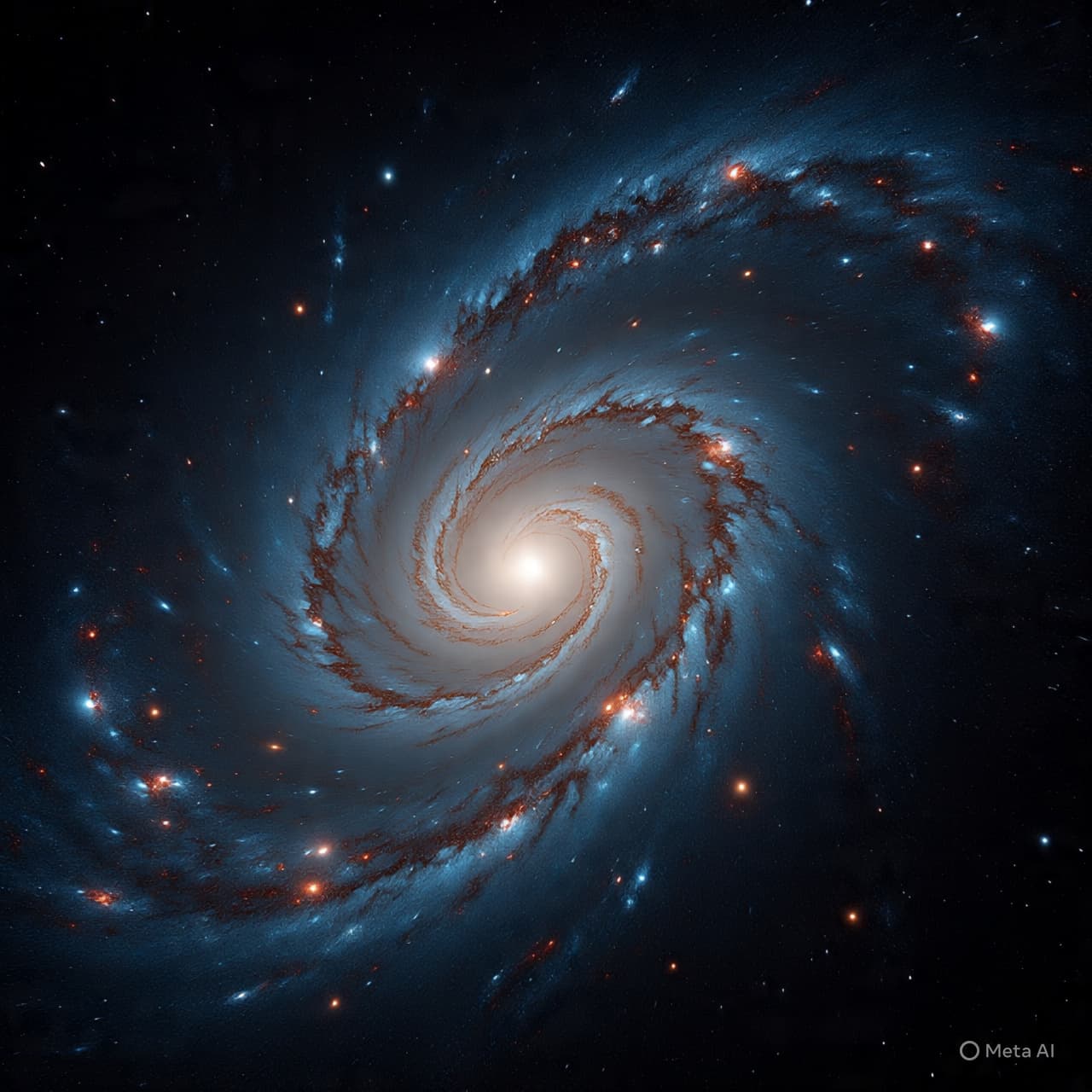
The barred spiral galaxy, identified as Ceers-2112, appears roughly 11 billion years in the past, when the universe was only about two billion years old. In cosmic terms, that is early morning—long before astronomers believed such mature structures could take shape. Barred spiral galaxies are defined by a central bar of stars stretching across their core, with spiral arms gracefully unfurling from each end. Our own Milky Way is thought to host such a bar, a structural feature that helps channel gas inward and nurture star formation.
For many years, scientists assumed that these intricate forms required time—vast stretches of it. In the young universe, galaxies were expected to be irregular, clumpy, still colliding and assembling. The presence of a well-defined bar at such an early epoch suggests that some galaxies evolved faster than models predicted. It hints at a universe capable of organizing itself with surprising efficiency, shaping stellar architecture earlier than once believed.
The discovery was made possible by Webb’s powerful infrared instruments, which allow it to peer through cosmic dust and across immense distances. Because light from distant galaxies takes billions of years to reach Earth, observing them is akin to looking back in time. Webb’s sensitivity has opened windows into epochs previously blurred or entirely hidden, revealing structures that older telescopes could not resolve with clarity.
The barred spiral observed does not stand merely as an isolated curiosity. It carries implications for how astronomers understand galactic dynamics and evolution. Bars play a role in redistributing material within galaxies, funneling gas toward central regions and potentially influencing the growth of supermassive black holes. If such mechanisms were already active so early, then the timeline of galactic maturity may need recalibration.
This finding does not overturn decades of research; rather, it invites refinement. Scientific understanding, like the cosmos itself, expands gradually. Models will be revisited. Simulations will be adjusted. The early universe may prove more structurally sophisticated than once assumed, not chaotic but already experimenting with order.
In measured terms, astronomers note that more observations are needed to determine how common such early barred spirals may be. Webb continues its mission, scanning deeper and further, offering data that will either confirm this galaxy as an outlier or reveal it as part of a broader pattern. For now, the discovery stands as a quiet reminder that the universe retains its capacity to astonish—especially when viewed with sharper eyes.
As research continues, scientists will analyze additional early galaxies to understand how quickly such structures can emerge. The findings contribute to ongoing efforts to map cosmic history with greater precision. In the steady accumulation of evidence, the early barred spiral galaxy becomes not just a surprise, but a stepping stone toward clearer insight into how galaxies, including our own, came to be.
AI IMAGE DISCLAIMER Illustrations were produced with AI and serve as conceptual depictions.
SOURCE CHECK
Credible mainstream and niche media covering this finding include:
Reuters BBC News The Guardian Space.com Nature
Published by Banx Network. This article is part of the Banx decentralized media programme, powered by the BXE token on the XRP Ledger.