
Key Highlights
- Egypt deploys combat drones near Sudan, indicating military escalation.
- Sudan's conflict has caused tens of thousands of deaths and millions displaced.
- The drone technology represents a significant shift in regional military dynamics.
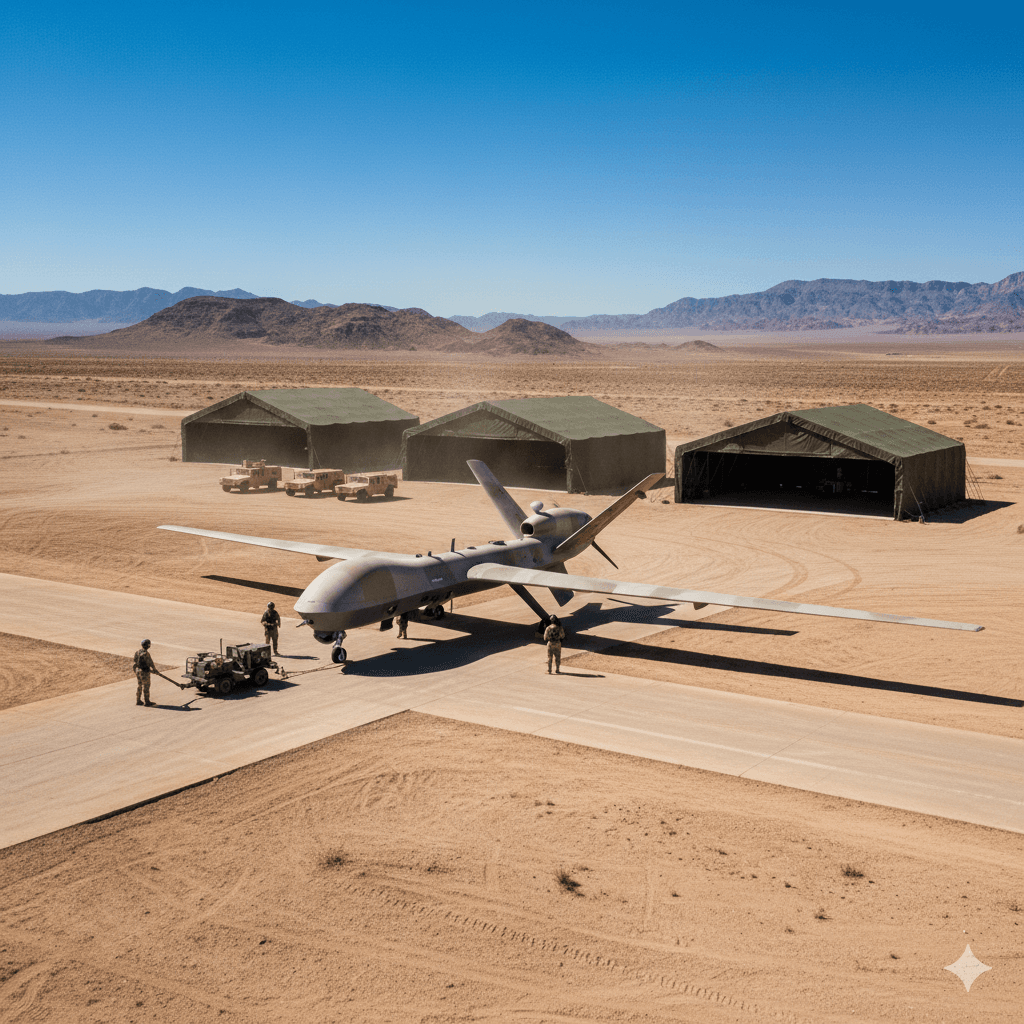
Egypt's recent deployment of advanced combat drones near its border with Sudan marks a significant shift in the geopolitical landscape of Northeast Africa. Satellite imagery has confirmed the positioning of Turkish-made Bayraktar Akinci drones at an airstrip in East Oweinat, close to the Sudanese frontier. This development suggests that Egypt may be transitioning from a stance of indirect support for Sudan's military to a more direct operational involvement in the ongoing civil war.
The conflict in Sudan, now entering its third year, is characterized by a power struggle between the Sudanese Armed Forces and the Rapid Support Forces (RSF), a paramilitary group. This war has resulted in tens of thousands of deaths and displaced millions, creating one of the world's largest humanitarian crises. Historically, Egypt has supported Sudan's military leadership through political and diplomatic channels but has largely refrained from direct military engagement. However, as the RSF has gained ground, including capturing strategic areas in Darfur, Egypt's position appears to be evolving.
The Akinci drone represents a major technological advancement in military capabilities. With the ability to conduct high-altitude, long-endurance missions lasting up to 24 hours, these drones can carry various precision munitions. This capability allows for extensive surveillance and potential strike operations, fundamentally altering the dynamics of the battlefield in Sudan. The deployment of such technology not only enhances Egypt's military posture but also raises concerns about the implications for regional security.
The situation in Sudan is further complicated by the involvement of multiple foreign powers, each supporting different factions through political backing, arms transfers, or logistical assistance. Egypt's recent military actions add another layer to an already intricate geopolitical environment, which includes the interests of Gulf states and other regional actors. For Egypt, the conflict in Sudan is not merely a distant issue; it is closely tied to its own national security priorities, particularly regarding Nile River security and regional stability.
From a military perspective, the positioning of drones near the border serves several purposes: it allows for surveillance of cross-border movements, acts as a deterrent against hostile forces, and prepares for rapid response operations if security is threatened. Analysts suggest that this move reflects Cairo's growing concern that instability in Sudan could spill over into neighboring countries, potentially destabilizing the region further.
However, this deployment also escalates tensions. The RSF has previously warned that any foreign military involvement would be treated as legitimate targets, highlighting the risk that external actions could widen the scope of the conflict. The humanitarian implications of the ongoing war in Sudan are dire, with mass displacement, famine risks, and infrastructure collapse becoming increasingly prevalent. The potential for expanded foreign involvement raises critical questions about the future of the conflict and its regional ramifications.
In conclusion, Egypt's drone deployment near the Sudanese border represents a complex intersection of national security needs and regional risks. It underscores a moment where defense priorities and conflict dynamics are becoming increasingly intertwined. The coming months will be crucial in determining whether Egypt's actions are a defensive precaution or part of a broader shift in military involvement across the region. As the situation evolves, each new development will continue to reshape the geopolitical landscape of Northeast Africa.
Published by Banx Network. This article is part of the Banx decentralized media programme, powered by the BXE token on the XRP Ledger.



