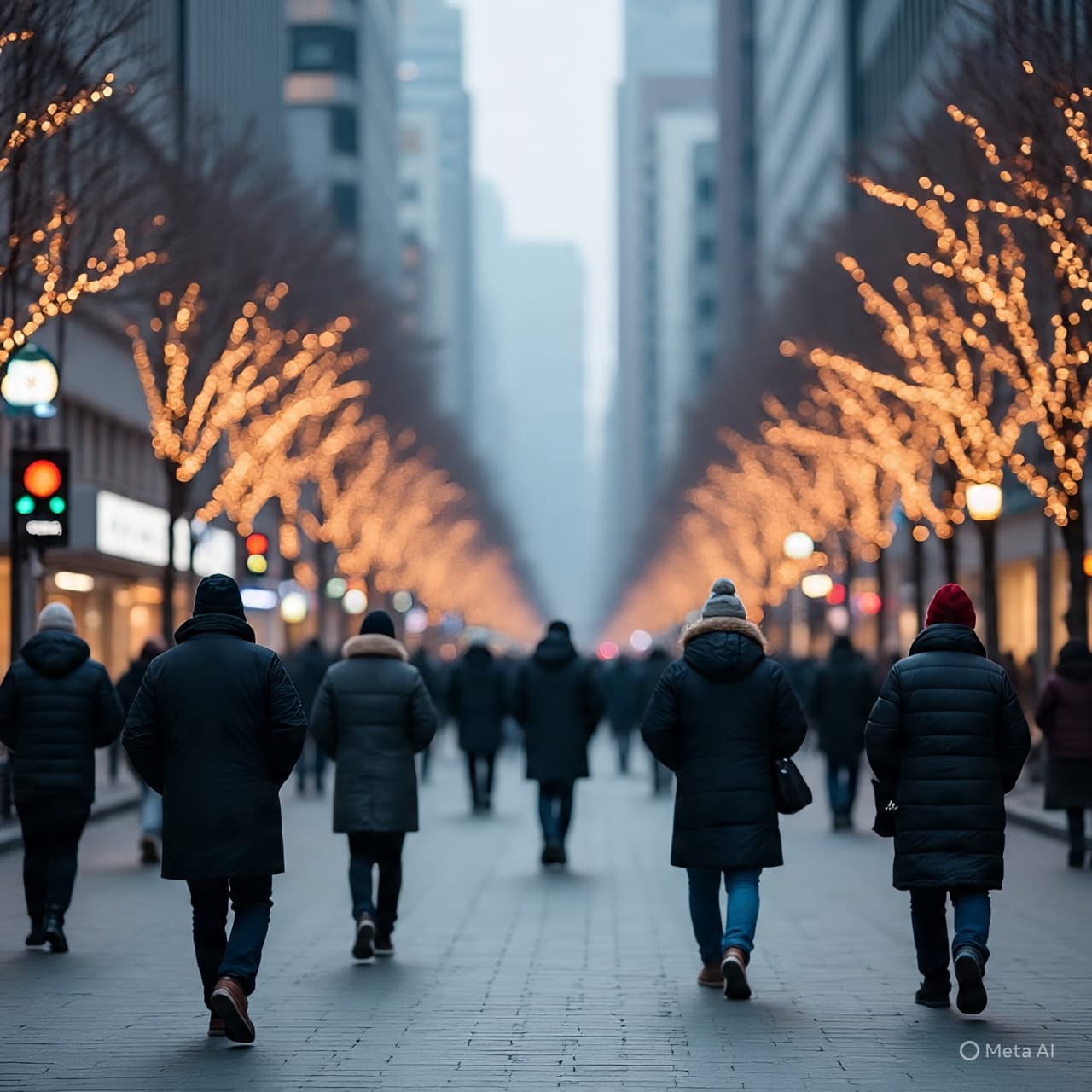
In the gray half-light that lingers over Seoul in winter, the city carries on with an almost ritual cadence. Morning buses hum along their routes, storefronts lift their shutters, and the soft glow of phones marks the rhythm of everyday life. It is a season of motion and routine, of quiet persistence. Yet beneath this ordinary flow, another current moves—slower, heavier, shaped by waiting.
For weeks, the country has existed in a kind of pause, suspended between memory and outcome. Courtrooms have become silent landmarks in the national imagination, not because of spectacle, but because of what they represent: a moment when time itself feels elongated, when anticipation settles into the fabric of daily conversation. Words like “insurrection” and “martial law” drift through public discourse, no longer sharp with shock, but worn smooth by repetition.
At the center of this stillness stands former president Yoon Suk-yeol, facing charges linked to his brief declaration of martial law in December 2024. What began as a sudden political rupture has become a prolonged legal journey, unfolding not in dramatic bursts but in the measured language of procedure, testimony, and deliberation. The case has stretched across seasons, carrying with it a sense of unresolved gravity that follows commuters into subways and families into their living rooms.
Across the country, the mood has shifted from alarm to fatigue. Many citizens speak not with anger, but with exhaustion—an emotional weariness born from the long presence of a story that refuses to conclude. Conversations drift away from ideology and toward a simpler desire for quiet, for a return to concerns closer to home: school schedules, rising prices, weekend plans, the small architecture of ordinary life. The trial remains, but the public spirit surrounding it has softened into something more subdued, more distant.
And yet, the significance of the moment does not fade. Beneath the tiredness lies an awareness that this is not only about one man or one decision. It is about the boundaries of power, the endurance of institutions, and the slow, deliberate workings of accountability. The legal process moves with its own gravity, untouched by impatience, following a rhythm older than the headlines that surround it.
Outside the court, the city breathes. Street vendors arrange fruit in careful rows. Trains arrive and depart. Winter light slips between buildings and across river water. Life continues, not in defiance of the trial, but alongside it—parallel, indifferent, steady. The nation waits, not in tension, but in quiet endurance.
As the verdict approaches, the atmosphere feels less like suspense and more like release delayed. Whatever the court decides will arrive in the calm language of law, not spectacle. And when it does, the country will absorb it as it absorbs all things—with conversation, reflection, disagreement, and, eventually, movement forward.
South Korea is awaiting a court ruling in the trial of former president Yoon Suk-yeol, who faces insurrection charges related to his brief declaration of martial law in December 2024, with the outcome expected to bring legal resolution to one of the country’s most significant recent political crises.
AI Image Disclaimer
Visuals are AI-generated and serve as conceptual representations.
Sources (Media Names Only)
The Guardian Reuters Associated Press Yonhap News Agency BBC News
Published by Banx Network. This article is part of the Banx decentralized media programme, powered by the BXE token on the XRP Ledger.