In the fragile blue hour before sunrise, when the world still lingers between night and day, a column of fire gently stitched Earth to sky. From Florida’s Space Coast, a rocket rose not with defiance, but with quiet purpose — a reminder that exploration often begins in silence. As engines thundered and clouds of vapor drifted outward like morning breath, four astronauts began their measured ascent toward a laboratory that circles our planet every ninety minutes.
This mission, known as Crew-12, marks another chapter in the enduring partnership between and . At the heart of the launch stood a Falcon 9 rocket carrying the Crew Dragon spacecraft, lifting its passengers toward the — a structure that has quietly orbited Earth for more than two decades, hosting science, cooperation, and human resilience.
The astronauts aboard Crew-12 now join a lineage of explorers who have traveled this precise corridor between Earth and orbit. Their mission is not merely symbolic; it is practical and essential. Over the coming months, they will help sustain research ranging from human physiology in microgravity to materials science and climate observation. Each experiment conducted aboard the station adds another brushstroke to a larger portrait of how humanity might live and work beyond Earth.
There is something almost poetic in the routine of these launches. The countdown unfolds with practiced calm. The first stage separates and returns to Earth in a controlled descent, landing upright with the grace of repetition refined. Meanwhile, the capsule continues its steady climb, preparing for orbital insertion and an automated rendezvous with the station roughly a day later.
Crew-12’s arrival will restore the station’s full operational rhythm. A fully staffed ISS allows scientific investigations to proceed at optimal capacity, ensuring that research schedules, maintenance tasks, and technology demonstrations remain on track. In this way, the launch is not only about departure — it is about continuity.
International collaboration remains a quiet undercurrent of the mission. Astronauts representing multiple space agencies share the spacecraft and will share life aboard the ISS. In orbit, borders soften. Research becomes collective. Earth below appears as one horizon rather than many.
As the spacecraft approaches docking, a familiar choreography will unfold: alignment, soft capture, hatch opening, greetings exchanged in weightlessness. What follows will be months of disciplined work — experiments conducted, systems monitored, spacewalks perhaps prepared — all carried out against the ever-present view of our blue planet turning silently beneath them.
In straightforward terms, NASA confirmed that Crew-12 launched successfully aboard a SpaceX Falcon 9 rocket and is en route to the International Space Station. Docking is scheduled approximately 24 to 36 hours after liftoff. The crew will spend several months aboard the ISS conducting scientific research and station operations before returning to Earth at mission’s end.
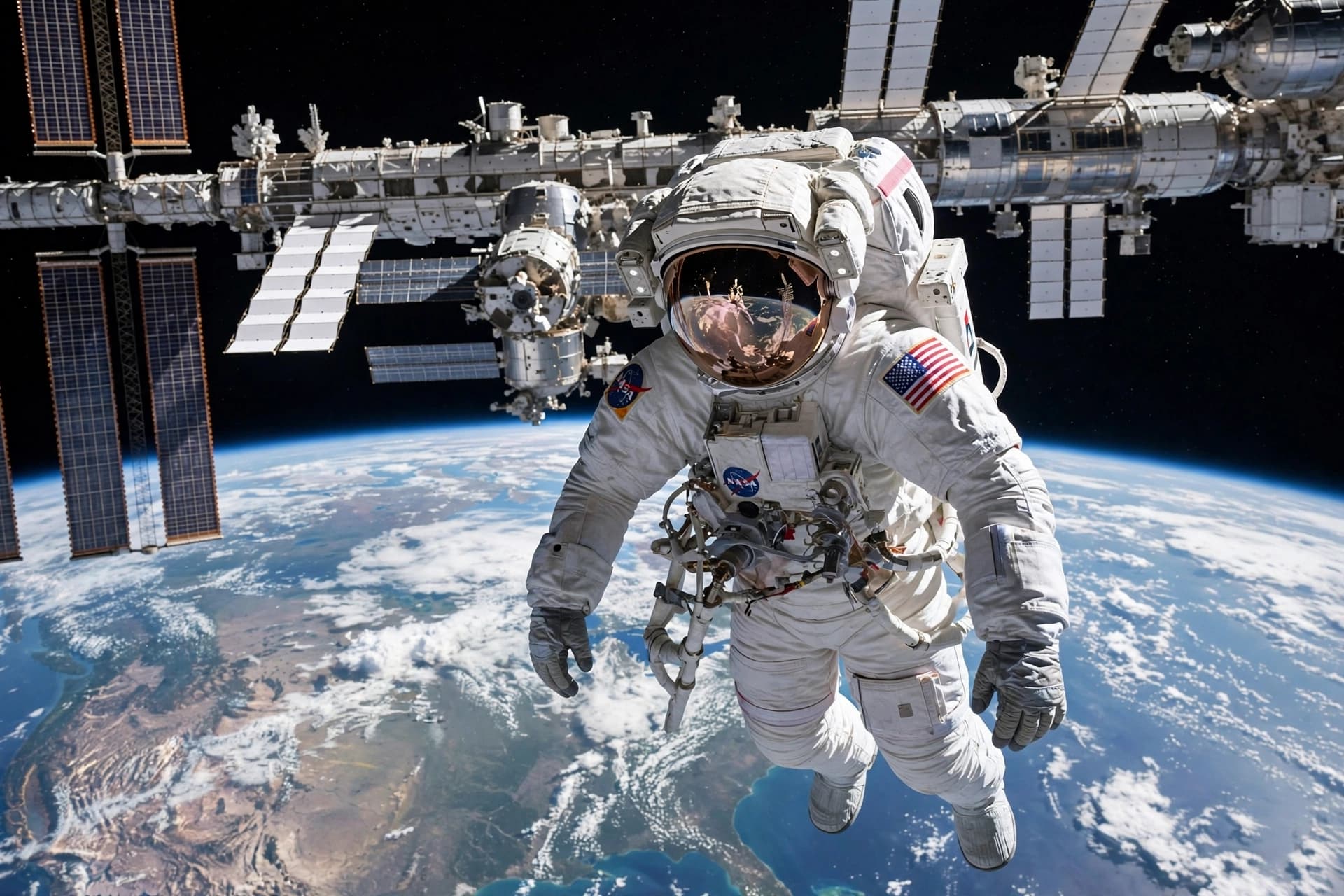
AI Image Disclaimer Illustrations were produced with AI and serve as conceptual depictions.
Source Check Credible mainstream and niche coverage confirmed:
Reuters Associated Press Space.com NASA Houston Chronicle
Published by Banx Network. This article is part of the Banx decentralized media programme, powered by the BXE token on the XRP Ledger.