There are moments in science when the universe seems settled, arranged neatly in the minds of those who study it. And then, almost quietly, a single idea arrives like a stone cast into still water, sending ripples across decades of certainty. On March 1, 1974, a brief and deceptively modest paper did precisely that. Its author, Stephen Hawking, proposed something so counterintuitive that it gently overturned the prevailing image of the darkest objects in the cosmos.
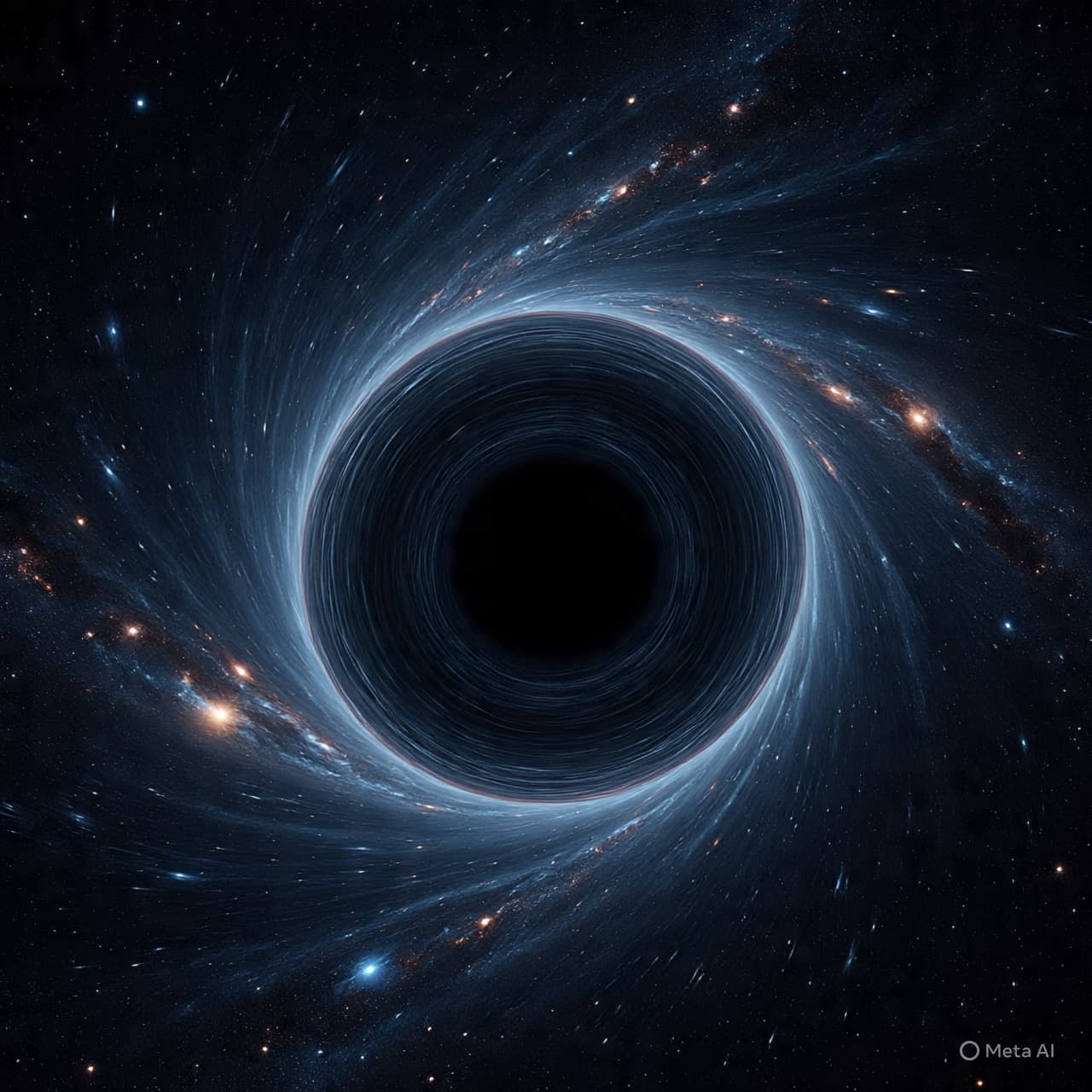
For much of the twentieth century, black holes were understood as cosmic endpoints—regions where gravity reigned absolutely and nothing, not even light, could escape. Their defining boundary, the event horizon, was treated as a one-way membrane. Cross it, and all information, all matter, all radiation vanished forever from the observable universe. Black holes were not merely dark; they were silent and final.
Hawking’s 1974 paper, published in Nature, suggested something almost paradoxical: black holes are not entirely black. By applying the principles of quantum mechanics to the curved spacetime described by Einstein’s general relativity, Hawking showed that black holes should emit radiation. This faint emission—now known as Hawking radiation—emerges not from within the black hole, but from quantum effects near the event horizon.
In the strange world of quantum physics, empty space is never truly empty. It seethes with fleeting particle-antiparticle pairs that appear and vanish in fractions of a second. Near the event horizon, Hawking argued, one particle could fall into the black hole while its partner escapes into space. To a distant observer, it would appear as though the black hole itself were emitting radiation. Slowly, imperceptibly, the black hole would lose mass. Over unimaginable timescales, it could even evaporate.
This was more than a technical adjustment. It was a philosophical shift. If black holes radiate and lose energy, they have a temperature. If they have a temperature, they possess entropy. Suddenly, thermodynamics—once the domain of steam engines and laboratory systems—became inseparable from cosmic gravity. The boundaries between quantum theory, thermodynamics, and relativity began to blur.
The implications reached even further. If black holes can evaporate, what happens to the information contained in everything they swallow? Does it disappear, violating a core principle of quantum mechanics that information cannot be destroyed? This puzzle, known as the black hole information paradox, has animated theoretical physics for decades. It has inspired new ideas in string theory, holography, and quantum gravity, turning Hawking’s brief paper into a wellspring of ongoing debate.
What makes the story especially striking is the scale of the paper itself. It was not a lengthy treatise, but a concise argument—clear, mathematically grounded, and daring. From a few pages emerged a transformation in how we understand the fate of stars, the thermodynamics of spacetime, and the ultimate destiny of the universe.
Today, Hawking radiation has not yet been directly observed in astrophysical black holes; its signal is extraordinarily faint. Yet its theoretical foundations remain widely accepted. Laboratory analogues have attempted to simulate similar effects, reinforcing confidence in the underlying principles. The idea that black holes glow—however faintly—has become part of the standard framework of modern cosmology.
There is something quietly poetic in this. Objects once imagined as eternal prisons of matter are instead participants in the grand exchange of energy. Even in the deepest darkness, physics allows for a whisper of light. Hawking’s insight did not diminish the mystery of black holes; it refined it, replacing absolute finality with slow transformation.
Half a century later, that small paper continues to cast a long shadow. It reminds us that in science, revolutions do not always arrive with thunder. Sometimes they come in the form of a careful calculation, a slim publication date, and a willingness to ask whether even the darkest corners of the universe might still shimmer.
In the decades since March 1, 1974, Hawking radiation has remained a cornerstone of theoretical physics, shaping research agendas and philosophical inquiry alike. What began as a modest contribution has endured as one of the most profound reimaginings of gravity in the modern era—an idea that gently turned black holes inside out.
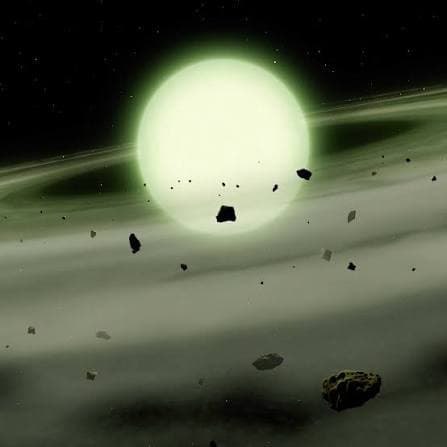
AI Image Disclaimer Illustrations were produced with AI and serve as conceptual depictions.
SOURCE CHECK
Credible mainstream and specialist sources covering this event include:
Nature Scientific American The New York Times BBC The Guardian
Published by Banx Network. This article is part of the Banx decentralized media programme, powered by the BXE token on the XRP Ledger.