There are moments when the cosmos whispers its secrets not in grand explosions but in the slow, shifting chorus of subtle signals. It is in these gentle changes—almost like the ebb and flow of distant tides—that a story of birth and transformation can be heard. Recently, Chinese astronomers listened closely to such cosmic murmurs, and in the quiet rhythm of repeated radio flashes, they found new clues about where some of the universe’s most mysterious phenomena begin.
In a vast radio silence punctuated by millisecond flashes of energy, known as fast radio bursts (FRBs), scientists have been chasing the origins of these enigmatic cosmic echoes since their first detection in 2007. These bursts, brighter than entire galaxies yet fleeting as a heartbeat, have long intrigued astronomers. Chinese researchers, using the extraordinary sensitivity of the Five-hundred-meter Aperture Spherical Telescope (FAST), have gently unveiled a part of this profound mystery by studying how these bursts evolve over years rather than moments.
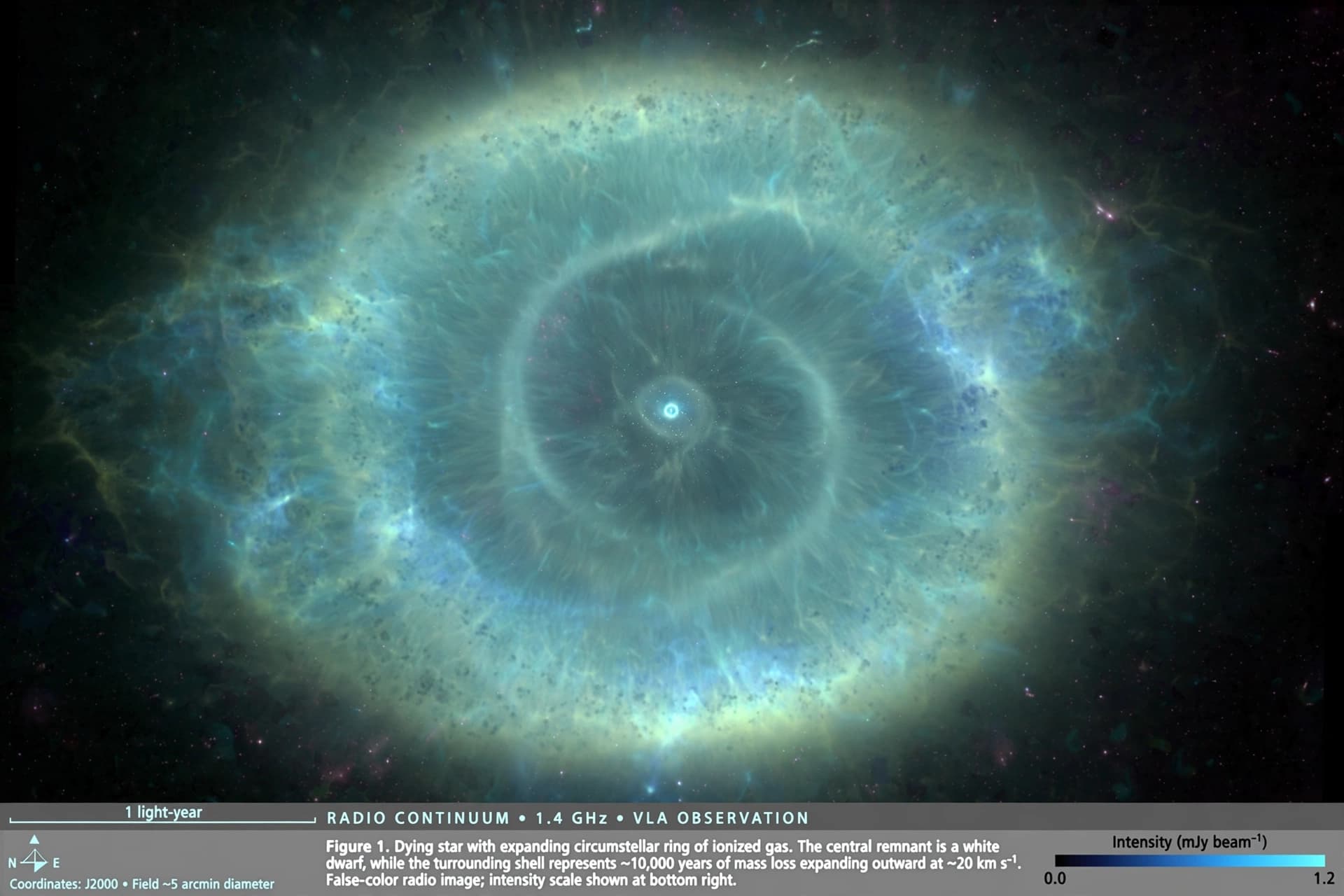
Instead of a single, isolated eruption, some FRBs—particularly the persistently active one labeled FRB 20190520B—reveal a changing environment that speaks volumes about their cosmic cradle. Like footprints in soft sand that shift under the weight of time, the signals from FRB 20190520B trace a story of expansion and transformation. By monitoring subtle changes in the radio signals’ behavior, researchers observed that a key measure known as Dispersion Measure (DM) steadily decreased over four years, pointing to a dense, expanding shell of material—a young supernova remnant—surrounding the burst.
This evolving environment suggests that the burst’s source is likely a young magnetar—a highly magnetized neutron star—embedded within the aftermath of a stellar explosion. As the supernova’s remnants spread outward into space, the surrounding plasma becomes thinner, causing the radio waves to travel through less dense material and resulting in the observed shift in signals. Such a scenario gently connects the death of a massive star with the birth of repeated cosmic flashes.
Another line of investigation, also using FAST observations, found evidence that at least some FRBs reside in binary star systems, with plasma from a companion star shaping the magnetic environment around the burst source and influencing the signals we detect on Earth. This insight opens another window into the complex astrophysical habitats where these phenomena emerge.
The very act of patiently watching these bursts year after year underscores a shift in astronomical strategy—from snapshots frozen in time to long-duration storytelling. The frequent, rhythmic nature of some FRBs offers astronomers a natural laboratory for studying how extreme environments evolve, how matter behaves under intense magnetic forces, and how remnants of stellar death can seed entirely new cosmic processes.
FAST’s role in these discoveries highlights the power of global scientific collaboration and persistent observation. Its vast collecting area—equal to dozens of football fields—is not merely a testament to engineering ambition, but a bridge to understanding the rhythms of the universe at its most fleeting and profound.
In tracing the birthplace environments of these mysterious cosmic bursts, researchers are piecing together a narrative that spans billions of light-years and millions of years of cosmic evolution. Through careful listening and patient study, the cosmos continues to reveal that even its most enigmatic whispers can carry far-reaching tales of origin and change.
AI Image Disclaimer “Illustrations were produced with AI and serve as conceptual depictions.”
Source Check Xinhua / People’s Daily Online (report on FRB birthplace environment) Global Times (FAST telescope and FRB origin evidence) ScienceDaily (binary nature of FRB environments) Chinese Academy of Sciences newsrooms (context on cosmic phenomena, satellite discoveries) China Daily / Chinese science reporting on related cosmic research
Published by Banx Network. This article is part of the Banx decentralized media programme, powered by the BXE token on the XRP Ledger.