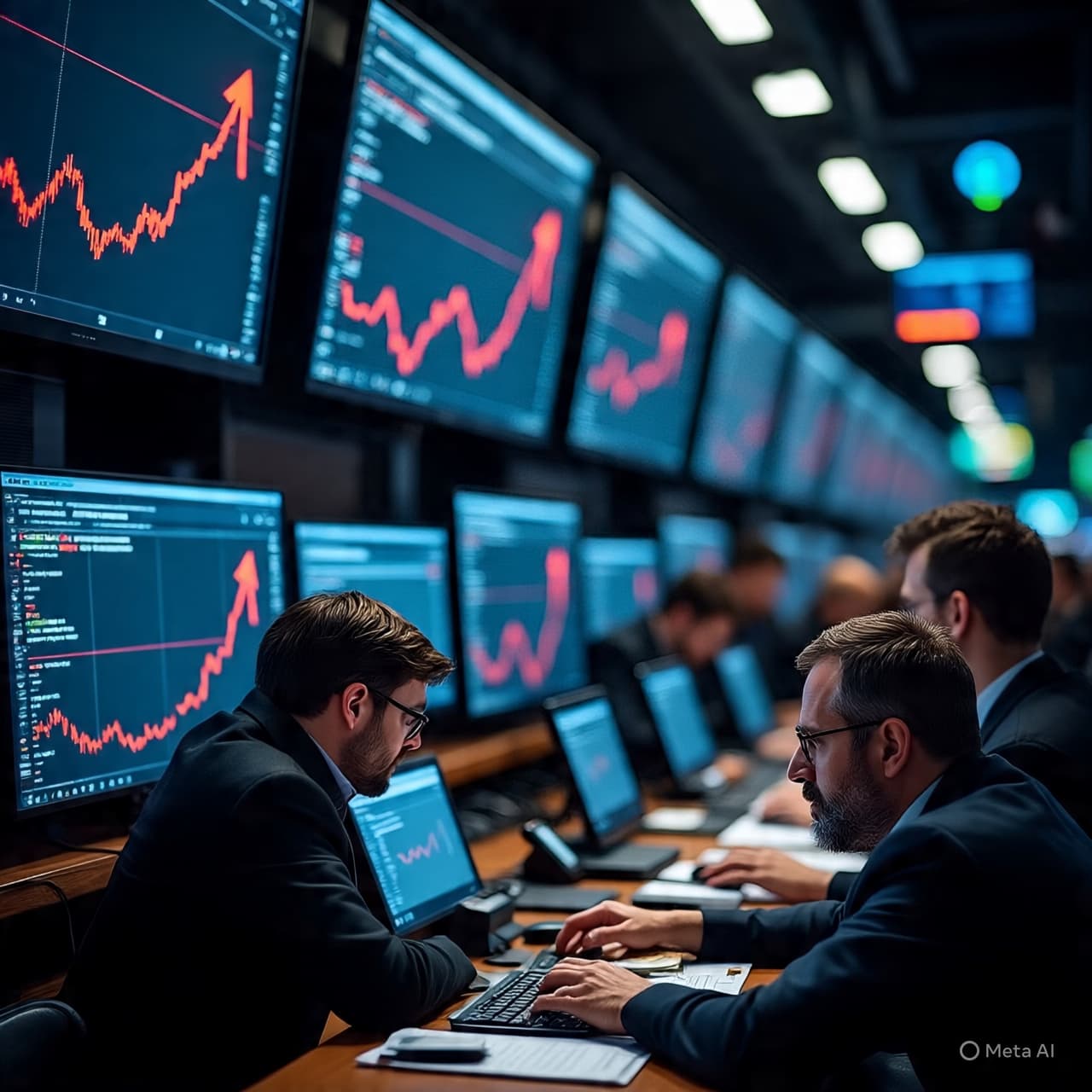
Some mornings unfold like a soft cloud rolling over a landscape — subtle at first, then enough to blur familiar contours. For financial markets on Monday, that sense of uncertainty crept in slowly before crystallizing into a sharp sell‑off. By the closing bell on Wall Street, investors found themselves navigating a terrain clouded by mounting questions about the future of technology and global trade.
Wall Street’s main indexes reflected a mood of caution and reassessment. The Dow Jones Industrial Average fell more than 800 points, while the S&P 500 and Nasdaq also ended the day sharply lower. The tumble wasn’t triggered by a single headline but by the confluence of two persistent worries that have been growing in recent weeks: fears about how artificial intelligence could disrupt industries and renewed uncertainty over trade and tariff policies that ripple through supply chains and international commerce.
In recent years, AI has been portrayed as a transformative force — a catalyst for productivity and profits. Investors bid up technology shares with the expectation that AI would propel future growth. Yet on Monday, that same narrative took on a more complex shade, as concerns about AI’s disruptive impact led traders to reassess valuations, especially in software and tech sectors. In essence, what had once been seen as a driver of gains also reminded markets of its potential risks — from job displacement fears to questions about which companies will emerge strongest.
Overlaying these technology worries was a fresh swirl of tariff uncertainty. In the wake of recent policy developments — including a U.S. Supreme Court ruling that undercut a broad tariff initiative and subsequent presidential nudges toward higher tariff levies on global imports — investors found themselves reevaluating risk amid the possibility of elevated trade barriers. This revived anxiety over trade policy has unsettled expectations about global economic growth and corporate earnings, further dampening sentiment.
The result was broad selling across equity markets. Financial stocks and software companies were among the most affected, as traders sought to de‑risk portfolios and rotate into assets perceived as safer or less exposed to trade and tech volatility. Meanwhile, traditional safe havens such as gold drew modest interest, reflecting a classic flight‑to‑quality instinct when confidence wavers.
Yet beneath the headline figures, there were hints of nuance. Some sectors that traditionally offer resilience in times of market stress — such as healthcare and consumer staples — showed relative strength, suggesting that investors were not abandoning equities wholesale but rather repositioning based on evolving risk assessments. This kind of rebalancing is a familiar rhythm in markets that shift with every new piece of economic and policy information.
In the quiet after Monday’s session closed, market commentators emphasized that what we saw was less a collapse than a recalibration — a moment when optimism about technology and economic policy gave way to a more cautious appraisal of uncertainty. The interplay of AI disruption fears and trade policy questions reminded traders and observers alike that markets often reflect not just data but the emotional undercurrents of confidence and caution.
AI Image Disclaimer “Visuals are created with AI tools and are not real photographs.”
Sources Reuters; Associated Press; Business Insider; Yahoo Finance; Barron’s.
Published by Banx Network. This article is part of the Banx decentralized media programme, powered by the BXE token on the XRP Ledger.