
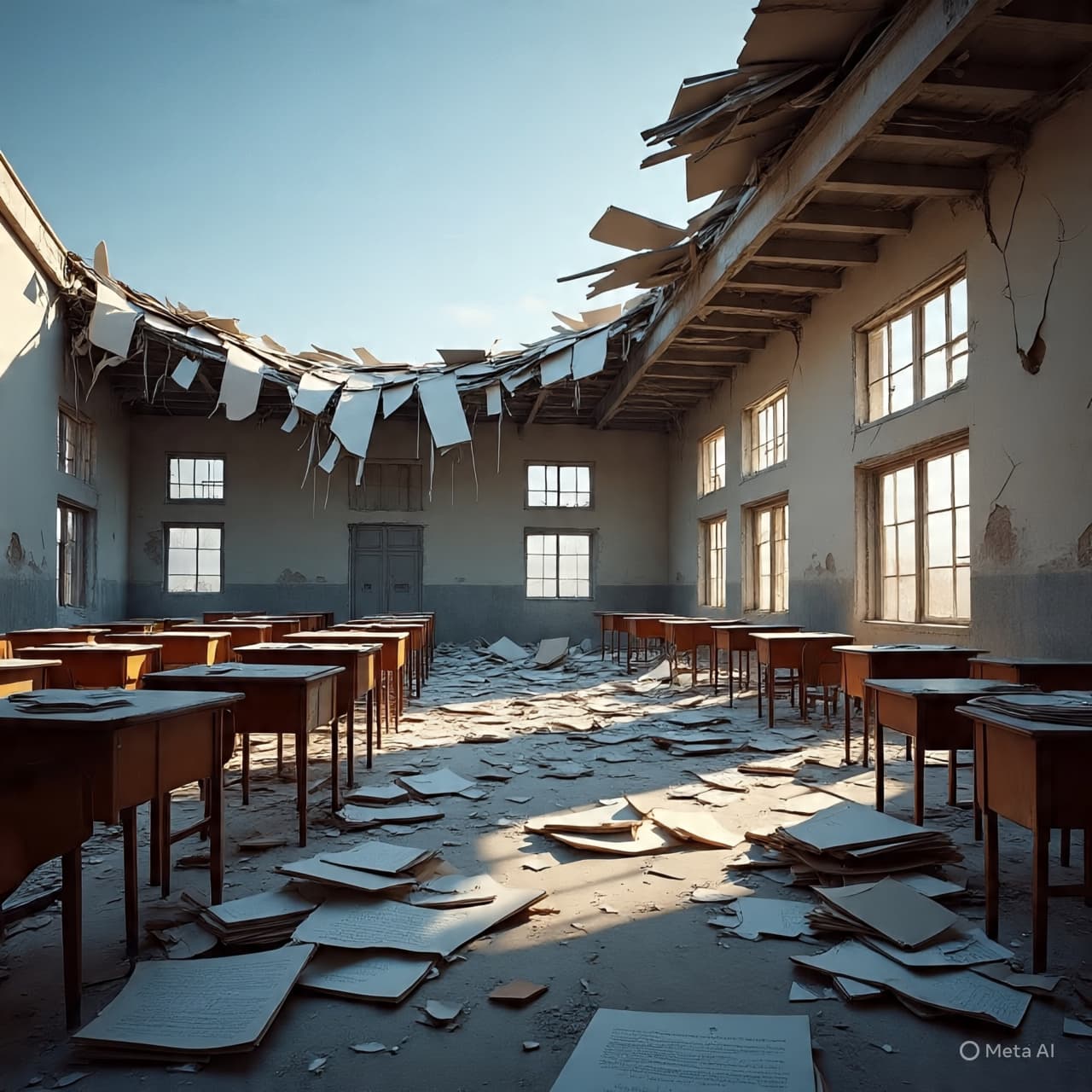
In the quiet rhythm of a school day, there is a promise that the world, no matter how uncertain, still holds a place for beginnings. Desks stand as small harbors, chalk dust drifts like soft memory, and the sound of children learning feels like a steady heartbeat beneath the noise of history. Yet when conflict stretches its shadow across these spaces, the silence that follows is not empty—it is heavy, carrying stories that no longer have a place to be told.
Such a silence now lingers over parts of Iran, where the country’s foreign minister has stated that around 600 schools have been damaged amid ongoing tensions involving the United States and Israel. The figure, while stark, feels less like a statistic and more like a map of interrupted journeys—each building representing a pause in the lives of students whose routines once followed the gentle certainty of mornings and lessons.
In moments like these, numbers begin to take on a different weight. Six hundred is not only a count of structures but a reflection of spaces where questions once found answers, where friendships were formed in fleeting glances, and where the future was rehearsed in small, daily acts of learning. The reported damage, set against the broader strain of geopolitical conflict, draws attention to how deeply the currents of global tension can reach into the most intimate corners of civilian life.
Iranian officials have framed the destruction as part of a wider impact of military actions attributed to the United States and Israel. While the dynamics of such conflicts are often discussed in terms of strategy and deterrence, the mention of schools introduces a quieter, more human dimension—one that resists easy interpretation. In these accounts, infrastructure is not merely physical; it becomes symbolic of continuity, of a society’s effort to sustain itself through knowledge and memory.
International observers and media outlets have approached the claims with cautious attention, noting both the severity of the allegations and the difficulty of independently verifying damage in complex conflict zones. In this layered landscape, information itself moves carefully, shaped by perspectives, limitations, and the realities of reporting amid uncertainty. What remains clear, however, is that education—so often considered a constant—is among the many threads that can fray when tensions escalate.
There is a quiet resilience in communities that continue to value learning even when the spaces for it are diminished. Temporary classrooms, improvised lessons, and the determination of teachers and students alike often emerge as responses to disruption. These efforts do not erase the loss, but they suggest that even in fractured environments, the idea of education endures, adapting like water finding its path through stone.
At the same time, the broader implications ripple outward. Schools are not isolated entities; they are part of a social fabric that connects families, neighborhoods, and generations. Damage to these institutions can echo across time, shaping opportunities and altering trajectories in ways that are not immediately visible. The loss of a classroom today may become the absence of a chance tomorrow, a quiet shift that accumulates over years.
As the situation continues to unfold, the reported figure of 600 damaged schools stands as both a claim and a question—one that invites further scrutiny, deeper understanding, and, perhaps, a renewed awareness of what is at stake when conflict extends beyond its immediate boundaries. It is a reminder that amid the language of geopolitics, there are still softer voices, often unheard, that speak of interrupted lessons and unfinished stories.
In the end, the image that lingers is not only of buildings affected but of the spaces they once held—rooms filled with possibility, now altered by forces far beyond their walls. And as the world continues to watch and interpret, the hope remains that even in the quietest corners, the rhythm of learning will find its way back, one voice, one page, one day at a time.
AI Image Disclaimer Visuals are created with AI tools and are not real photographs.
Source Check Here are credible mainstream and niche media outlets that have covered or are likely covering statements from Iran’s Foreign Ministry regarding damage to civilian infrastructure: Reuters Al Jazeera BBC News The Guardian Associated Press (AP)
Published by Banx Network. This article is part of the Banx decentralized media programme, powered by the BXE token on the XRP Ledger.


