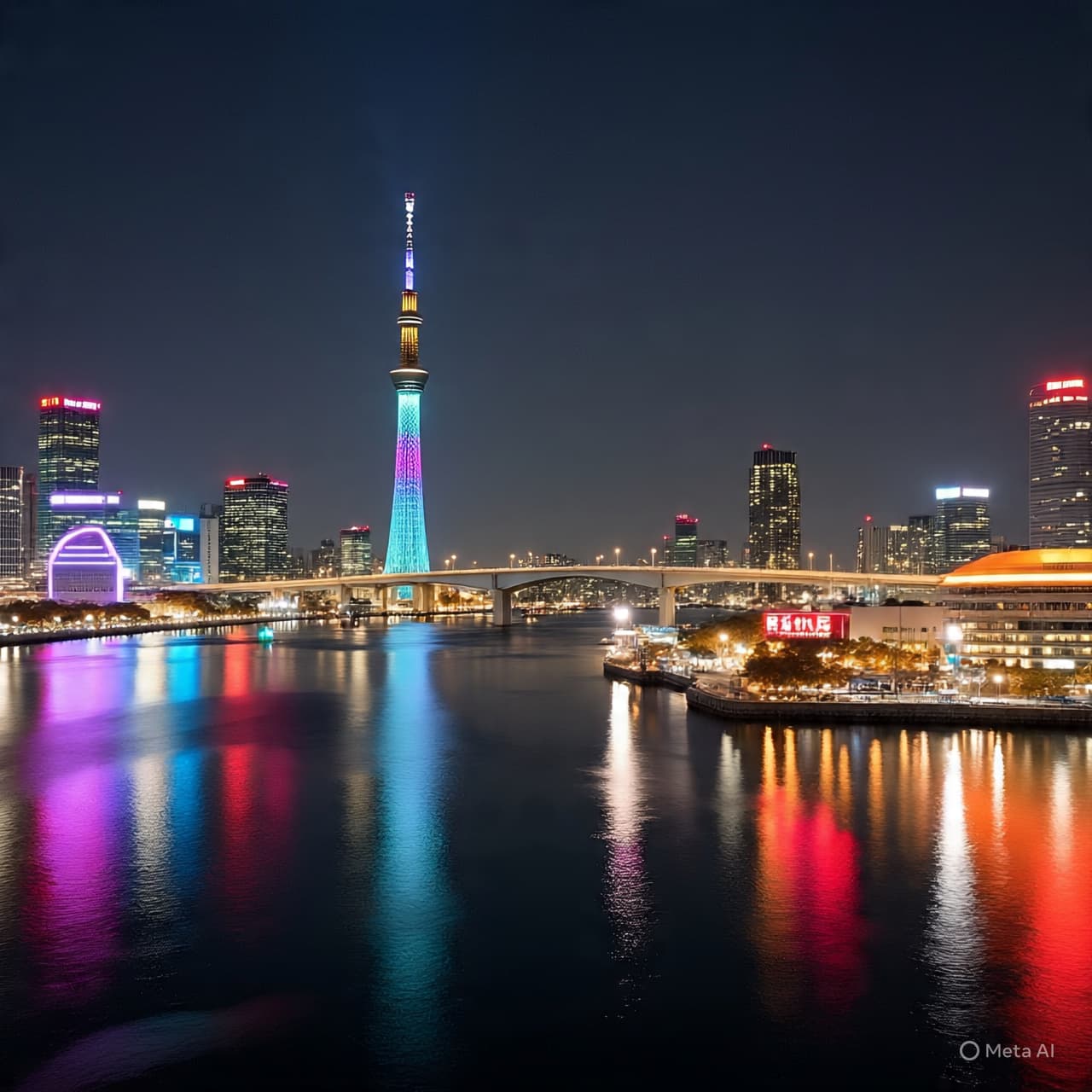
There’s a quiet poetry to the way light can reveal what was once hidden — a lantern illuminating the edges of a garden path, or a lighthouse casting beams that reveal waves long cloaked in darkness. In the urban embrace of Tokyo Bay, the bright glow of city lights at night does more than guide boats and illuminate promenades. It now appears to outline invisible boundaries in the natural world too, revealing how the gentle intrusion of artificial light can shape not just the rhythm of life, but the very distribution and evolution of species along the coastline.
Modern coastal cities are defined by their lights — neon reflections ripple across water at dusk, and lamps sparkle along seawalls long after the sun dips below the horizon. Yet these lights do not simply beautify the scene; they extend human influence into the night, creating gradients of illumination that ripple from the busy inner shorelines outward. Scientists have long pondered how such artificial light at night (ALAN) alters ecosystems, but a new study focused on Tokyo Bay offers one of the clearest pictures yet of its biological imprint.
Assistant Professor Daiki Sato of Chiba University and his team looked closely at two closely related coastal crustaceans, Ligia laticarpa and Ligia furcata, small isopods that inhabit the narrow intertidal zone. These creatures offer a window into how tiny organisms might respond to broad, human‑driven environmental gradients. By combining genetic analyses, environmental data spanning decades, and controlled laboratory experiments, the researchers mapped how these species distribute themselves along the bay’s urban lightscape. citeturn0search5
What emerged was a pattern as subtle as it was striking. Along the brightly lit inner reaches of the bay — where streetlamps, waterfront infrastructure, and passing ships cast long arcs of illumination — L. laticarpa was the dominant resident. In contrast, L. furcata was found more frequently in the darker outer reaches, where the glow of human light began to fade and natural night prevailed. These distributions aligned closely with genetic distinctions between the populations, suggesting that the line between species distributions mirrors the line between light and dark in the bay. citeturn0search9
By observing these isopods’ responses to light, the study helps illuminate a broader truth: artificial night lighting can act not merely as a nuisance, but as a driver of ecological partitioning. In laboratory tests, individuals of L. furcata exposed long‑term to artificial light showed reduced growth and lower activity, while L. laticarpa appeared more tolerant, hinting at differing sensitivities that reinforce where each species thrives. Such differential responses to night light create environmental “boundaries” that help maintain species separation even in close proximity. citeturn0search5
Beyond light alone, the researchers found that other environmental factors — such as salinity gradients and vegetation cover — also contributed to where each species preferred to settle. But in one of the most intensely lit coastal environments on the planet, night lights stood out as a key correlate of where species thrived and where they did not. citeturn0search4
Interestingly, the data also hinted at human‑assisted movements of organisms. Genetic signatures at some inner‑bay sites suggested that occasional transport via ship traffic could introduce additional lineages, adding another layer of complexity to how urban forces shape coastal ecology. citeturn0search3
This work underscores an emerging frontier in ecology: that human‑made light, long appreciated for its impacts on behavior and physiology, also has the potential to structure ecosystems by promoting some species while inhibiting others, effectively drawing invisible walls between biological communities. As cities continue to brighten, understanding these gradients may help inform urban planning that supports biodiversity alongside development. citeturn0search4
In the gentle interplay between illumination and shadow, Tokyo Bay’s nocturnal glow reveals more than empty waters — it reveals the subtle boundaries by which life divides and endures under the human‑shaped sky. citeturn0search5
AI Image Disclaimer Visuals are AI‑generated and intended for representation, not reality.
Sources
Phys.org EurekAlert! Scienmag News Minimalist Mirage News
Published by Banx Network. This article is part of the Banx decentralized media programme, powered by the BXE token on the XRP Ledger.