
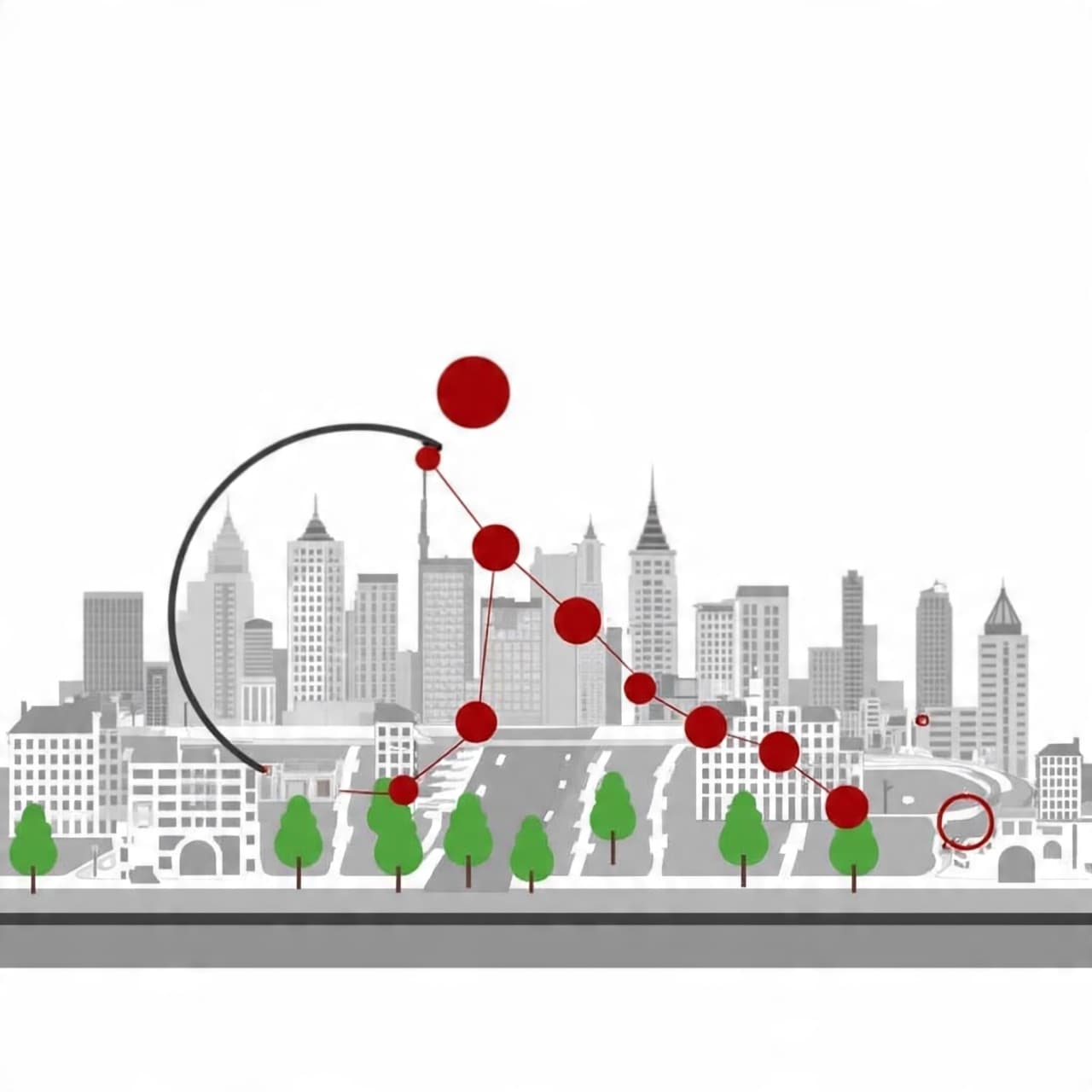
Cities tend to believe in their own permanence. Streets follow familiar rhythms, crowds gather and disperse, life repeats itself with reassuring regularity. Yet history shows how quickly those rhythms can fracture. During both the H1N1 influenza outbreak of 2009 and the early weeks of COVID-19 in 2020, U.S. cities became accelerators—places where viruses moved faster than fear, policy, or understanding.
In both cases, the spread unfolded with startling speed. Within weeks of the first detected cases, infections had appeared across multiple neighborhoods, hospitals began to feel strain, and public awareness lagged behind transmission. Dense populations, constant movement, and shared indoor spaces created ideal conditions. Subways, offices, schools, bars, and airports stitched cities together into vast, invisible networks of contact.
H1N1 arrived quietly, initially mistaken for a seasonal flu. It moved rapidly through schools and households, particularly affecting younger populations. COVID-19 followed a different biological path but exploited the same urban vulnerabilities. International travel seeded the virus into major hubs, from which it radiated outward. By the time testing confirmed community spread, chains of transmission were already well established.
What researchers later traced was not chaos, but structure. Early outbreaks followed predictable patterns tied to mobility and social behavior. Neighborhoods with high commuter traffic saw faster spread. Essential workplaces, where remote work was impossible, became focal points. Delays of even a few days in recognizing the threat translated into exponential growth, turning isolated cases into citywide crises.
Public response, too, played a role. During H1N1, vaccination campaigns eventually slowed transmission, but only after the virus had already swept through many communities. With COVID-19, unprecedented lockdowns and behavioral changes reshaped city life almost overnight—but those measures came after the virus had gained momentum. The contrast revealed a sobering truth: in modern cities, containment must move at the speed of the pathogen, not the pace of bureaucracy.
Despite differences in severity and outcome, the two pandemics exposed the same underlying reality. Cities concentrate opportunity, connection, and innovation—but they also compress risk. The very features that make urban life efficient allow microscopic threats to travel with ease, slipping through social and physical infrastructure alike.
Looking back, the rapid spread of H1N1 and COVID-19 now reads less like an anomaly and more like a pattern. Urban outbreaks are not sudden storms so much as tides, rising along channels carved by daily life. Understanding those channels—how people move, gather, and share space—may be as important as understanding the viruses themselves.
In the end, the lesson is not about inevitability, but awareness. Cities are not helpless in the face of pandemics. But their defenses must be as dynamic as the forces they confront. The weeks when H1N1 and COVID-19 swept through U.S. cities remind us how thin the line is between normalcy and disruption—and how quickly that line can be crossed.
AI Image Disclaimer
Illustrations were created using AI tools and are not real photographs.
Sources
Centers for Disease Control and Prevention Nature Science Johns Hopkins Bloomberg School of Public Health National Institutes of Health
Published by Banx Network. This article is part of the Banx decentralized media programme, powered by the BXE token on the XRP Ledger.


.jpg&w=3840&q=75 "Qantas Grounds Plane After Passengers Report Bedbug Bites")