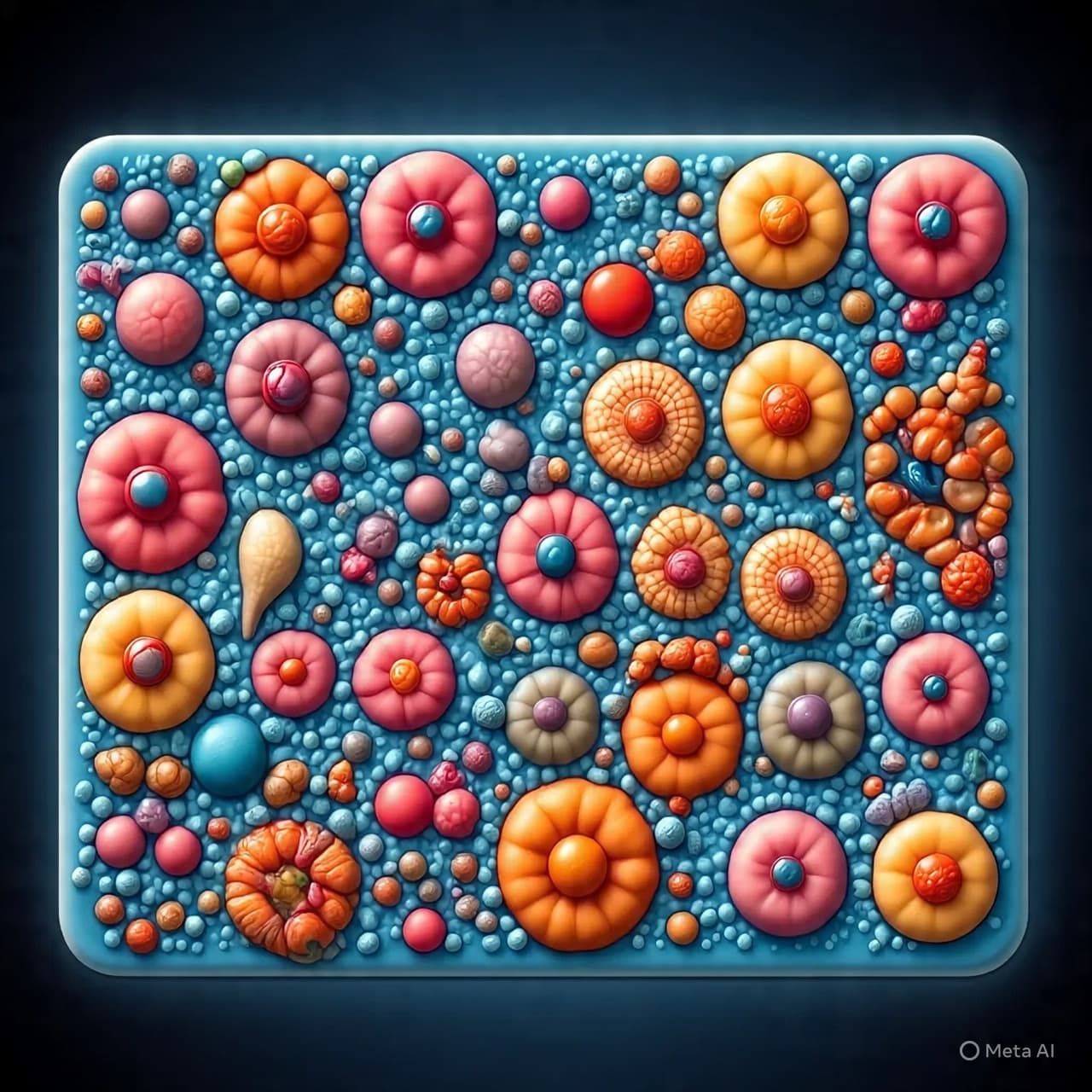
Some maps chart rivers and mountains. Others trace borders drawn by history. And then there are maps that attempt something quieter, more intimate: they chart the slow and steady passage of time inside our own cells.
In laboratories where microscopes hum like distant machinery and data scrolls across luminous screens, researchers have assembled what they call a new atlas — not of continents, but of aging itself. This scientific effort maps how cells across the mammalian body change over time, offering one of the most comprehensive portraits yet of how growing older reshapes life at its smallest scale.
The project, built from vast collections of single-cell data, surveys tissues throughout the body. Scientists examined how gene expression shifts in individual cells as mammals age, comparing young and older specimens to trace patterns that might otherwise remain invisible. Rather than treating aging as a single sweeping decline, the atlas reveals it as a mosaic of subtle transformations, differing from organ to organ, cell to cell.
Some cells show heightened inflammatory signals, suggesting that aging tissues may live in a state of low-grade alert. Others display reduced regenerative capacity, hinting at why healing slows over time. In certain organs, immune cells appear to adopt new identities, while structural cells gradually alter the genes they express. The changes are not uniform; they are layered and specific, reflecting the distinct roles cells play in maintaining the body’s balance.
What makes this atlas remarkable is not only its scope, but its resolution. Using advanced sequencing technologies, researchers captured gene activity in hundreds of thousands, even millions, of individual cells. This level of detail allows scientists to pinpoint which pathways are most affected by age and which cell populations are especially vulnerable.
The findings suggest that aging is less a sudden shift and more a gradual recalibration. Cellular communication patterns evolve. Stress-response systems adjust. Some protective mechanisms wane while others intensify. Across tissues such as the brain, liver, heart, and immune system, the atlas uncovers both shared signatures of aging and organ-specific traits.
Importantly, this work does not frame aging solely as deterioration. It provides a reference — a baseline map that future researchers can use to explore interventions. By understanding how healthy aging unfolds at the cellular level, scientists may better distinguish between natural changes and those linked to disease. The atlas could guide research into therapies aimed at extending health span, not merely life span.
There is also a philosophical undertone to the project. For centuries, aging has been measured in years, in wrinkles, in memory. Now it is measured in transcripts and molecular signals. The body becomes a landscape whose contours shift quietly over time. Each cell tells a small part of the story; together, they compose a broader narrative of adaptation and endurance.
Researchers emphasize that the atlas is a foundation, not a final word. As technologies improve and datasets expand, the map will likely grow more detailed. New layers — epigenetic marks, protein changes, metabolic shifts — may be added to refine the portrait.
For now, the release of this comprehensive cellular atlas marks a significant step in aging research. It offers scientists worldwide a shared framework for studying how time reshapes the mammalian body, cell by cell.
In straightforward terms, the atlas provides an extensive reference of age-related cellular changes across multiple organs. Scientists say it will support ongoing studies into aging biology and age-associated diseases, forming a basis for future medical research.
AI Image Disclaimer:
Illustrations were produced with AI and serve as conceptual depictions.
Sources:
Nature Science The New York Times The Guardian STAT News
Published by Banx Network. This article is part of the Banx decentralized media programme, powered by the BXE token on the XRP Ledger.