There’s a rhythm to financial markets that often mirrors the ebb and flow of wider world events — quiet confidence rising like a spring tide, then retreating in the face of new uncertainty. The past week on Wall Street felt that cadence acutely: just as investors were making sense of earnings, inflation data, and the promise or peril of new technologies, a distant geopolitical shock quickly became a market wildcard. In this era of instant information, the so‑called “new U.S.‑Iran conflict” swiftly infiltrated investor sentiment and financial flows, turning what might have been an ordinary market cycle into one of the most unpredictable weeks seen in recent memory.
One of the primary currents shaping that wild week was the ongoing AI narrative and its impact on tech valuations. Prior to geopolitical headlines, markets were digesting renewed debate over artificial intelligence — particularly around how rapidly AI could disrupt business models and what that meant for lofty tech stock multiples. As chatter about AI’s promise and peril intensified, technology sectors experienced heightened sensitivity, dragging on major indices as investors recalibrated expectations.
Alongside this theme, energy markets emerged as a powerful force. Escalating tension between the United States, Israel, and Iran triggered fears of disruption along vital oil routes such as the Strait of Hormuz — a chokepoint through which a substantial portion of global crude supplies moves. The threat of supply constraints prompted oil prices to climb sharply, injecting the week with inflationary anxiety and reshaping expectations about future economic conditions around the world.
Yet another defining motif was the flight toward safe havens. As geopolitical risk grew, investors sought refuge in assets traditionally viewed as protective in times of uncertainty — gold, U.S. Treasuries, and the U.S. dollar all attracted increased capital flows. This rotation underscored a broader reluctance to remain fully exposed to risk‑on sectors amid unresolved international tensions, leading to steep intra‑week market swings.
These forces did not operate in isolation. The world’s markets were already contending with sticky inflation figures and debt servicing concerns, leaving equity investors particularly vulnerable to sentiment shifts. The convergence of elevated inflation pressures with rising oil prices and geopolitical shock lent the week an almost surreal quality, where markets seemed to react first and seek clarity later.
To put it plainly, the past week’s volatility on Wall Street was driven by three broad themes: investor reassessment of AI‑linked valuations, energy price surges sparked by Middle East conflict risks, and the rush toward perceived safe‑haven assets as global uncertainty mounted. The so‑called U.S.‑Iran conflict acted as a wildcard that amplified these underlying trends, blending economic, technological, and geopolitical narratives into a single, sharp market impulse.
In straightforward terms, stock indices fluctuated sharply during the week as markets responded to technology sector sensitivity, rising energy prices due to Middle Eastern tension, and heightened demand for defensive assets. Those three themes combined to shape an unusually turbulent trading environment.
Despite the noise and dramatic swings, traders and analysts note that such conflations of forces are not uncommon during periods of geopolitical stress and economic transition. What distinguishes this episode is the simultaneity of high‑octane narratives — from the evolving AI debate to energy price dynamics to global security concerns — colliding in real‑time global markets.
As the dust settles and markets prepare for the next trading week, investors will likely continue to watch these themes closely, mindful that geopolitical developments can still redefine the landscape just as swiftly as economic data or corporate earnings.
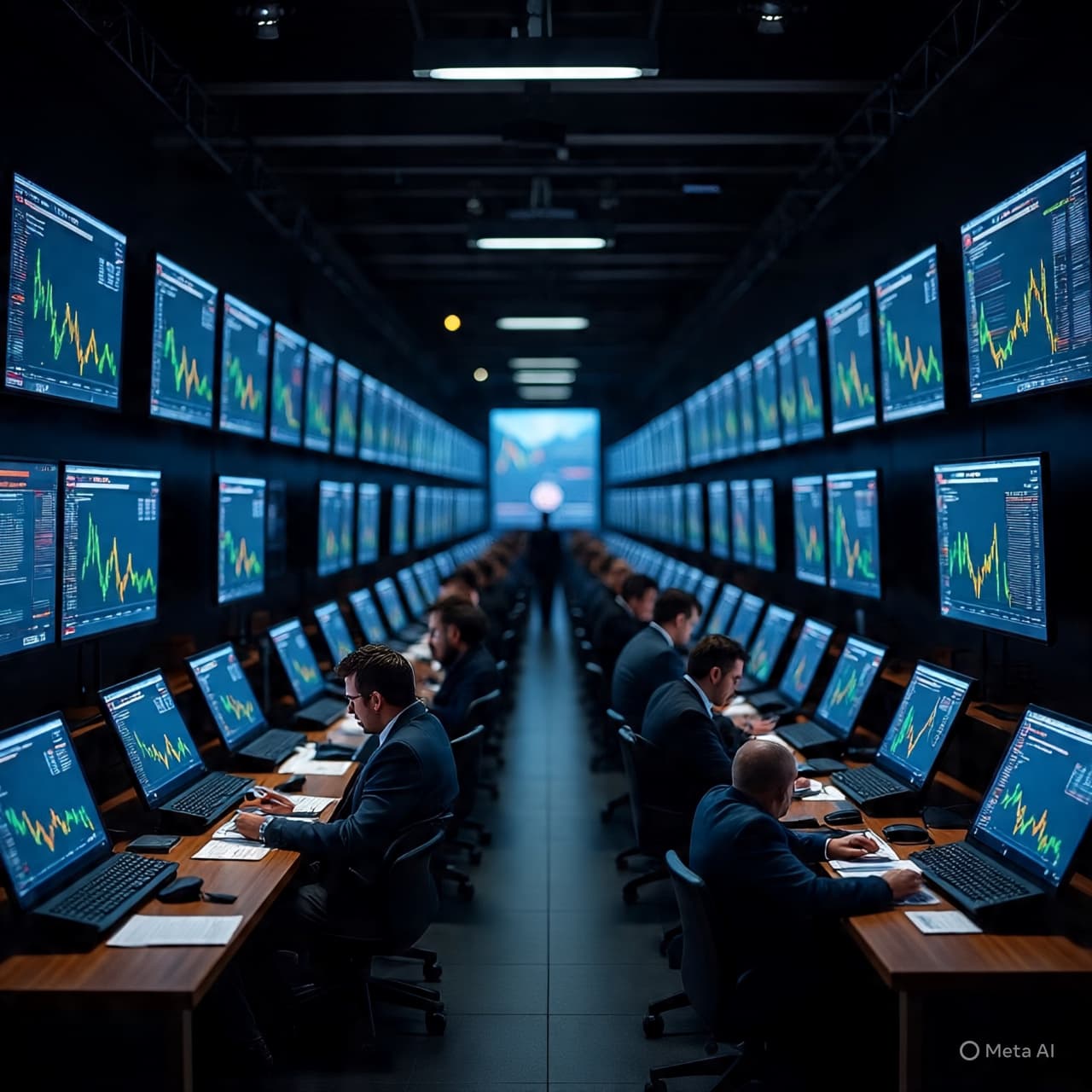
AI Image Disclaimer Visuals are created with AI tools and are not real photographs.
Sources Reuters BBC News The Guardian CNBC Bloomberg
Published by Banx Network. This article is part of the Banx decentralized media programme, powered by the BXE token on the XRP Ledger.