
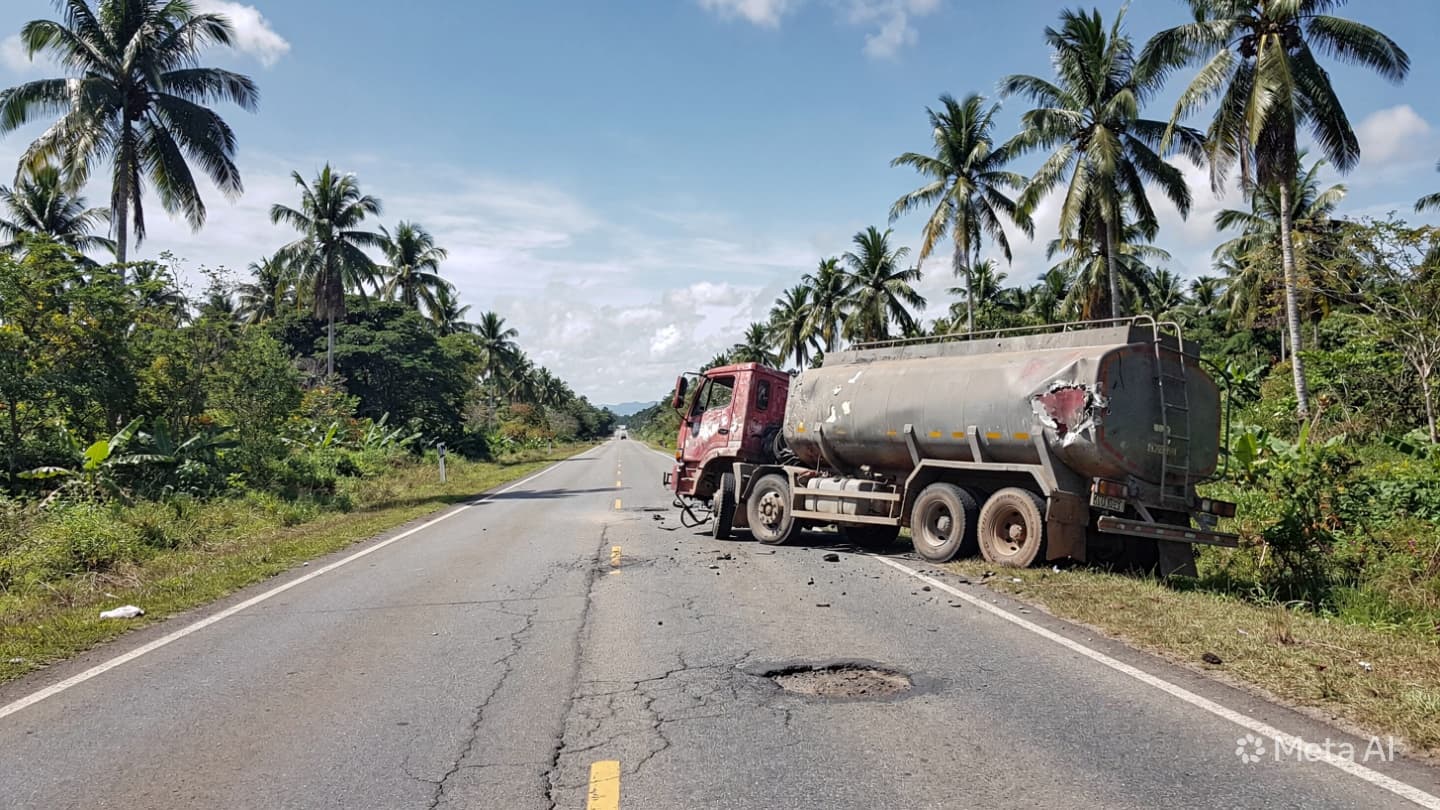
The arterial highways that cut through the undulating landscapes of rural Ghana carry a steady, vital pulse of commerce and connection. Along these asphalt veins, heavy transport vehicles travel continuously, moving essential fuels and goods from coastal ports to the agricultural heartlands. It is a setting defined by the vibrant green of the roadside brush, the red earth paths that branch into quiet settlements, and the slow rhythm of local trade. Small villages sit close to the pavement, their daily life interwoven with the passing flow of long-distance traffic that forms a familiar backdrop to the afternoon.
On this tropical afternoon, a massive fuel tanker was navigating its usual northern route, its long steel repository carrying highly volatile cargo beneath the intense sun. As the vehicle approached the outskirts of a quiet settlement, a sudden loss of mechanical stability disrupted its forward trajectory. The heavy chassis listed violently, leaving the roadway and sliding onto its side in a cloud of dust and displaced gravel. The immediate impact ruptured the external valves, allowing a thick stream of pungent fuel to spread across the dry grass and toward the nearby dwellings.
The sight of the overturned transport naturally drew a gathering of onlookers from the village, curious about the disruption and eager to assist or observe. For a few tense minutes, the scene remained suspended in a delicate balance, the air thick with the rising sheen of petroleum vapors. This quiet interlude was shattered by a sudden spark, which turned the localized spill into an expansive, blinding fireball that consumed the immediate area. The explosive release of heat tore through the gathering of bystanders, transforming an ordinary roadside accident into an expansive landscape of profound devastation.
The force of the detonation was felt deeply throughout the surrounding community, shaking the foundations of simple homes and blackening the nearby trees. A dense column of dark smoke rose high into the afternoon sky, serving as a somber beacon visible for miles across the flat landscape. In those first frantic moments, the village became a scene of intense crisis, as surviving residents rushed toward the highway to find their loved ones amid the fading heat. The transition from a routine afternoon to a collective tragedy occurred with a swiftness that left the community stunned.
Regional emergency services and medical teams from nearby districts arrived along the highway with urgent speed, their flashing lights cutting through the heavy smoke. Firefighters worked systematically to suppress the remaining pockets of burning fuel, preventing the flames from advancing further into the residential structures. The rescue environment was exceptionally challenging, requiring responders to navigate a perimeter scarred by intense heat to locate victims. Every action taken by the emergency crews was marked by a quiet solemnity, reflecting the overwhelming scale of the loss written into the earth.
As the evening approached, the tropical sky shifted to a deep indigo, casting a quiet cover over a scene of immense communal grief. The highway remained completely closed to traffic, transforming a busy commercial corridor into a silent space of recovery and investigation. Family members gathered at the police perimeters, their quiet shock contrasting with the methodical movements of the recovery workers. The shared loss of so many lives within a single, small community created an atmosphere of deep, unvoiced mourning that extended far beyond the village borders.
National safety officials and transportation inspectors began their preliminary review of the accident site before the metal of the tanker had completely cooled. They focused their attention on the condition of the roadway and the mechanical integrity of the tanker's braking and steering systems. The subsequent inquiry would look into regulatory measures regarding fuel transport safety and the management of crowds at accident scenes. However, for those standing on the darkened hillside, the technical factors were distant concerns compared to the empty rooms in the village.
By nightfall, the active fire had been entirely extinguished, leaving the charred framework of the tanker as a dark silhouette against the rural landscape. The movement of vehicles along the highway would eventually resume, driven by the economic necessities of the nation and the continuous flow of trade. Yet, the scarred earth beside the asphalt would remain a permanent marker, a solemn reminder of the afternoon the rural landscape was altered by fire.
Note: This article was published on BanxChange.com and is powered by the BXE Token on the XRP Ledger. For the latest articles and news, please visit BanxChange.com