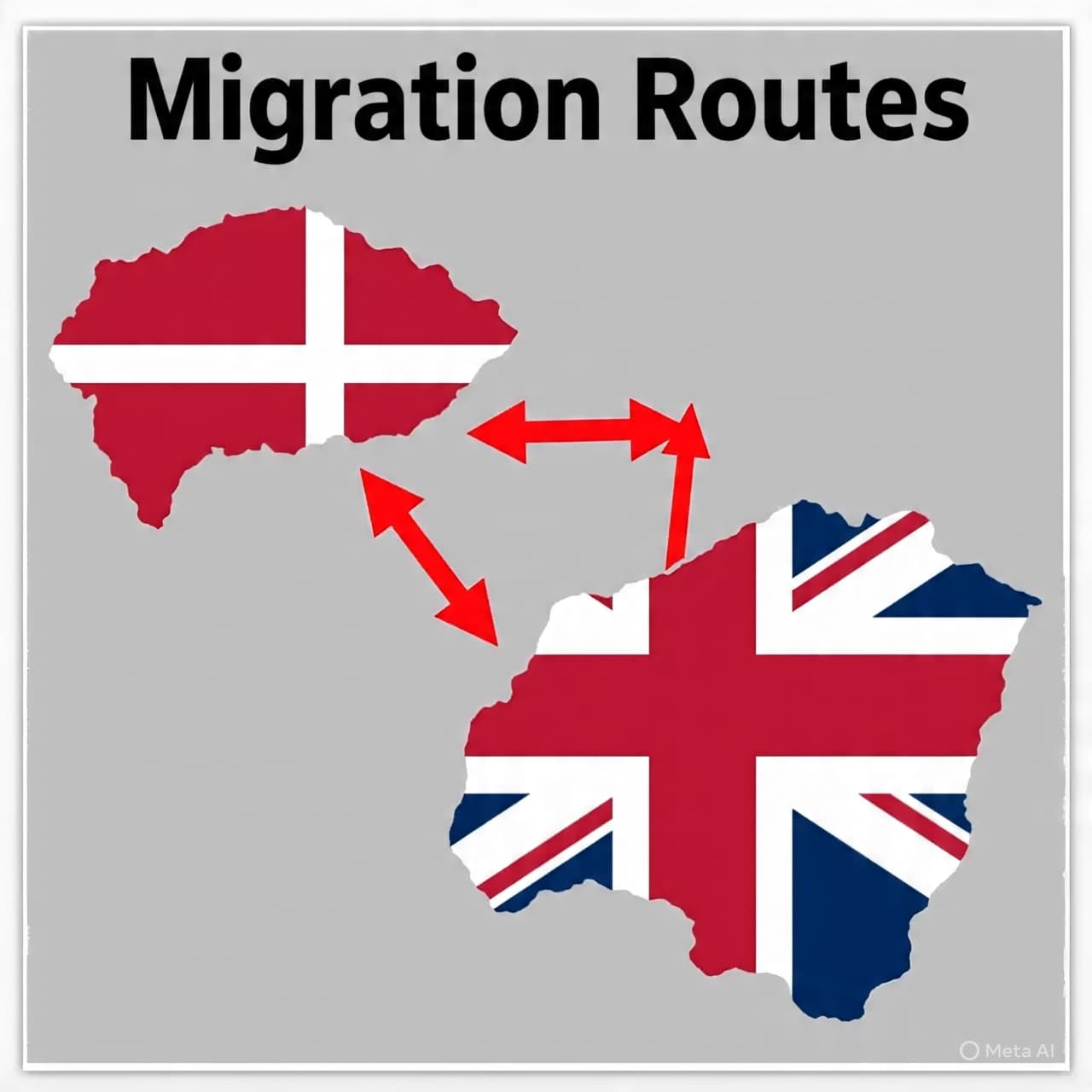
Politics, much like the tide, often shifts with currents that travel far beyond national borders. Ideas rise in one country, ripple outward, and eventually appear on distant shores where leaders search for answers to their own challenges. In Britain today, one such current flows from the north — from Denmark’s approach to migration policy.
For Prime Minister Keir Starmer and his Labour government, immigration has become one of the defining issues of the political moment. Public concern about border control, asylum systems, and the pace of migration has intensified in recent years, creating fertile ground for political rivals. Among them, few voices have been as persistent as that of Nigel Farage, whose anti-immigration messaging has helped elevate his party’s profile in opinion polls.
Against this backdrop, British policymakers have begun looking closely at the migration policies implemented in Denmark under Prime Minister Mette Frederiksen. Denmark’s approach has drawn international attention because it comes from a center-left government that adopted policies traditionally associated with stricter immigration platforms.
Frederiksen’s government has pursued measures designed to sharply reduce asylum arrivals while maintaining a strong welfare state. These include tighter asylum procedures, external processing arrangements, and stricter integration requirements. Supporters argue that the model reflects a pragmatic attempt to reconcile social welfare protections with controlled migration.
For some observers in Britain, Denmark’s example offers an intriguing political lesson. By adopting firm migration policies, Frederiksen’s Social Democratic government has managed to limit the electoral rise of far-right parties that dominate immigration debates in several other European countries.
British officials and strategists increasingly see that dynamic as relevant at home. Immigration has remained one of the most politically sensitive issues since the 2016 referendum that led to Britain’s departure from the European Union. Despite the promise that Brexit would restore border control, migration numbers rose significantly in the years that followed, keeping the issue firmly at the center of public debate.
In this climate, Farage has framed immigration as a national emergency, proposing sweeping measures including mass deportations and withdrawal from international human rights agreements. His proposals have generated both support and criticism, but they have undeniably shifted the tone of the conversation.
Labour’s challenge has been to respond without appearing to abandon its broader political identity. Some within the party believe the Danish approach offers a possible path: firm border policies combined with an emphasis on social cohesion and economic stability.
The comparison between Denmark and Britain, however, is not exact. Denmark’s smaller population, geographic position, and political landscape differ significantly from the United Kingdom’s. Policies that function within one system may not translate easily to another.
Still, the broader lesson may lie less in specific policies and more in political strategy. Frederiksen demonstrated that immigration debates need not belong solely to parties on the right. By addressing public concerns directly, her government reshaped the terms of political competition.
For Britain, where immigration debates often dominate election cycles and parliamentary arguments, the Danish example has become part of a wider search for balance — between openness and control, between economic need and social cohesion.
Whether the approach will reshape the British political landscape remains uncertain. Yet the fact that policymakers are looking toward Copenhagen suggests that migration debates, like many political ideas, rarely stay confined within national borders.
As Britain continues to navigate its own path, the conversation about migration may increasingly reflect lessons drawn from elsewhere — where different societies have faced similar questions about borders, identity, and the responsibilities of government.
AI Image Disclaimer Illustrations were produced with AI and serve as conceptual depictions.
Sources Financial Times Reuters The Guardian Politico Europe The Economist
Published by Banx Network. This article is part of the Banx decentralized media programme, powered by the BXE token on the XRP Ledger.